


Digital investment platforms: is Pakistan entering a new era for stock market participation?

While Pakistan reportedly has 20 million active cryptocurrency investors, stock market participation remains dismally low at only 464,000 accounts, according to recent numbers from the National Clearing Company of Pakistan (NCCPL). Reasons for this include a lack of trust, low financial literacy, Shariah non-compliance, and high risk and volatility, which have traditionally been cited as factors behind the low investor base of the Pakistan Stock Exchange (PSX).
The rapid adoption of crypto trading in the country brings into the equation another important variable that has been missing from the PSX: a fully digital user experience. Not only do strong digital platforms attract younger audiences, but they also allow people from second and third tier cities to access financial services through technological scalability. Pakistan’s long-standing neighbor, India, offers an interesting case study in this regard. It has witnessed a tremendous rise in the number of stock market investors in recent years, growing from 27 million in 2019 to 136 million in 2025. This growth has primarily been driven by the rise of digital platforms such as Zerodha, Groww, and others.
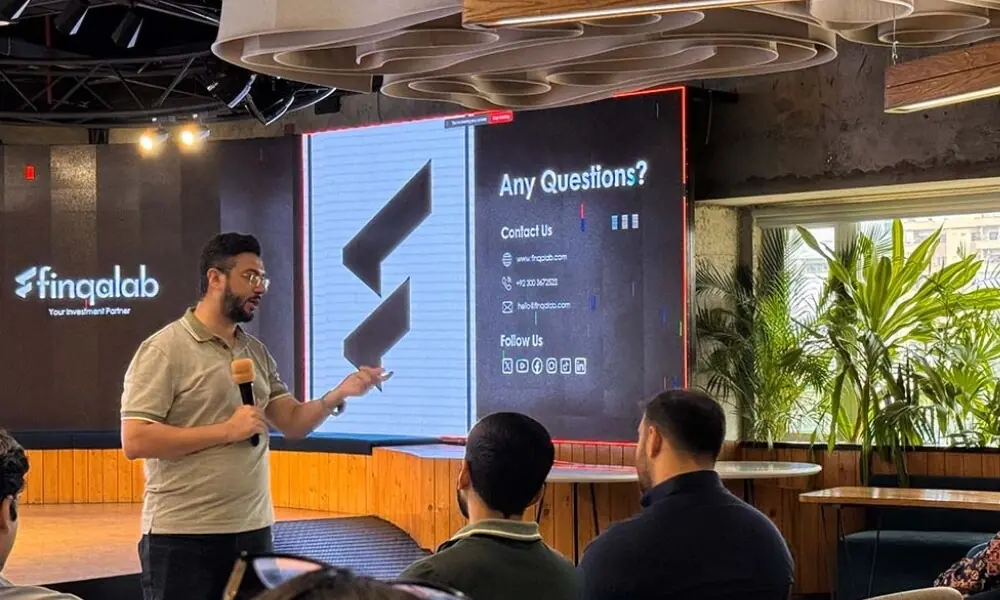
Similar platforms exist in Pakistan as well. One company that is trying to help users invest digitally is Finqalab, whose name means “Financial Revolution.” It is an invest-tech startup that launched a consumer stock-trading app in mid-2024 with the aim of simplifying access to Pakistan’s capital markets.
From the outset, Finqalab has positioned itself as a digital alternative to legacy brokerage channels, concentrating on three mutually reinforcing goals: removing logistical and administrative barriers to account opening, providing market information and educational content, and delivering a mobile trading experience designed for first-time and casual investors, as well as more active traders. In June 2024, Finqalab became the first company in the sector to introduce instant deposits within its app.
The company processed its first PKR 1 billion in transactions within a few months of launch. With the passage of time, this figure has crossed PKR 26 billion in cumulative transactions, according to recent data. Adoption signals extend beyond transaction volumes. The Google Play developer listing shows tens of thousands of app downloads, and there have been 40,000 sign-ups and 10,000 trading accounts since its launch in June 2024.
Online discussions and user feedback have generally focused on accessibility, ease of onboarding, and the platform’s educational orientation, while also highlighting operational challenges commonly faced by rapidly growing digital financial services. Some users have reported delays and limitations related to customer support, particularly during periods of increased onboarding activity. Such challenges are not uncommon among fast-growing digital financial platforms, where onboarding volumes can outpace operational capacity during early growth phases. In response to negative customer support feedback, Finqalab says it has introduced operational measures aimed at improving the user experience, including the rollout of an in-app ticketing system to streamline support requests and issue resolution.
By October 2025, the company’s platform ranked fifth nationwide in terms of opening first-time investor accounts. Within approximately 15 months of launch, Finqalab also ranked eighth in terms of most active investor accounts. Unlike conventional brokerage houses that orient themselves toward high-frequency or institutional players, Finqalab’s user base largely consists of passive and first-time investors seeking a more transparent and simplified entry point into capital markets.
“Traditional brokerages are built around short-term trading,” said Fatiq Bin Khursheed, CEO of Finqalab, in a conversation with Business Recorder.
“Finqalab, on the other hand, is focused on helping people build long-term wealth. We’ve tried to make the app intuitive and informative, giving users a clear view of their portfolio, how it’s allocated, and what’s happening with the companies they invest in, particularly during result season.”
Younger teams across the fintech and brokerage ecosystem are driving innovation in account opening, deposits, and corporate action visibility. As Fatiq noted: “Our entire onboarding process is digital. We were the first to introduce instant deposits… In other words, Finqalab is constantly evolving.”
The company’s education-focused ecosystem operates primarily through Finqalab Academy, which serves as a platform for learning resources, media content, and community engagement. The Academy consolidates beginner-oriented market explainers, tutorials, and educational videos intended to support informed decision-making among retail investors. It has gained over 50,000 subscribers so far and appears set to reach new milestones.
Looking ahead, Finqalab’s strategy manager, Zarmeen Khalid, said accessibility will define the future. “As more people become aware of the importance of financial independence, digital platforms will become the primary avenue for accessing the stock market and other asset classes. We hope that manual processes will be automated and onboarding barriers will ease for investors,” she told Business Recorder.
Finqalab’s approach reflects a broader invest-tech trend, in which technology and content are used to make established financial markets more accessible to retail audiences. However, such transformations are rarely driven by a single company; the country needs more platforms of this nature. The regulatory body, the Securities and Exchange Commission of Pakistan (SECP), has also made concerted efforts toward deepening capital market participation. One notable initiative that stands out, in particular, is the introduction of the Sahulat Account, which requires only a CNIC to start investing in the PSX. Nevertheless, significant work remains to be done to further digitize capital market infrastructure and accelerate the pace of growth.


























Comments
Comments are closed for this article.