


FTO cannot assume the role of revenue maximiser or taxation policymaker: President
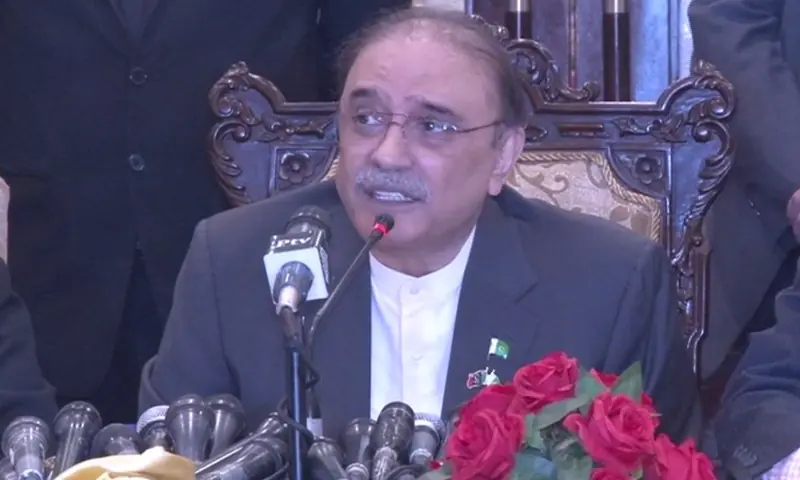

ISLAMABAD: President Asif Ali Zardari has categorically declared that the Federal Tax Ombudsman (FTO) cannot assume the role of revenue maximizer or tax policy maker through interpretation of tax laws.
The President has accepted 11 representations of the Federal Board of Revenue (FBR) against own motion findings/recommendations of the FTO in 11 different cases and subsequently modified the order of the FTO.
In this regard, the President’s Secretariat has issued orders against 11 own motion findings/recommendations of the FTO.
According to the President, 11 different own motion notices were related to the sector-wise analysis, lack of symmetry in management of credit of withholding taxes, systemic gaps and loopholes in prevalent withholding tax monitoring and payment system and huge tax evasion in the banking sector, quality of amended orders passed by Unit Officers and conduct of supervisory officers in discharge of their official engagements and discrepancies in charging and collection of electricity duty (ED) and other issues.
READ MORE: FTO recommendation: FBR delays implementation
The FTO had directed the Member IR (Operations) to implement a digital system that integrates data from manufacturers, lessors and registration authorities which automatically verifies the advance tax payment and ensures it is correctly credited to the lessee.
Consequently, aggrieved by the recommendations/orders of the learned FTO, the Agency/FBR preferred to file 11 representations before the President.
The 11 representations have been filed by the Federal Board of Revenue against the Suo Moto Notice of the Federal Tax Ombudsman (FTO).
The arguments for and on behalf of the Agency/FBR were heard at considerable length. The crux of the arguments furnished by the representatives of the Agency is that the impugned orders suffer from jurisdictional error. Reliance was placed on the order passed by the Islamabad High Court in Writ Petition No. 1460/2021 dated 12.05.2021 and order passed by the DB of IHC in Intra Court Appeal No. 326/2022.
The President held that the powers exercised by the Federal Tax Ombudsman are circumscribed by the limits of jurisdiction defined under the FTO Ordinance, 2000. The question that arises is whether the impugned orders fall within the ambit of maladministration as defined under Section 2(3) of the FTO Ordinance, 2000.
There is no denying the fact that the definition of maladministration is inclusive and not exhaustive or restrictive. However, the inclusiveness cannot be stretched to such an extent that it covers academic questions, policy matters, interpretation of law or exercise of appellate jurisdiction vested in tax authorities, the President maintained.
Looked into from this standpoint, the Ombudsman cannot assume the role of revenue maximizer or policy maker. Suggestions for improved governance fall within the executive domain.
Accordingly, the impugned orders of the learned FTO are modified to the extent of directing the Agency to initiate departmental actions in a just and fair manner and in accordance with law. Beyond this, the learned Federal Tax Ombudsman shall exercise jurisdiction within statutory limits, the President added.
Copyright Business Recorder, 2026




















Comments
Comments are closed for this article.