


Pakistan’s latest Household Integrated Economic Survey was released at an awkward moment. Inflation has finally cooled, the stock market is setting new records with enviable regularity, the external account is behaving itself for once, and Pakistan is once again enjoying a brief cameo in the geopolitical spotlight.
On paper, things look calmer. In kitchens across the country, however, the story is moving in the opposite direction.
The HIES 2024-25 makes one uncomfortable point abundantly clear: Pakistanis are eating less. Not just the poor, not just rural households, not just one province or one demographic category. Per capita food consumption has deteriorated across income quintiles and across regions compared with the last survey in 2018-19.
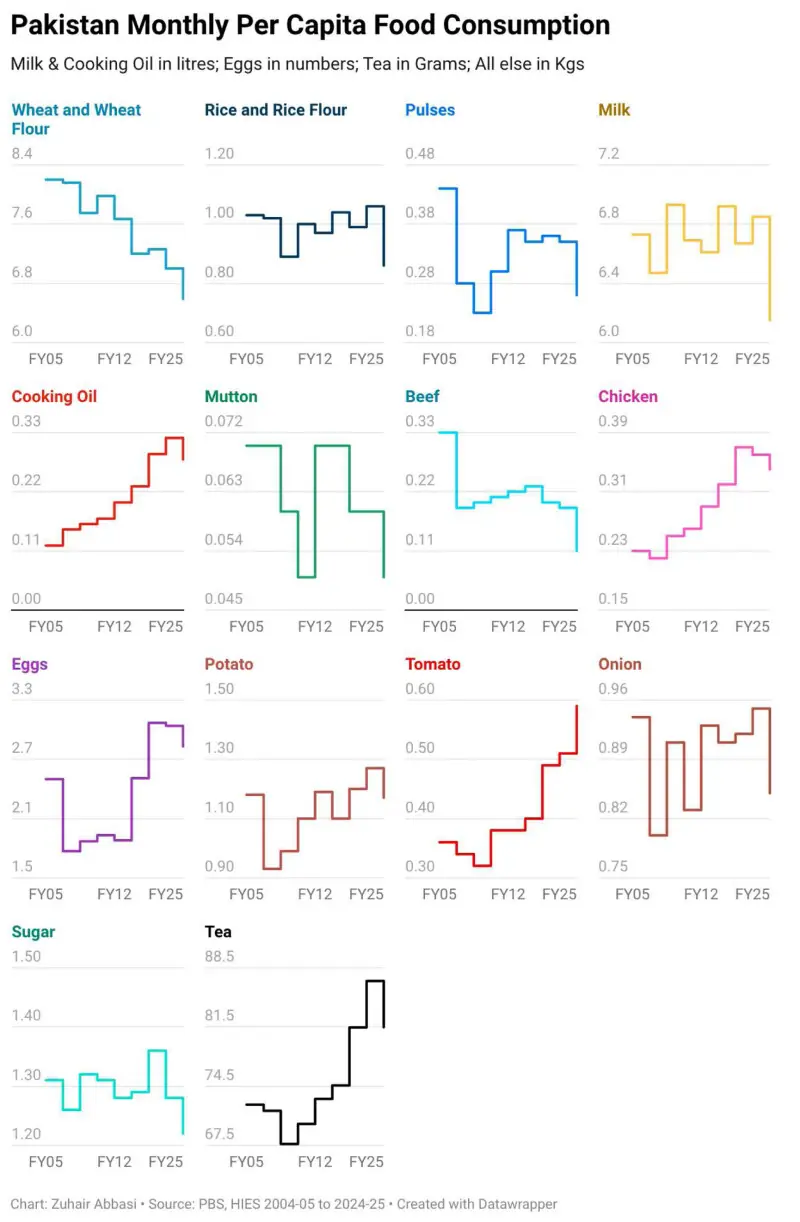
In several staples, the decline is even starker when compared with two decades ago. This is not a temporary blip. It is a slow, grinding erosion of household welfare.
Some will rush to put a positive spin on parts of the data. Wheat and rice consumption is down, they will say, perhaps this is a sign of changing dietary preferences, improved health awareness, or a shift away from excessive carbohydrates. This argument might hold water in a country where food choices are driven by lifestyle decisions. In Pakistan, it borders on parody.
The same HIES tells us that 24 percent of households now face moderate to severe food insecurity, up sharply from 16 percent in 2018-19. This is not the profile of a population making conscious, health-driven substitutions. It is the profile of households cutting back because they have no choice.
When pulses consumption is lower than it was two decades ago, when milk intake shows a declining trend despite population growth and urbanization, when beef and mutton consumption continues its long slide and even chicken consumption struggles to hold gains, the explanation is not wellness. It is affordability.
The chart accompanying these numbers makes for grim reading. Wheat and wheat flour consumption has steadily declined over time. Rice has failed to compensate. Pulses, the protein fallback for millions, remain well below past levels. Milk consumption, often treated as a basic nutritional indicator, has weakened.
Cooking oil consumption has risen, yes, but largely because calories must come from somewhere and oil remains a relatively cheap way to stretch meals. This is not dietary diversification. It is coping behavior.
Tea consumption, meanwhile, continues to rise, perhaps the most Pakistani response of all. When meals shrink, chai fills the gaps.
This is where the macro narrative collides with household reality. Real incomes have not merely stagnated. They have been hollowed out, slowly over two decades and violently over the past three to four years. Households are eating less so that they can keep a roof overhead, pay school fees, cover transport costs, or simply keep the lights on.
Energy, housing, and basic services have crowded food out of household budgets, not because food has become less important, but because everything else has become unavoidable.
The health consequences of this adjustment are not immediately visible in headline numbers. They will not show up in quarterly GDP prints or market indices. They will appear later, in stunting, weakened immunity, lower cognitive outcomes, and rising long-term healthcare costs. A population that consistently under-consumes protein and dairy does not become more productive with time. It becomes more fragile.
The uncomfortable truth is that macro stability has been purchased by squeezing households, and the squeeze is now showing up in plates, not just balance sheets. Celebrating stable inflation after prices have already reset at much higher levels misses the point. Applauding stock market performance in a country where a quarter of households face food insecurity is an exercise in selective vision.
HIES 2024-25 should be read not as a routine statistical release, but as a welfare alarm bell.
The numbers suggest that Pakistan’s growth model, such as it is, has failed to protect basic consumption even during periods of supposed stabilization. If people are eating less today than they did five, ten, or twenty years ago, then something fundamental is broken.
Markets may be calm. Accounts may be balanced. Headlines may sound optimistic. But the data tells us that Pakistanis are tightening belts that were already tight. And no amount of macro spin can turn an emptier plate into a success story.















Comments
Comments are closed for this article.