


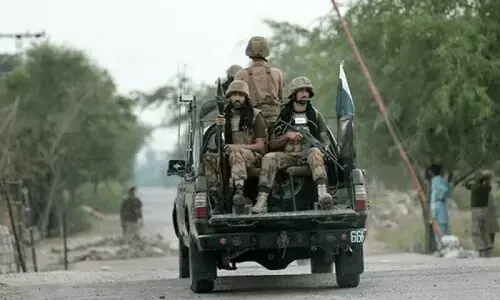
EDITORIAL: The Corps Commanders’ Conference this week followed a year in which militant violence surged across multiple regions, especially KP and Balochistan, exacting a heavy toll on civilians and security personnel alike, while the economy struggled under the weight of uncertainty and risk. Against that backdrop, the military’s declaration that no malicious interest, political or otherwise, would be allowed to undermine national unity and stability was less a warning than a statement of necessity.
Pakistan’s internal security environment in 2025 has been among the most challenging in a decade. KP and Balochistan have borne the brunt of terrorist attacks, and the return of suicide bombings to the federal capital after many years underscored how wide the threat spectrum has become. Official figures and independent reporting alike point to a sharp rise in casualties, making this one of the bloodiest years since the mid-2010s. These are not abstract numbers; they clearly reflect a sustained campaign by banned outfits seeking to destabilise the state.
In such conditions, the linkage highlighted by the military leadership between terrorism, crime and vested political interests cannot be dismissed as rhetorical overreach. Pakistan’s own counterterrorism experience has repeatedly shown how militant networks survive by embedding themselves in criminal economies and exploiting political polarisation. When such nexuses are allowed to persist, they weaken law enforcement, corrode institutions and blur the lines between violence and politics. The cost is paid not only in lives lost but also in the erosion of state authority.
The economic consequences are equally severe. Insecurity raises the cost of doing business, deters investment, disrupts logistics and forces scarce public resources into reactive security spending rather than development. For an economy already under strain, the tolerance of actors who actively sabotage stability is not merely a security lapse; it is an economic self-inflicted wound. Protecting the economy, therefore, cannot be separated from confronting those who threaten internal order.
This is why the military’s position deserves support. In the present circumstances, ambiguity benefits only those who profit from disorder. A firm stance against all elements undermining security and cohesion is consistent with the National Action Plan and with the state’s constitutional responsibility to protect citizens. It is also essential if Pakistan is to create the conditions necessary for economic recovery.
At the same time, firmness does not imply indiscriminate action. The conference’s emphasis on public-centric initiatives, particularly in Balochistan, reflects an understanding that security cannot rest on force alone. Addressing governance failures, local grievances and development deficits is critical to undercutting the narratives that militant groups exploit. These measures, however, can only succeed if they are implemented alongside, not instead of, decisive action against violence.
The situation in KP further illustrates the complexity of the challenge. Alongside internal militancy, cross-border threats have persisted, with repeated attacks traced to sanctuaries beyond Pakistan’s borders. Diplomatic engagement remains necessary, but diplomacy cannot substitute for internal resolve. Clear signals that destabilisation will not be tolerated are indispensable, both domestically and regionally.
It must be noted, though, that supporting a strong security posture does not require sidelining civilian institutions or bypassing legal safeguards. On the contrary, the effectiveness and legitimacy of any crackdown depend on adherence to law, due process and institutional accountability. Action must be evidence-based and targeted at conduct, not dissent. That distinction is critical if public confidence is to be maintained.
The alternative is far more damaging. Allowing violent and criminal networks to operate with relative impunity entrenches a cycle in which insecurity feeds economic decline and this weakness, in turn, fuels further instability. Breaking that cycle demands clarity, coordination and resolve across the state.
The message from the military leadership is therefore timely. Pakistan cannot afford hesitation when both its security and its economy are under pressure. Those who actively harm either must be confronted decisively and lawfully. Anything less would signal weakness at a moment when the country can least afford it.
Copyright Business Recorder, 2025

























Comments
Comments are closed for this article.