


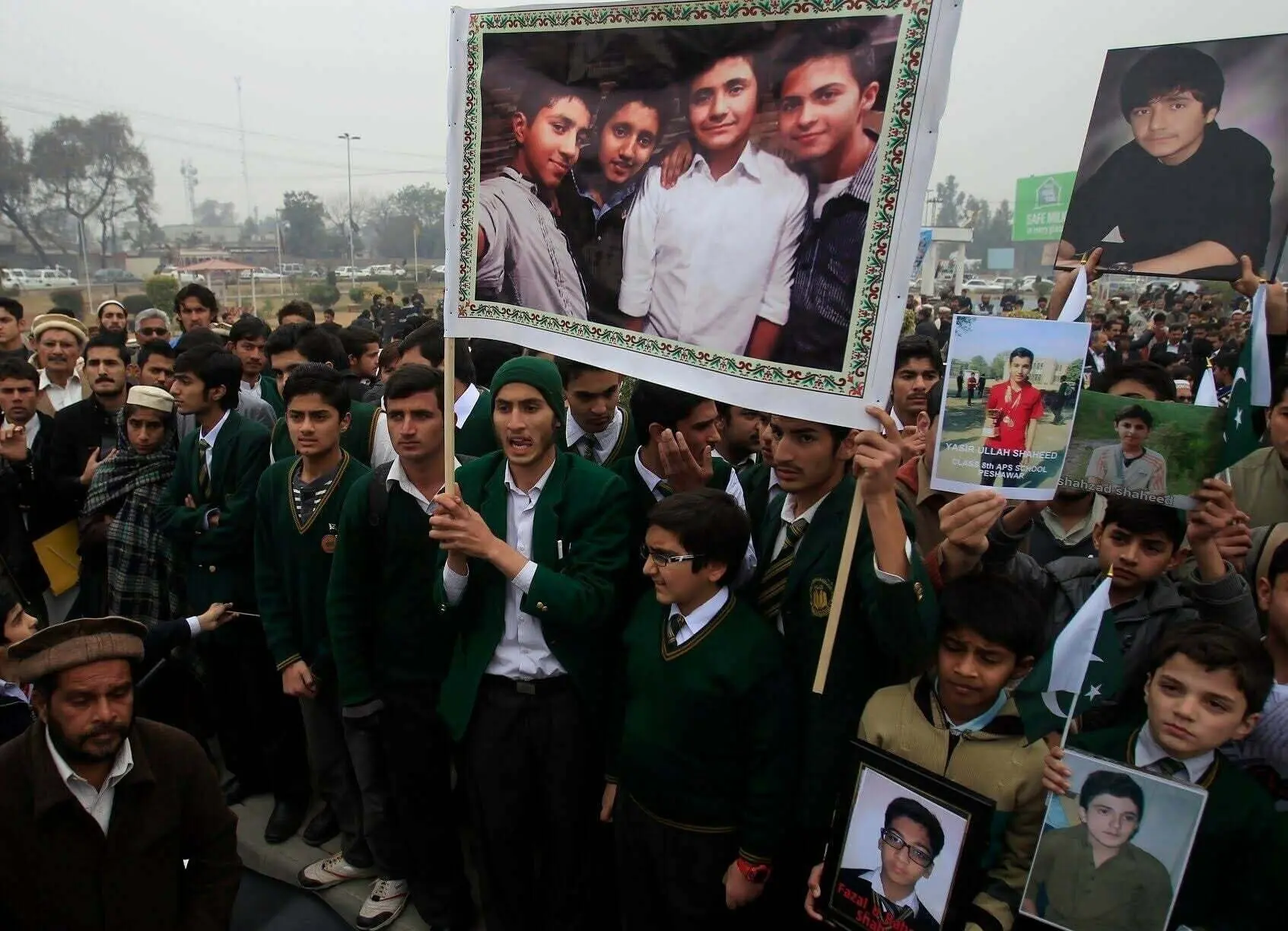
EDITORIAL: Eleven years have passed since the horrific December 16 attack on the Army Public School (APS) in Peshawar, yet the pain inflicted by that tragedy remains fresh in the public memory. The massacre of 132 children and 15 staff members shook the nation to its core.
On the eve of the 11th anniversary the candle-light vigils held by the bereaved parents and other relatives, along with the observance of a black day by educational institutions across Khyber Pakhtunkhwa, served as solemn reminders that the threat of terrorism has not been eliminated and that justice for the victims’ families remains elusive.
In the immediate aftermath of the APS carnage, there was an exceptional moment of political unity: leaders from across the political spectrum came together to formulate a 20-point National Action Plan (NAP), pledging decisive action against terrorism and extremism. That consensus, however, proved short-lived. More than a decade later, much of the NAP – and even its revised versions – remains unimplemented. Instead of sustained resolve and coordinated policy, counter-terrorism efforts have been marked by inconsistency, half-measures, and political point-scoring.
The consequences of this failure are stark. The outgoing year has reportedly been the deadliest in a decade, with a disturbing resurgence in militant violence. This reality underscores the uncomfortable truth that terrorists have adapted and regrouped, exploiting policy gaps and political discord.
The ongoing tensions between Islamabad and the Khyber Pakhtunkhwa government, marked by blame-shifting, only deepen these vulnerabilities and create space for militant groups to exploit the situation to their advantage.
For the families of the APS victims, the passage of time has not brought closure. As they marched towards the APS campus demanding justice, their grief was compounded by a profound sense of abandonment. Ajoon Khan, President of the Shuhada (Martyrs) APS Forum, rightly pointed out that despite the lapse of eleven years, the bereaved families have yet to receive justice. His demand for a fresh judicial inquiry, as well as for the public release of the earlier judicial commission’s report ordered by the Supreme Court, speaks of a fundamental principle: transparency is not optional in matters of national trauma. Unfortunately, we have a troubling history of burying commission reports, allowing them to fade into obscurity without accountability. This practice only deepens public mistrust and prolongs the suffering of victims.
The parents and siblings of the slain children and staff members have an unquestionable right to know who failed them – whether through negligence, incompetence, or complicity – and why those failures have gone unpunished.
The APS tragedy was to become a turning point, a moment that would galvanise the nation into sustained and decisive action against terrorism.
But eleven years on, it appears that necessary lessons have not been fully learnt. A coherent counter-terrorism policy, political unity, and an unwavering commitment to justice remain conspicuously absent. Until these shortcomings are addressed with sincerity and resolve, the shadow of APS will continue to loom large over the collective conscience of the nation.
Copyright Business Recorder, 2025




















Comments
Comments are closed for this article.