


New Rome metro stations showcase ancient treasures after years of delays
- The driverless Metro C line now stretches from the Italian capital's eastern suburbs to Porta Metronia and the Colosseum
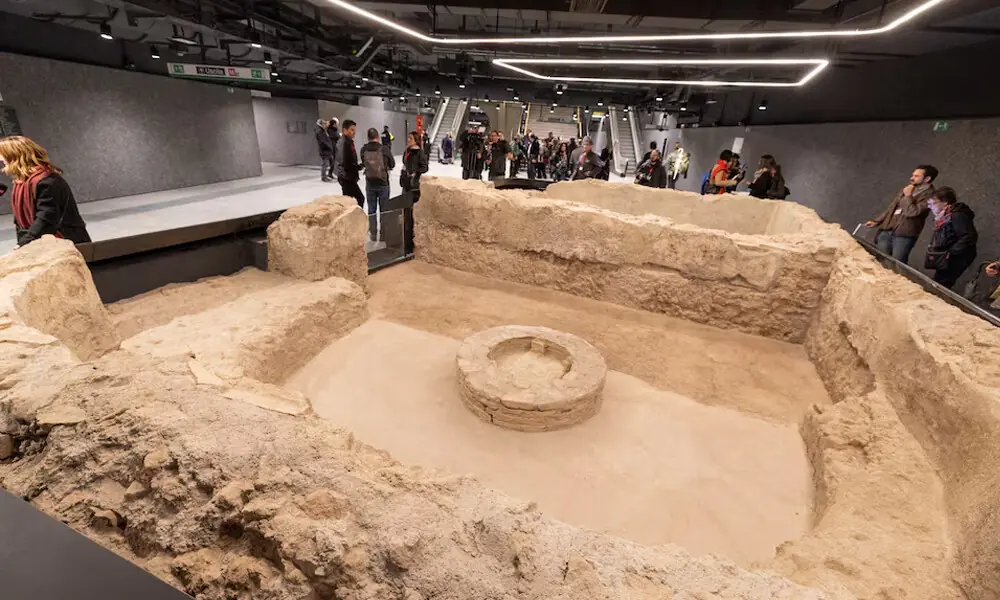

ROME: After years of delays and spiralling costs, Rome inaugurated two new metro stations on Tuesday, including one by the Colosseum, showcasing archaeological discoveries that might become tourist attractions in their own right.
The driverless Metro C line now stretches from the Italian capital’s eastern suburbs to Porta Metronia and the Colosseum, extending its reach into the historic city centre.
Future plans will take it even deeper under Rome’s baroque heart, beneath the river Tiber and onto the Vatican, though the next stop at Piazza Venezia is not expected to open before 2032.
Excavations for the new stations revealed remarkable finds, which slowed work as archaeologists painstakingly preserved layers of ancient Rome they hadn’t known were there.
At Porta Metronia, drilling rigs uncovered a military barracks dating back 2,000 years, as well as a residential house, complete with frescoed rooms and mosaics, which are preserved in a museum within the station.
During the Colosseum excavations, workers discovered 28 ancient wells and hundreds of everyday artefacts, including hairpins, phallic-shaped oil lamps, irrigation pipes, knives, and statues, many of which are on show.
“These two stations will travel around the world,” Transport Minister Matteo Salvini said on Tuesday, predicting they would soon flood social media.
“Beyond serving commuters and Romans, anyone who comes here from Italy or from abroad will stop in these stations. They might take the metro even if they don’t need it, just to enjoy the ride,” he added.
Long delays, cost hikes
Rome’s Metro C was meant to link the city’s two main Basilicas by the year 2000. Instead, the line only reached the imposing San Giovanni Basilica in 2018, and the Vatican station near St. Peter’s Basilica won’t be ready for at least another decade.
The initial plan to build 24 stations to the Colosseum was priced at 2.23 billion euros ($2.63 billion), but costs have surged past 3 billion euros, and the entire line could exceed 6 billion by the time the final seven stations are completed.
Engineers say Rome is among the most challenging cities in the world for metro construction, due to buried archaeological sites that require safeguarding and concerns that vibrations could damage the heritage above ground.
At the next stop, at Piazza Venezia, a construction team is digging an 85-metre deep (280 feet) ring around the site which will be filled with reinforced concrete to protect the six underground floors of the station that are being dug out.
Rome Mayor Roberto Gualtieri said it was worth the effort.
“Without these major works, we would never have discovered the barracks at Porta Metronia, we would never have found these wells, and today we would have known far less about our extraordinary past,” he said.
Metro C is intended to carry 600,000 passengers a day, easing Rome’s notorious traffic and speeding tourists between major landmarks. At present it carries 41,000 daily, but the new openings should see numbers climb.




















Comments
Comments are closed for this article.