


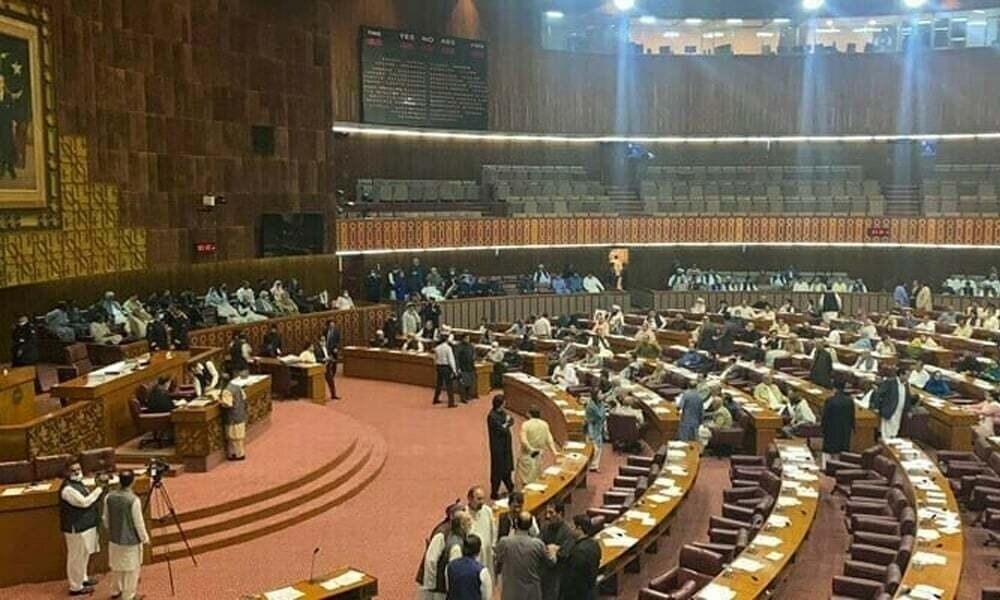
EDITORIAL: The legislation passed on December 2 enabling the creation of the National Commission for Minority Rights is a long-overdue, essential step towards building a fairer, more accountable framework for protecting vulnerable communities and strengthening Pakistan’s democratic fabric. The travesty here is that this milestone arrives an entire decade after the widely celebrated 2014 Supreme Court judgement, which had explicitly directed parliament to legislate on minority rights.
The delay underscores how the rights of the most vulnerable Pakistanis have consistently been treated as an afterthought by those in power. In fact, it has been worse than neglect. Entrenched segments have actively opposed and sabotaged attempts to secure such protections, which meant that successive governments found it easier to just sidestep the hard work needed to build credible safeguards for upholding fundamental rights for all citizens.
Even now, it is difficult to shake the sense that the government rushed this legislation through a joint session of parliament, not out of a principled commitment to protecting minority communities, but because Pakistan’s GSP-plus status – granted by the European Union and hinging on its human rights record – is up for renewal soon. However, despite concerns over the government’s approach, it is the conduct of the opposition benches that demands special scrutiny.
It was extremely disheartening to see that as the vote unfolded, much of the resistance was anchored in deep-seated unfounded fears that its passage would somehow conflict with Islamic principles. When opposition is framed in such potentially inflammatory terms, and comes with little evidence of having engaged with the actual text of the bill, it inevitably makes any initiative controversial, especially given the religious sensitivities at play.
Despite assurances from Law Minister Azam Nazir Tarar that the legislation simply provides a formal platform for non-Muslims to air and resolve grievances, drawing from precedents set by Prophet Muhammad (PBUH), the debate was overtaken by religiously charged objections.
Maulana Fazlur Rehman was particularly forceful, warning — without basis — that the law could be potentially misused by a certain religious minority. Even if such groundless fears held any merit, they offer no rationale for blocking a law that directly concerns the rights of Hindu, Christian, Zoroastrian, Sikh, and other minority communities.
Their constitutional protections cannot be put on the back burner yet again merely to appease the xenophobic anxieties of a particular segment. This reasoning is untenable. The state has an unequivocal duty to protect the fundamental rights of all citizens, regardless of how any group perceives itself.
While the stance of the religious parties was predictable, it was the PTI’s reaction that proved most disappointing. Its grievances against the rulers are understandable, with many of its leaders and members having faced clear violations of their rights in recent times.
That is precisely the reason why one might have expected it to stand firmly with groups that are arguably even more vulnerable. Lawmakers and society at large must never forget the Quaid’s historic August 11, 1947 address to the Constituent Assembly.
In that speech, he made it unequivocally clear that a citizen’s faith would have no bearing on the business of the state. With that declaration to the body tasked with drafting the country’s constitution, the Quaid had, in effect, set out a vision of equal citizenship and justice under the law. One can only hope that the National Commission for Minority Rights will at last move the country closer to fulfilling that long-ignored goal.
Copyright Business Recorder, 2025




















Comments
Comments are closed for this article.