


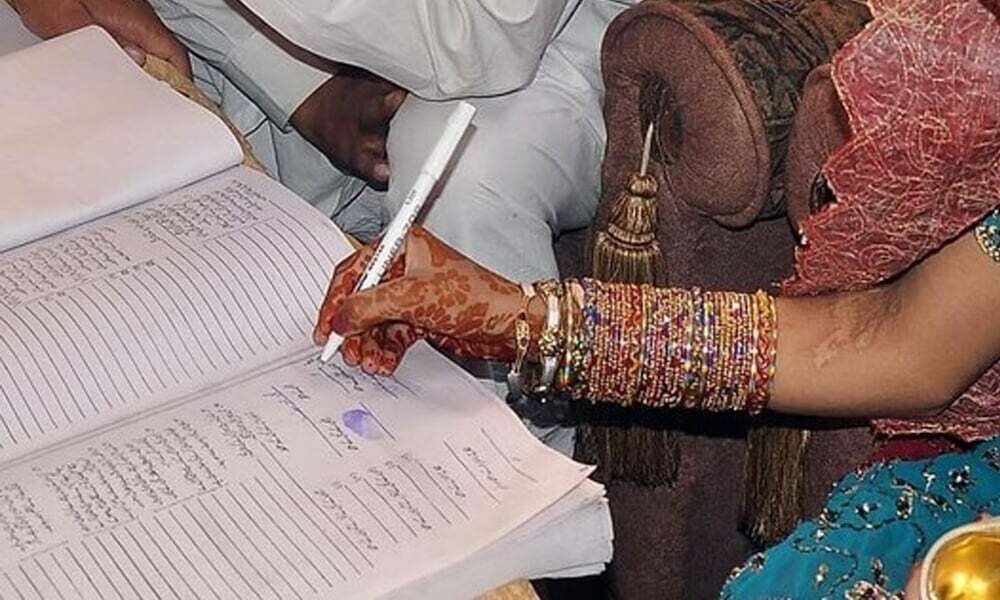

While growing up it was a usual and fun game among friends to play pretend weddings, girls dressing up in glittery clothes, singing and dancing as if it were a fairy tale. Often our domestic help’s daughter Alishba, same age as me, was always part of those games. We grew up together, sharing laughter’s and small joys together.
But suddenly, everything changed. News came that she would be leaving our home forever as her grandmother decided to get her married to her cousin.
At just 14, she was being prepared for a life she didn’t choose. Despite my mother’s best efforts, she couldn’t convince her family otherwise. It was heart-breaking to lose a friend and even more to see her leave behind the opportunity to experience so much more in life while mine continued with school, fun and games.
She later sent her wedding pictures, which reminded me of the pretend games once we staged, except this time it was real. I consoled myself, thinking she is perhaps happy in her new life until she came to visit me a few months ago. It felt like looking at a stranger; frail, pale and six months pregnant. Her lively voice and cheerful smile had disappeared. When asked how she was, her eyes said more than words ever could; helplessness, exhaustion and fear.
A few months later, the news became even more devastating. Complications during childbirth led to the loss of her baby. In an attempt to save her life, the doctors hurried her into emergency surgery. Although she lived, she emerged physically and emotionally damaged, traumatised and weakened. She had already lost her childhood, her education and her dreams.
Years later, when I read about the revision of the ICT child marriage law, which finally raised the minimum age of marriage to eighteen, my thoughts returned to Alishba. For the first time, I felt compelled to research the issue more deeply. Why do girls in Punjab not deserve the same safeguards as those in Islamabad? Why must young girls continue to be denied the basic right to safety, health and a childhood? Alishba’s experience, along with countless others, shows that this is not merely a policy gap, it is a matter of dignity, protection and far too often a matter of life and death.
Child marriage is defined as a marriage in which the individual or individuals are under the age of 18. It is communally acknowledged by the medical profession and human rights organizations as a denial of fundamental rights like the rights to health and education and the right to control one’s own body. According to UNICEF, marrying before the age of 18 is a “fundamental violation of human rights.”
Early marriage of adolescent girls is a common reason for taking them out of schools, they start having poorer physical and mental states of health, are more at risk for complications during pregnancy and at birth and more at risk for abuse.
In much of rural Punjab, a confluence of poverty and cultural tradition alongside a failure to raise awareness leads child marriage to persist. Families often perceive the marriage of their young daughters as a means to alleviate economic strain or safeguard perceived honour, frequently overlooking the significant dangers involved. These early marriages lead directly to cases similar to the Alishba’s. Pregnancies before the body is ready, infant mortality or death in utero, long?term health issues, psychological trauma and in many cases social isolation.
In Punjab, a 2015 Amendment in Restraint of Child Marriage increased the punishment for child marriage to six months in jail and Rs 50,000 fine, but concurrently allowed the marriage of 16-year-old girls.
The new bill for 2024-25 is set for the minimum girl’s age at 18 years, in line with the global standard. Sindh, however, previously ratified the Child Marriage Restraint Act in 2013, elevating the age of marriage for girls to 18 years. It was celebrated as a progressive step, and the media suggested Sindh was the sole province so far banning marriage under the age of 18 outright.
Experts and advocates also warn that having laws in place is not enough; effective application, social change, and improved awareness are also important parts. In Punjab, the statistics are alarming.
The Pakistan Demographic and Health Survey (2017-18) 18.3 percent of girls in Pakistan are married before the age of 18 and 33.6l percent are married before 15. International human rights and health organisations point out that early pregnancy is a leading cause of maternal death in low- and middle-income countries, and children born under such circumstances face higher risks of neonatal death, low birth weight, and long-term health complications (UNFPA, 2023; WHO, 2023).
Alishba’s case is not isolated, it is the confluence point of law, custom, poverty and gender discrimination. Current legislation in some provinces like Sindh is better, but not standardized for the whole country. Even more troubling is that social tradition and economic imperatives continue to compel households to turn a blind eye or escape existing legislation.
Thousands of girls in Punjab are deprived of their childhood, health and future because of outdated laws and entrenched norms. The revisions of the ICT child marriage law to 18 years old is evidence that change is possible when girls’ rights are recognised and there is will. Punjab must follow suit, raising the legal marriage age to 18, to safeguard education, preserve childhood, and protect young girls from preventable harm. It is a moral imperative, a question of justice and a matter of life itself.
References:
UNICEF (2023) Child Marriage. Available at: https://www.unicef. org/protection/child-marriage
UNFPA (2024). Adolescent Pregnancy. United Nations Population Fund. Available at: https://www.unfpa. org/adolescent-pregnancy
World Health Organization (2024). Adolescent Pregnancy: Fact Sheet. Available at: https://www.who.int/en/ news-room/fact-sheets/detail/adolescent-pregnancy
Copyright Business Recorder, 2025
The writer is an aspiring youth activist, actively engaged with community-based organizations to advance the health and well-being of adolescent and young girls in marginalised communities across Punjab

























Comments
Comments are closed for this article.