


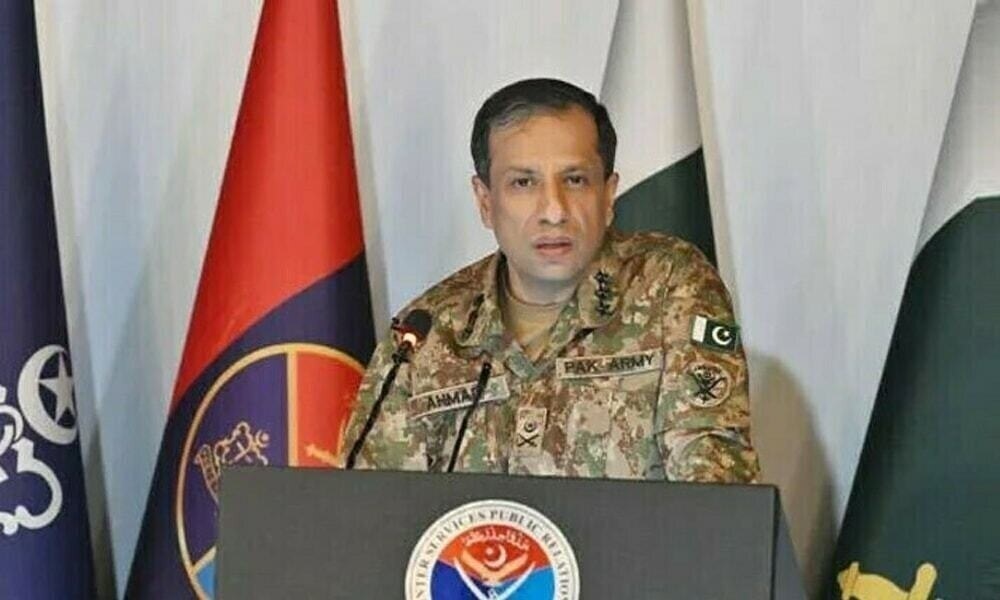

ISLAMABAD: Military’s spokesman Lieutenant General Ahmed Sharif Chaudhry has stated that there should be no speculation regarding the court martial of former senior military officer Faiz Hamid.
Briefing senior journalists, the Director General of Inter-Services Public Relations (ISPR) emphasised that the proceedings are part of a legal and judicial process. He added that once the implementation takes place and any decision is reached, the public will be informed accordingly.
The DG ISPR firmly remarked that guessing or speculating over the court martial is inappropriate. He raised concerns over the role of certain social media accounts, saying that these accounts are promoting narratives against the state and operating from abroad.
He stressed that clarity would only come through due legal process, not through external commentary or online assumptions.
Pakistan on Tuesday firmly rejected Kabul’s allegations of cross-border airstrikes, with the military urging the Afghan interim administration to act responsibly and refrain from issuing statements “typical of non-state actors” amid rising regional tensions.
Director General of Inter-Services Public Relations (ISPR) Lt Gen Ahmed Sharif Chaudhry dismissed the Afghan Taliban’s claims that Pakistan had attacked Khost, Kunar, and Paktika, calling them “baseless.”
“Pakistan has not attacked Afghanistan. We do not carry out covert operations; we act openly and never target civilians,” he stressed, responding to Taliban spokesperson Zabihullah Mujahid’s accusations that Pakistan had bombed these regions, which Islamabad denied.
He reiterated that Pakistan’s issue is with terrorism, not the Afghan people. “Blood and trade cannot run together,” he said. “We cannot face attacks and conduct business as usual.”
He warned Afghanistan’s interim government that sovereignty comes with responsibility and urged the Taliban not to act like a non-state actor. “How long will it remain interim,” he asked, adding, “There is no good or bad Taliban. Terrorists are terrorists.”
He reaffirmed Pakistan’s hard line on militancy: “The only good terrorist is a dead terrorist,” emphasizing that the state will not engage with groups responsible for killing its citizens.
He said security forces will continue targeting militants under the Constitution and the National Action Plan. Outlining Pakistan’s security strategy, he highlighted the need for an operation in the Tirah Valley as part of a long-term effort to dismantle terror networks linked to the narcotics trade.
He noted that militants had exploited the region due to political facilitation and weak governance. “The threat in Tirah is serious. Pakistan will continue operations with clarity and resolve. There will be no no-go areas anywhere in the country,” he added.
He also highlighted the growing regional security threat posed by the USD7.2 billion worth of US military equipment left behind in Afghanistan, as reported by SIGAR. US-made weapons recovered in the Mianwali attack and bullet-proof vehicles funded by narcotics money had been used in 29 terror incidents across Pakistan this year. He warned that further arms supplies to Afghanistan would have global consequences, stating, “Any country supplying weapons to Afghanistan is arming terrorists and endangering the world,” and called for a ban on non-custom-paid vehicles, now a key tool in terror operations. Chaudhry discussed Pakistan’s broader policy toward Afghanistan, stressing that the core issue is the Afghan Taliban’s non-representative regime, which has failed to act against the TTP.
He clarified that Pakistan does not seek to block Afghanistan or hinder its economy but urges the international community to hold Kabul accountable with clear expectations: stop supporting terrorists, dismantle sanctuaries, and act responsibly.
He emphasized that Pakistan’s border restrictions are designed to prevent attacks, not disrupt legitimate trade, and called for verifiable actions from Afghan authorities to ensure lasting stability.
The DG also provided an update on ongoing development efforts in Balochistan, including the completion of five major dams worth Rs17.7 billion aimed at enhancing water security and supporting agriculture in vulnerable districts.
He emphasized that these infrastructure projects are crucial for stabilizing remote regions and countering socio-economic vulnerabilities exploited by militants.
He also revealed that foreign-based social media networks from the US, Singapore, and India have been identified as spreading disinformation to undermine Pakistan’s development narrative in the region.
Chaudhry warned of a political-criminal-terror nexus in areas with weak state authority, where some political actors – intentionally or not – create space for militants, while criminal groups profit from smuggling and illicit trade that funds terrorism. He explained that in such environments, local populations are often misled into resisting security operations, complicating efforts to tackle extremism.
He provided an update on Pakistan’s crackdown on fuel smuggling, one of the largest in recent years. While Balochistan’s official fuel quota is 6.5 million litres per day, prior to the crackdown, nearly 20.5 million litres were being smuggled. This has now been reduced to 2.7 million litres per day, a drop of over 210%.
He highlighted that smuggling had fuelled a parallel economy, generating Rs3 billion daily for criminal networks. He also noted that while smuggling enforcement is a provincial responsibility, the Pakistan Army and Frontier Corps are fully supporting the crackdown.
Further updating on Pakistan’s counterterrorism efforts, he revealed that security forces had conducted 67,000 intelligence-based operations nationwide this year, including 1,387 in Khyber Pakhtunkhwa and 3,485 in Balochistan.
He reported the deaths of 210 militants in 2025, with 607 security personnel lost. In November alone, 4,910 operations were carried out, resulting in 57 Army and Frontier Corps casualties, and 14 civilian deaths. Chaudhry also discussed Pakistan’s evolving military strategy, noting the shift to multi-domain operations under the 27th Amendment, integrating land, air, maritime, space, IT, and cyber capabilities.
He explained that the proposed creation of a Chief of Defence Forces role aligns with global practices and aims to enhance inter-service coordination while preserving institutional independence.
These reforms, he emphasized, are essential for strengthening Pakistan’s war-fighting capacity in an increasingly complex security environment.
Copyright Business Recorder, 2025




















Comments
Comments are closed for this article.