


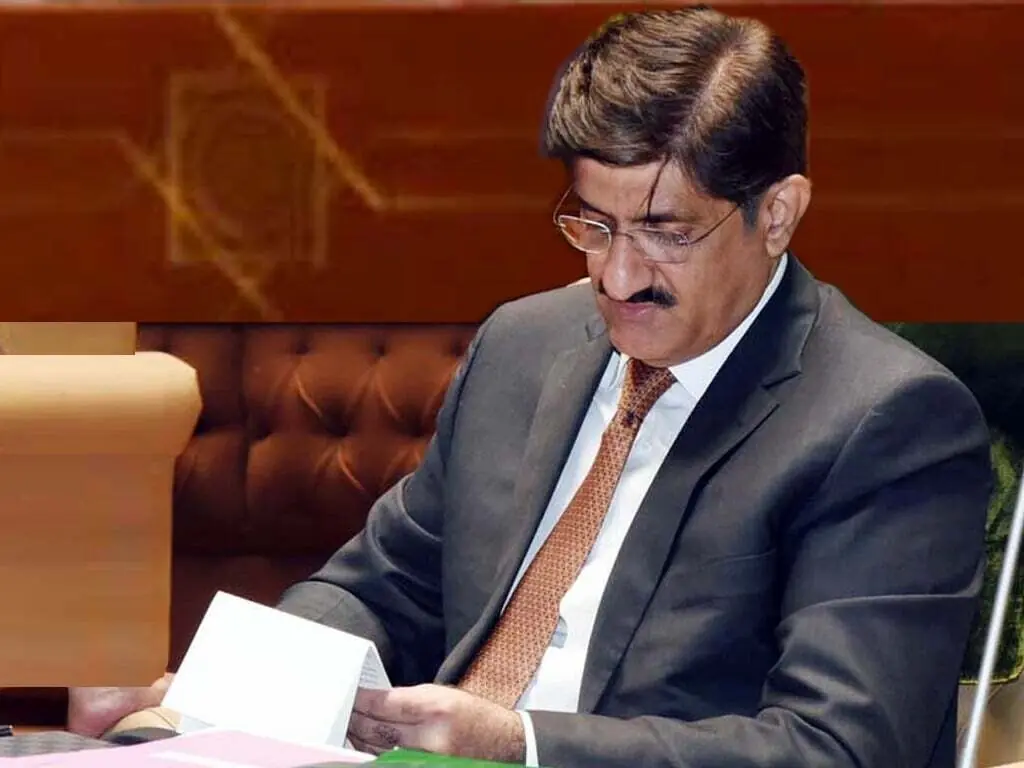

KARACHI: Sindh Chief Minister Syed Murad Ali Shah, addressing the Sindh Education Foundation programme of the Accelerated Digital Learning Programme (ADLP), stated that approximately 22.6 million children are out of school nationwide, with 7 million in Sindh alone; the number of out-of-school children in the country surpasses the total populations of many countries globally.
“This is why the Sindh government, in collaboration with the Sindh Education Foundation (SEF), has decided to launch phase II of the Accelerated Digital Learning Programme (ADLP), a major expansion of its technology-enabled learning initiative aimed at underserved and out-of-school children across the province.
The decision follows the strong performance of the ADLP pilot phase, launched in June 2023 in partnership with the Teach the World Foundation (TTWF).
The chief minister highlighted that Pakistan ranks fourth among South Asian nations in terms of GDP and literacy, which underscores the urgent need for innovative educational solutions.
The ADLP, launched in August 2023 and approved by the Sindh government, is a pioneering initiative by the Sindh Education Foundation in partnership with Teach the World Foundation. The programme utilises digital technology to extend quality education to out-of-school children, especially in remote and underserved communities, Murad Shah explained.
Murad Ali Shah offered private organisations and individuals the opportunity: the Teach the World school can accommodate 100 students. If any private organisation or individual adopts a school, the government will match it and establish a second school in their name.
The launching ceremony, held at CM House, was attended by Minister of Education Syed Sardar Shah, PSCM Agha Wasif, Secretary of Education Zahid Abbasi, MD SEF Ganhwar Leghari, Shafiq Khan and Arshad Anis of Teach the World, Shahnaz Wazir Ali, Haji Nazim, Stephen Lyon, Imam Jahangir, Dr Kalbe Abbas, Javed Jabbar, Sultana Siddiqui, Zubair Chhaya, and others.
The ADLP aims to improve foundational literacy and numeracy through modern, digital learning tools, operating via two delivery models: Micro-Schools for out-of-school children and In-School digital classrooms for enrolled students who are falling behind academically. Collectively, these models provide flexible access to learning, support children with diverse needs, and help facilitate their transition into formal education.
According to the midterm evaluation by an independent firm, the ADLP pilot programme has demonstrated significant progress. A total of 100 Micro-Schools and 25 in-school digital classrooms have been established, enrolling more than 11,000 children across both models.
Micro-Schools set up as single-room community learning centres operate in four daily shifts, each offering a two-hour, self-paced, tablet-based digital learning cycle. These centres are strategically located in low-income urban and peri-urban settlements with high concentrations of out-of-school children.
The evaluation reports notable improvements in foundational learning among Micro-School participants who have completed at least nine months in the programme. Girls have outperformed boys, reflecting a positive gender-equity impact. Parents have also reported increased interest and engagement from their children. Despite challenges related to attendance and retention, driven by socioeconomic pressures and mobility, the program has consistently exceeded its quarterly attendance targets.
The In-School model, implemented within SEF’s Foundation Assisted Schools, supplements traditional teaching with structured digital content, providing additional support to academically weak learners.
Minister of Education Sardar Shah stated that building upon the success of the pilot, the Sindh government, through SEF, has approved the launch of ADLP phase II, which will establish 200 new Micro-Schools over the upcoming two fiscal years. One hundred new centres have been made operational, which the chief minister inaugurated today, and a further 100 in 2026–27 will be launched next year.
These new centres will operate alongside the current 100 Micro-Schools from Phase I, as they complete their full implementation cycle. The expansion aims to facilitate access to digital learning for approximately 30,000 out-of-school children, greatly expanding the programme’s reach.
The chief minister emphasised that the launch of Phase II marks a vital step in scaling a community-centred, evidence-based digital learning approach that has proven its feasibility and impact.




















Comments
Comments are closed for this article.