



For Camus, “all executioners are alike”, but what if an executioner is one, wearing different masks and appearing in the guise of a redeemer, yet acts like a colonizer?
At the 1884-5 Berlin conference, Africa’s fate was decided by the European colonizers. They shared it among themselves and clung to Africa as a plague which afflicts its people even today. Most of African countries have won their political freedom without securing their economic liberation and survive as mere client states.
Imperialism has stuck to their body politics, as a parasite, refusing to leave them. Resources-rich Africa is starving, struggling to survive another day while metropolitan capital continues to make hey, stealing her resources in the broad daylight, shoring up internal dissent, civil wars, ethnic cleansing and mass killing when it is must. Striptease of Western civilization is revealing.
On one side of the spectrum, Palestine is on fire. The Sharm-el- Sheikh Accord has been disposed to where it belonged from the start — to the dustbin of history. After the theatrical performance, the marionettes have slumbered back, snugged in their seats of power and the people of Gaza and the West Bank continue to face the biggest holocaust of the century— or perhaps the millennium— if measured by its human causalities seen via live transmission.
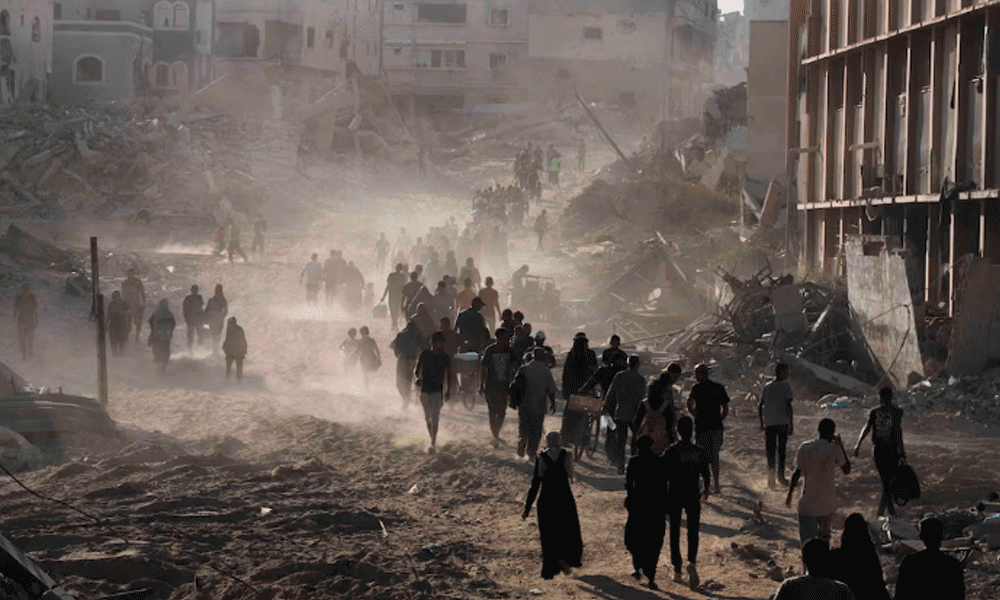
Meanwhile, the slaughter in Sudan increases every day; death and displacement reign supreme. More than 12 million people have been displaced since 2023; the death figure is unknown. Yet Sudan is not in the news because coloured lives don’t matter.
Since Sudan — or Bilad al-Sudan meaning land of Black, an Arabic word that reeks of racism— is an African country, it barely exists in the lexicon of the West. Like Palestine, a racial, imperialist policy is displaying and dancing naked for the countries of the Global South to see, to decide whether they want to confront imperialism— head on with unity or through integration.
After taking off the yoke of colonialism, Sudan won its independence from the British — Egyptian dominance but fell to the British trained generals, who expropriated their country shamelessly — a danger Fanon warned about. Resistance emerged, but the generals continued to push the civilians to the edge of the grave only to fall into it on their turn.
Finally, to counter a dominant class consciousness in Sudan, triggered by the socio-economic conditions and a large Communist Party, Omer al-Bashir, a Bonaparte struck.
Overthrowing an elected government, he took the reins. Lacking legitimacy, he used “the opium of people” to put them to sleep. The “cry of haven” was bludgeoned into submission. The brute necessity of Western capitalist expansion aligned itself with the fundamentalist Islamists and the army. Bashir was the product of that necessity.
With Hassan al-Turabi and the Muslim Brotherhood—the National Islamic Front (NIF) — Bashir played havoc on Sudan. Political parties were banned, massive privatization began, the resource grab went into full swing, the country was Arabized, militias were created to control opposition—the Islamic fundamentalist force Janjaweed was promoted to control the dissent. The seed of religious extremism sown by the British metastasized, leading to the amputation of the oil rich region of South Sudan, depriving Sudan of its biggest source of foreign exchange.
The US, as Jeffery Sachs confirmed, played the major role in the partition of Sudan. The British were gone, but the tactic of partitioning countries remained intact. The economy was in tatters, but since the oil pipelines went through the North Sudan, a clueless Bashir found some means to extract income from the oil flow.
Sudan, an agrarian country, once called the breadbasket of Africa, underwent massive privatization of its land before and during Bashir’s era. The beneficiaries were the barren countries, unable to grow their own food. The UAE, Saudi Arabia, and Russia bought large tracts of lands and took proceed to their countries. Gum Arabic from Acacia plants— another vital export of Sudan— was either privatized or held by the army, denying people its financial benefits.
Once gold was discovered, the regime used cheap labour to extract it, not with the help of technology but manually, paying 3–4 dollars a day to the workers, especially children working in inhuman conditions. Capitalists don’t invest in technology as long they can exploit cheap labour.
The National Congress Party, the continuation of NIF, was the biggest and most organized political party. Being a proto-fascist Islamist party, it impeded all social welfare schemes, and was instrumental in promoting Arab chauvinism by elevating the Arabs and Islam over the other enthno-religious communities— largely Muslims of African descent. Before starting his crusade against the “Godless Soviets”, bin-Laden stayed in Sudan, most probably as an official state guest. Political Islam, a product of western hegemonic design, proliferated under the watchful malignant gaze of the West.
Akin to other militias, the Rapid State Force (RSF), nurtured by the Bashir regime to maintain its hegemony through coercion, started gaining hold. Mainly comprising the pastoralist Arabs, who moved across the region in dry seasons, their plight during the massive drought of the 1980s — involving many parts of Africa — was exploited by Bashir. Instead of providing them with economic support, he turned them into his loyalists, giving them arms and money to fight against the South Sudanese. They are also called Baggara tribes or Chadian Arabs. Later, the UAE backed these militias, which in recent times have committed ethnic cleansing in Al-Fasher and were previously perpetrated atrocities in Darfur.
By arming communities, exploiting internal contradiction and natural calamities and to continue fleecing the natural resources to align with the western interests, Bashir and his predecessor’s legacy became a forty-year saga of death and destruction imposed upon the Sudanese people. Even the Saudi government used RSF as a mercenary force during its aggression against Yemen.
The Sudan Armed Force (SAF) is no better. A vestige of Bashir and now backed by Islamist NCP and Egypt, it seeks to maintain the time-worn Islamo-fascist rule in Sudan. Turkey and the ethno-racist genocidal entity of Israel are also involved in the ethnic cleansing and pillage of Sudan’s resources. In one UN General Assembly session the war criminal Netanyahu put up a map showing his favourite and ‘blessed countries’— Saudi Arabia, Jordan, Egypt, the UAE, and Sudan. For him, they were part of the future Middle East. One wonders how an African country could become a part of the future Middle East designed by a war criminal.
A palpably strong resentment can be seen among the Sudanese, for they want to remain a part of Africa rather than a puppet of Jewish settler-colonial regime. In 2019, people sick of thirty-year-long iron-fisted rule of Bashir revolted against Bashir. To maintain the status quo, the army ditched him. A rudderless spontaneity without ideological conviction fell flat. The political parties entered a five-year transition plan, dominated by the army for the first two years; afterwards power was to be transferred to the civilian leadership.
The hybrid system, as expected, turned turtle and once the two-year period was over the incumbent general was replaced by another. The absorption of RSF into SAF was a pipe-dream to start with. Two armed forces backed by the foreign powers looking to plunder Sudan’s resources didn’t want a peace. Besides the US, and its sanctions on Sudan the small powers or the Tent powers — as Eqbal Ahmed called the sheikdoms, where sheikhs sitting beneath the tents with oil and wealth emerging under British umbrella— have the same colonial instincts as their master.
They didn’t hesitate to sell the Arab Palestinian blood to an apartheid regime turning their own countries a literal brothel for the Jews, why would they mind the slaughter of Sudanese Muslims or other minorities?
What is the solution to the problems of Sudan? For the short run, there seems none. Kenya is allegedly backing the RSF and the Northern wing of SPLM— Sudan People’s Liberation Movement—bringing them together to fight the SAF. This could draw the entire region into war and chaos. Sudan is not going through a civil war but a proxy war backed and handled by the foreign powers seeking their respective interests.
Sudan is multiethnic; half of its population is Arab—a mixture of Nubians and Chads— while the rest is non-Arabs. Even in Darfur with largely Muslim Sufi inclinations, the Fur, Zighawas and Masalit dominate. In such a diverse population scattered across Sudan, it will be difficult to cleave the country further. Instead of two new states, two autonomous regions ruled by different groups is the likely outcome. The fate of Sudan rests with its people and the people of the entire African continent. They must stop the foreign intervention and take the reins of their country into their own hands.
Borrowing lines from William Wordsworth one can only hope,
“Though nothing can bring back the hour Of splendour in the grass, glory in the flower We will grieve not, rather find Strength in what remains behind.”
Copyright Business Recorder, 2025
The writer is an Australian-based academic and has authored books on socialism and history. His Latest Work: “God’s Republic Making & Unmaking of Israel & Pakistan” is available in Pakistan & on Amazon.com. He can be reached at [email protected]




















Comments
Comments are closed for this article.