


Pakistan demands end to occupation, pathway to independent Palestinian state
- Asim Iftikhar says Pakistan voted in US resolution's favour to stop the bloodshed
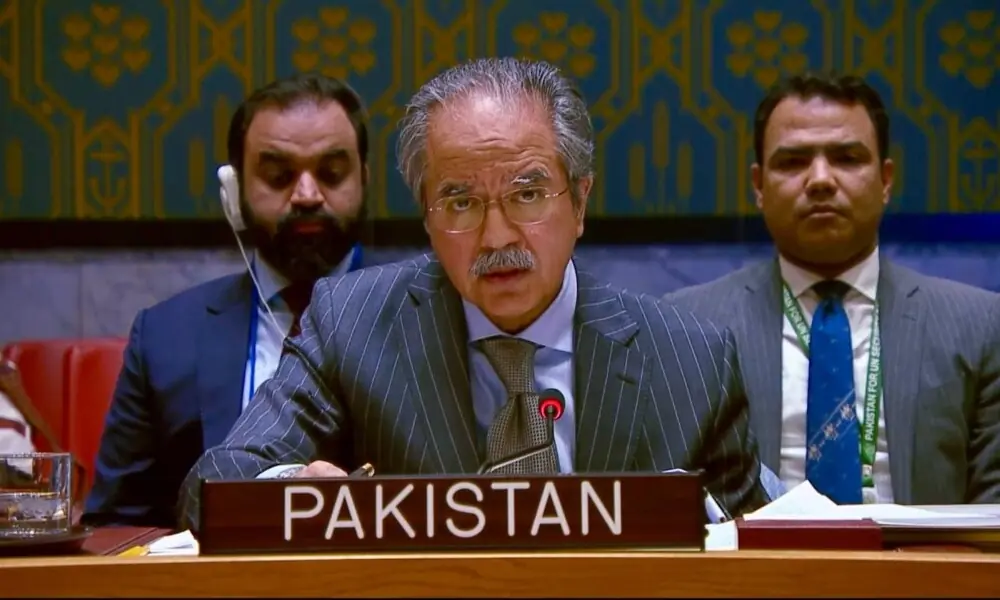

Pakistan has reaffirmed its unwavering support for the Palestinian people and their right to self-determination, calling for an immediate end to the occupation of Palestinian territories and the opening of a clear path toward the establishment of a Palestinian state.
The statement comes after the UN Security Council (UNSC) adopts a resolution on Monday, endorsing US President Donald Trump’s peace plan for Gaza and an international force as well as a governing “Board of Peace” following two years of Israeli war, with Pakistan underscoring that the authority in the enclave must remain with Palestinians through a committee.
The 15-member Council voted 13-0, with two permanent members — China and Russia — abstaining.
Speaking at the UNSC, Pakistan’s Permanent Representative to the UN Ambassador Asim Iftikhar Ahmad thanked the United States for tabling the resolution that welcomes and endorses President Trump’s “comprehensive plan” to end the Gaza conflict, and lays the groundwork for its implementation.
He said Pakistan has voted in favour of this resolution with the primary objective, in the immediate term, to stop the bloodshed, save the lives of innocent Palestinians including women and children, maintain the ceasefire, ensure much needed large-scale humanitarian relief, and secure the full withdrawal of Israeli forces from Gaza.
Israel quizzed at UN over torture allegations
Asim said the establishment of the temporary International Stabilisation Force (ISF) could truly be stabilising if guided by a clear peacekeeping mandate consistent with UN norms.
“Disarmament should take place through an agreed political process negotiated under a unified Palestinian National Authority, he said, adding protection of the people of Gaza will be a key priority in the ISF mandate.
Asim said Israeli troops must withdraw from Gaza, which is an essential requirement for restoring Palestinian sovereignty and securing durable peace. He emphasised that ISF mandate will only be effective once there is complete Israeli withdrawal.
“There must be no annexation and no forced displacement under any circumstances,” he said, emphasising that the territorial contiguity of the West Bank and Gaza is indispensable for a viable, sovereign, and independent State of Palestine.
The Pakistani ambassador also pointed out that some important critical suggestions were not reflected in the Gaza peace plan, such as: a clear political path to Palestinian self-determination and statehood, the central role of the Palestinian Authority in governance and reconstruction, and enhanced involvement of the UN, besides clarifications about the Board of Peace (BoP) and the mandate of the ISF.
“Those are all crucial aspects with a bearing on the success of this endeavour. We earnestly hope that further details in coming weeks will provide the much-needed clarity on these issues,” he emphasised.
Palestine—the last judgement that happens every day
After two years of devastating war and an unprecedented humanitarian catastrophe in Gaza, where more than 69,000 innocent Palestinians have been killed, most of them women and children, he said, a ray of hope emerged with the signing of the peace agreement at the Sharm-El-Sheikh Peace Summit between Egypt, Qatar, Türkiye and the United States.
“Pakistan, as a part of the group of eight Arab-Islamic countries, welcomed the efforts by President Trump and his proposal to end the war, rebuild Gaza, prevent displacement of Palestinian people, advance comprehensive peace, and halt the annexation of the West Bank,” he added.
He said Pakistan’s consistent policy, and every action pursuant to it, is for a just and lasting resolution of the Palestinian Question based on international legitimacy – Palestinian self-determination and the establishment of a sovereign, independent and contiguous State of Palestine based on pre-1967 borders with Al-Quds Al-Sharif as its capital.
“That must be the ultimate objective, and the culmination, of any peace process or initiative on the Middle East,” he maintained.
The envoy reiterated Pakistan’s stance that the role of the Palestinian Authority is absolutely central and critical in this process. A legitimate Palestinian representation is essential for credible governance and genuine Palestinian ownership, he added.
“Peace cannot be achieved in by passing the Palestinians. There must be an end to policies that undermine and weaken the Palestinian Authority,” he said.
‘Palestinian state’: Pakistan, Jordan reaffirm support
Asim stressed that Israeli troops must withdraw from Gaza, which is an essential requirement for restoring Palestinian sovereignty and securing durable peace. ISF mandate will only be effective once there is complete Israeli withdrawal, he said.
“Finally, we believe that in order to break the cycle of violence, it is absolutely necessary to end the occupation, and to have a political horizon, open the pathway to the Palestinian State through a credible, time-bound political process firmly anchored in the relevant UN resolutions. Durable peace and stability in the region will come only with the establishment of the Palestinian State as part of the two-State solution,” he said.
Resolution receives mixed reactions
The text of the resolution welcomes the “comprehensive plan” announced by President Trump on September 29. The first phase of the 20-point plan led to the ceasefire between Hamas and Israel days later. As per the resolution, Muslim-majority countries will contribute personnel to the ISF “in close consultation and cooperation” with Egypt and Israel.
“Thank you for joining us in charting a new course in the Middle East for Israelis and Palestinians and all the people of the region alike,” US Ambassador Mike Waltz said after the vote sailed through.
“Today’s resolution represents another significant step towards a stable Gaza that will be able to prosper and an environment that will allow Israel to live in security.”
He said the ISF “will stabilise the security environment, support the demilitarisation of Gaza, dismantle terrorist infrastructure, decommission weapons and maintain the safety of Palestinian civilians.”
China and Russia, while not supporting the resolution, let it sail through by abstaining in the vote. But they did highlight its deficiencies they perceived, especially that it sidelines UN’s role.
China’s UN Ambassador Fu Cong said the Council must secure a lasting ceasefire, address Gaza’s humanitarian crisis and begin reconstruction, but expressed “deep worry” that the resolution was vague on the structure and mandate of the Board of Peace and the International Stabilisation Force.
He criticised the text for giving too little visibility to Palestine and failing to clearly affirm Palestinian sovereignty and the two-State solution. He also faulted the rushed, non-consultative process and the limited UN role envisioned. Citing these concerns and regional positions, he said China abstained.
Russia’s UN Ambassador Vasily Nebenzy said his country could not support the draft, arguing it fails to uphold the “two states, two peoples” principle and improperly grants the International Stabilization Force peace-enforcement powers that could make it a party to the conflict.
He noted that none of the potential troop contributors agreed to such a mandate. Further, he warned that the text risks becoming a cover for United States and Israeli “experiments” in the Occupied Palestinian Territory, recalling past United States-driven initiatives that produced the opposite of their stated goals.
Algerian Ambassador Amar Bendjama acknowledged the efforts undertaken by President Trump in advancing peace worldwide – but stressed that genuine peace in the Middle East cannot be achieved “without justice for the Palestinian people who have waited for decades for the establishment of their independent State.”
He noted that the text has received the support of Arab and Muslim countries and that “the Palestinian Authority at the highest level has openly welcomed the initiative”.























Comments
Comments are closed for this article.