


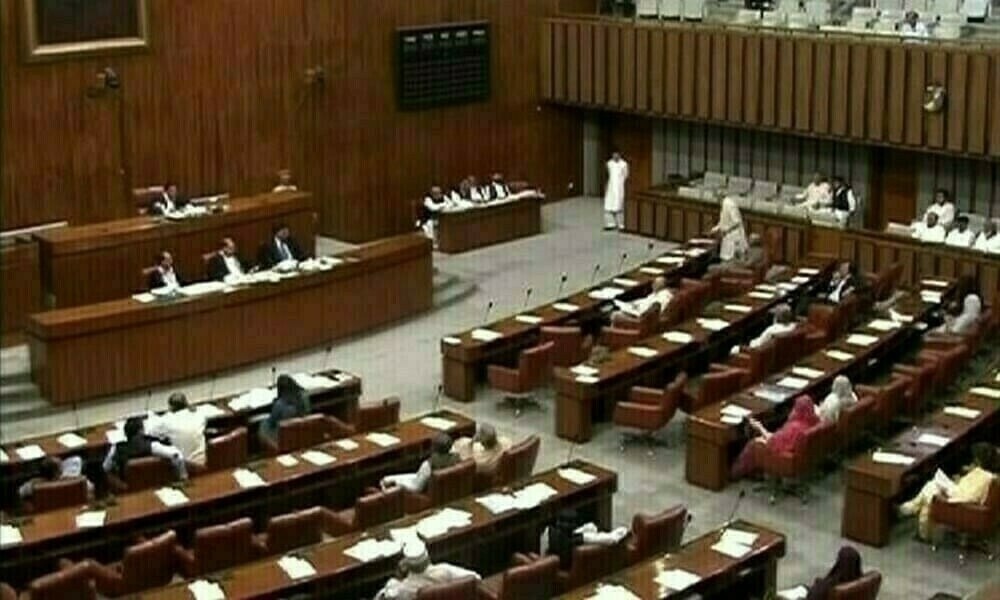

ISLAMABAD: Amidst an uproar sparked by opposition’s protests, the Upper House of Parliament on Monday finally approved the much-debated and highly contentious 27th Constitutional Amendment Bill, which grants constitutional protection to the top positions of the armed forces, establishes a federal constitutional court, permits the transfer of high court judges, and introduces several other key amendments and substitutions to the Constitution.
Presided over by Senate Chairman Yousaf Raza Gilani, the House saw a furore from the opposition lawmakers under the leadership of Allama Raja Nasir Abbas as soon as Law Minister Azam Tarar presented the bill in the Senate session.
In the 96-seat legislature, the treasury side managed to get the desired two-thirds majority by receiving 64 votes, the minimum number of votes required to secure the desired strength to sail a constitutional amendment through the House. The process of voting was carried out through the voice vote.
Finally, 27th amendment bill tabled in Senate
Gilani, being the Senate chief, could not vote on the amendment. Senator Irfan Siddiqui, who was reported to be critically ill and hospitalised, was also not present in the session.
Aimal Wali Khan, the lone Senator and head of the Awami National Party (ANP), voted for the amendment bill despite that he sides with the opposition in the Senate.
On account of the opposition’s walkout from the Senate, no vote was registered against the bill.
Two opposition senators, Saifullah Abro from the Pakistan Tehreek-e-Insaf (PTI) and Ahmed Khan from the Jamiat Ulema-e-Islam-Fazl (JUI-F), voted for the constitutional amendment bill in violation of their respective party policies, despite that the parliamentary leaders of these political parties categorically rejected the proposed law.
In a dramatic twist, Abro announced his resignation from the Senate but only after voting against his party’s policy.
“We will have you elected as a senator again,” Gilani responded to Abro’s announcement on the floor of the House.
“We are not part of this amendment—we reject this amendment altogether; from A to Z,” said JUI-F’s Parliamentary Leader in Senate, Maulana Atta Ur Rehman, who is also the younger brother of JUI-F chief Maulana Fazl Ur Rehman, before voting on the amendment began.
“Decisions are not taken here without the approval of the GHQ — decisions are made there and their drafts are shared here,” he added.
Ali Zafar, the PTI parliamentary leader in the Senate, spoke in rejection of the constitutional amendment bill a day earlier.
In an unusual instance, some members of the federal cabinet, including Aqeel Malik and Kesoo Mal Kheal Das, who are not senators, remain seated in the House when voting on the constitutional amendment began.
On the opposition’s objection, the chairman Senate directed them to leave the House immediately, which they did, and voting was started afresh by the Senate chief.
Earlier, the House adopted the report comprising recommendations of the Senate and the National Assembly’s joint law and justice panel on the 27th Constitutional Amendment. The House mainly passed the bill based on these recommendations, except for some “typo errors”, which were corrected on the request of the law minister at the voting stage.
According to the proposed constitutional amendment, the prime minister, on the recommendation of the chief of defence forces, will appoint a commander of the National Strategic Command from within the Pakistan Army. Under the amendment, any officer awarded the rank of field marshal, marshal of the air force, or admiral of the fleet will remain in uniform for life. Their ranks and privileges will also continue permanently.
The bill provides that the aforementioned three top armed forces officials, being the “national heroes,” cannot be removed from their official positions by the government. They can only be removed through impeachment by the Parliament in the light of this bill.
Furthermore, according to the proposed constitutional amendment bill, the holders of these ranks will enjoy judicial immunity similar to that of the President. Upon completion of their command tenure, the federal government may assign them any role or responsibility in the national interest.
In addition, according to the draft 27th Constitutional Amendment, a federal constitutional court will be established in the country, and the authority to transfer high court judges will be given to the Judicial Commission of Pakistan.
Equal provincial representation has been proposed in the Federal Constitutional Court. The proposed constitutional amendment states that if a judge refuses to accept a transfer, they will be considered retired.
A judge of the Federal Constitutional Court will remain in office until the age of 68. The chief justice of the Federal Constitutional Court will retire upon completing their three-year term. The President will appoint any judge of the Constitutional Court as the acting CJ.
The draft amendment further provides that neither the Constitutional Court nor the Supreme Court will have the authority to transfer any appeal or case from a high court to itself or to any other high court. The decisions of the Federal Constitutional Court will be binding on all courts in Pakistan, including the SC. All courts, except the Constitutional Court, will be bound by the decisions of the SC.
The initial judges of the Federal Constitutional Court will be appointed by the President, on the advice of the Prime Minister, and in consultation with the CJ of the Federal Constitutional Court.
Under the proposed constitutional amendment, Article 184 on suo motu notices has been removed.
The proposed law provides that no criminal proceedings can be initiated against the President for life, and no criminal proceedings can be initiated against a governor during their term. No court will be able to take action to arrest or imprison the President or a governor in accordance with this bill.
Meanwhile, the Senate meeting on Monday was scheduled at 11 am, but the House proceedings began by noon, in which business agenda items other than the constitutional amendment were taken up.
Deputy Prime Minister and Leader of the House in the Senate, Ishaq Dar, congratulated the House over what he described as “historic” passage of the bill.
He thanked allied parties and independent members for their support of the bill.
The Senate has been adjourned till Thursday.
Copyright Business Recorder, 2025
























Comments
Comments are closed for this article.