


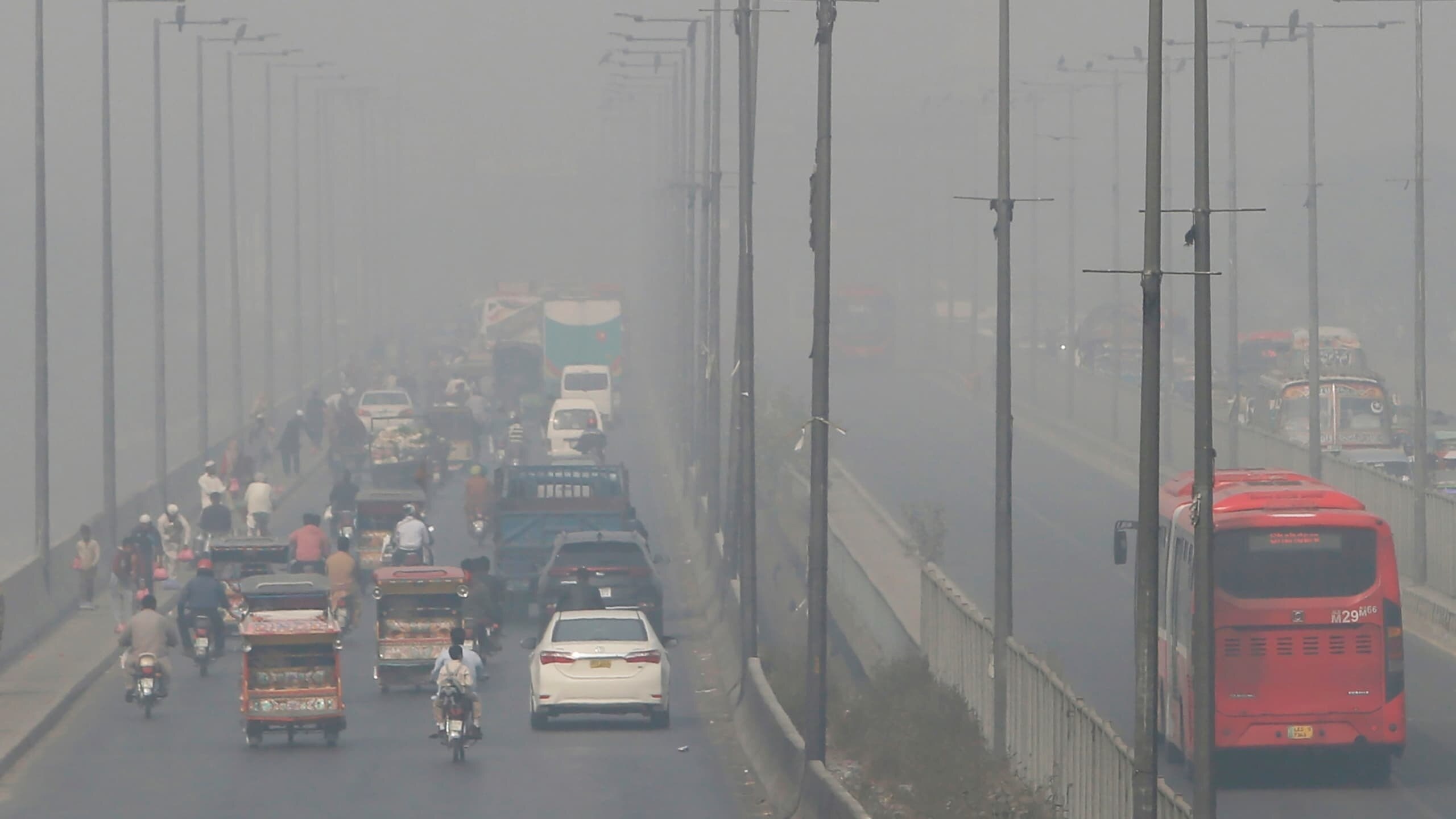
EDITORIAL: One would have expected that given the worsening air quality crisis that grips Pakistan each winter — particularly in Punjab — the country would by now have adopted a proactive, science-based approach to defining and rigorously enforcing air quality standards. The reality though remains starkly different. Even as 2024 was widely regarded as the worst smog season on record, meaningful progress is still absent.
This institutional inertia was laid bare on October 22 when the National Assembly’s Standing Committee on Climate Change was informed that Pakistan’s vehicular emission standards remain frozen at Euro-II levels, a benchmark the rest of the world moved past nearly two decades ago, with Euro-VI or equivalent standards now commonplace, including in neighbouring India.
Introduced by the European Union in the 1990s, these Euro benchmarks define progressively stricter limits on pollutants such as nitrogen oxide and hydrocarbons, making Pakistan’s continued adherence to Euro-II both outdated and environmentally untenable.
During the committee briefing, it was revealed that the Pakistan Environmental Protection Agency (Pak-EPA) — responsible for formulating the National Environmental Quality Standards (NEQS) for the entire country, and enforcing them within federal territories — remains hamstrung by severe financial and technical constraints. So limited are its means that it has to borrow air quality testing units from Punjab’s EPA, while the Capital Development Authority had to step in to finance the purchase of five more.
That a federal institution entrusted with protecting the country’s environmental health must depend on borrowed equipment and ad hoc funding arrangements is a stark indictment of official neglect. Committee chair Munaza Hassan captured the gravity of the situation when she observed that there was “no mechanism in place to check emissions or enforce compliance”.
The committee has now directed the climate change ministry to prepare a detailed plan to address air quality deterioration within four weeks, while also urging the need to strengthen the financial and institutional capacity of environmental bodies.
It is clear that Pak-EPA, which operates under the climate change ministry, must update not only vehicular, but also industrial emission standards, ensuring that revisions to the NEQS establish clear, enforceable thresholds on pollutants in line with both international benchmarks and Pakistan’s evolving environmental realities.
Equally essential is the establishment of robust monitoring and enforcement mechanisms — supported by clear, efficient funding streams for environmental bodies to help address chronic capacity constraints — at both federal and provincial levels.
Although the legal framework grants federal and provincial EPAs broad powers to act against violators, in practice they lack the autonomy and resources to do so effectively, leaving emissions poorly tracked, violations routine and accountability minimal.
Furthermore, more targeted interventions have now become imperative. Improving road infrastructure and traffic plans to ensure smoother, faster vehicular flow, mandating the retrofitting of older vehicles with modern emission-control technologies, requiring such systems in all new vehicles and transitioning to Euro-V or higher-grade fuels must anchor any credible air quality strategy. Equally essential are investments in efficient public transport systems to reduce vehicular congestion, along with enforceable measures to curb industrial emissions and crop burning, two of Pakistan’s most persistent pollution sources.
However, even these measures may only have a limited impact without a whole-of-society approach to environmental governance, rather than relying on disjointed, ad hoc fixes, like the artificial rain experiment carried out in Punjab two years ago that brought only fleeting relief.
Climate considerations must be woven into every strand of policymaking, from energy and agriculture to water management and urban planning. The current approach, marred by inadequate capacity, scarce financial resources and weak enforcement is clearly not fit for purpose, and unless reimagined with urgency and resolve, Pakistan’s air quality crisis, along with the broader climate emergency, will only deepen with each passing year.
Copyright Business Recorder, 2025























Comments
Comments are closed for this article.