


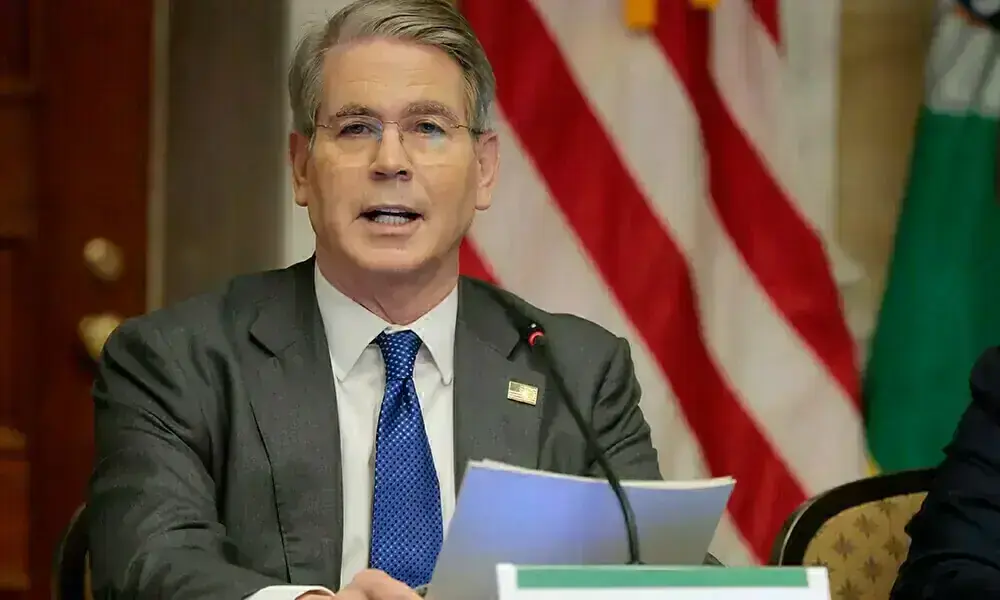

TOKYO: US Treasury Secretary Scott Bessent called for “sound monetary policy” during a meeting with Japanese counterpart Satsuki Katayama, his department said on Tuesday, in the latest swipe at the slow pace of interest rate hikes by the Bank of Japan.
The remarks briefly pushed up the yen and come ahead of the BOJ’s two-day policy meeting ending on Thursday, when markets widely expect the central bank to hold off on raising interest rates.
“Secretary Bessent highlighted the important role of sound monetary policy formulation and communication in anchoring inflation expectations and preventing excess exchange rate volatility,” the U.S. Treasury Department said in a statement.
The matter was critical since Japan’s economic conditions were substantially different from when former premier Shinzo Abe deployed his “Abenomics” stimulus measures 12 years ago, the statement quoted Bessent as saying during Monday’s discussions.
BOJ faces new political reality
The remarks have revived market expectations Washington may keep pressuring Japan to tighten monetary policy more quickly.
Japan’s finance ministry was not immediately available to comment on the U.S. statement.
Speaking to reporters after meeting Bessent on Monday, Katayama had said the two sides did not directly touch upon Japanese monetary policy.
An advocate of Abenomics, Japan’s new prime minister Sanae Takaichi has urged the BOJ to cooperate with government efforts to boost demand in remarks seen by analysts as pushing back against the central bank’s rate-hike plans.
After exiting a decade-long, massive stimulus launched as part of Abenomics in 2024, the BOJ raised interest rates twice through January, but still keeps borrowing costs at 0.5%.
Critics have blamed the slow pace of its rate hikes for weakness in the yen currency, which has become a political headache by pushing up import costs and broader inflation.
Complicating the argument, Japan’s economic revitalisation minister, Minoru Kiuchi, said on Tuesday a weak yen has benefits to the economy, signaling the administration’s sanguine view over the cost of prolonged yen declines.
Bessent’s comments come as rising costs of food and raw materials have kept Japan’s core inflation above the central bank’s 2% target for well over three years, causing some BOJ policymakers to worry about second-round price effects.
In overseeing Washington’s trade and exchange-rate talks with Tokyo, Bessent has repeatedly signalled his preference for tighter Japanese monetary policy.
The yen would find its own level if the BOJ follows “proper monetary policy” Bessent said during annual IMF meetings this month.
In August, he had said the BOJ was behind the curve in tackling the risk of inflation.
Some analysts see Washington pursuing a weak-dollar policy that would boost U.S. exports, thereby applying pressure on Japan to allow the yen to appreciate against the dollar.
While Governor Kazuo Ueda has signaled the BOJ’s resolve to keep raising rates, he has stressed the need to tread cautiously due to uncertainty over how slowing US growth and President Donald Trump’s tariffs could affect Japan’s economy.
“If Japan were to correct a weak yen, it would have to be through currency intervention or monetary policy,” said Shota Ryu, FX strategist at Mitsubishi UFJ Morgan Stanley Securities.
“But the market’s consensus is for the BOJ to next raise rates in December or January next year and, after a pause, push up borrowing costs to 1%.
It’s hard for the BOJ to increase rates to around 3% to 4%, like in Europe or the United States.“


























Comments
Comments are closed for this article.