


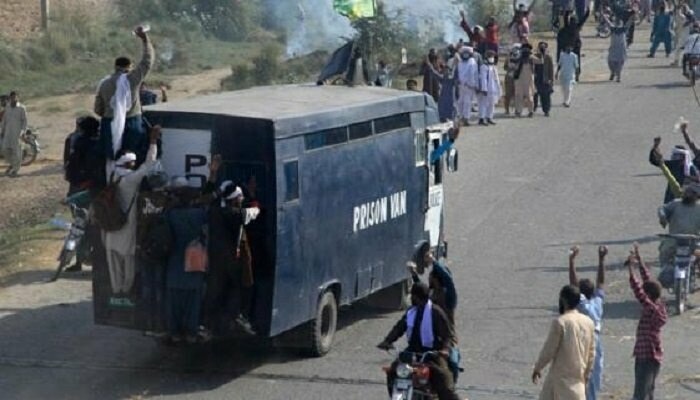

ISLAMABAD: In a decisive crackdown, the Federal Cabinet on Thursday officially declared Tehreek-e-Labbaik Pakistan (TLP) a banned and proscribed organization under the Anti-Terrorism Act, following a series of violent protests and riots organized by the party.
The approval, which came in response to urgent recommendations from the Punjab provincial government, was made during a Cabinet meeting chaired by Prime Minister Shehbaz Sharif, who convened the session to address mounting law and order concerns and the group’s escalating activities.
The Interior Ministry presented a detailed summary to the Cabinet, following an official request from the Punjab government to take action against the religious-political party, citing its continued involvement in violent and extremist actions across the country.
Senior Punjab officials, who participated in the meeting via video link, outlined the party’s long history of inciting unrest and leading destructive protests, which have resulted in both civilian and police casualties.
Founded in 2016 by fiery cleric Khadim Hussain Rizvi, TLP quickly rose to prominence with its fierce defense of the country’s blasphemy laws. Its violent tactics have repeatedly disrupted public life.
The Cabinet was briefed on a number of past violent protests organized by TLP, including the deadly 2017 sit-in at Islamabad’s Faizabad Interchange, protests against the acquittal of Aasia Bibi in 2018, and most recently, the Gaza March in October 2025.
While TLP was banned in 2021, it was allowed to resume operations after agreeing to refrain from violent protests. However, recent events—including the deadly October 13 clash in Muridke, which left one police officer dead and dozens injured—prompted renewed calls for a full ban.
The rally, initially aimed at expressing solidarity with Palestinians, quickly devolved into widespread violence, including vehicle burnings and violent clashes between protesters and law enforcement.
After reviewing TLP’s extensive history of violence, including its role in the recent riots, the Cabinet made the unanimous decision to designate the group as a proscribed entity. The Interior Ministry has been tasked with enforcing the ban, which includes freezing TLP’s bank accounts, seizing its assets, and blocking its social media presence.
All posters, banners, and advertisements associated with the party will be banned, and legal action will be taken against any violations of the Loudspeaker Act. Additionally, TLP’s leadership will be placed under the Fourth Schedule of the Anti-Terrorism Act (ATA) of 1997, which imposes stringent restrictions on individuals linked to terrorism.
The Cabinet also approved a recommendation to refer TLP leaders and workers involved in the violence to Anti-Terrorism Courts (ATCs) for trial.
The decision follows the tragic events in Muridke, where TLP protesters clashed violently with law enforcement, resulting in the death of one station house officer, injuries to 48 police officers, and several civilian casualties.
TLP first gained attention for its hardline stance on religious issues, particularly its vocal opposition to blasphemy law reforms. Despite the controversy surrounding its protests, the party’s growing political influence was demonstrated in the 2024 general elections, where it emerged as the third-largest party in Punjab, securing nearly 2.9 million votes.
Under the leadership of Saad Hussain Rizvi, the son of the late TLP founder Khadim Hussain Rizvi, the party has extended its political reach, especially in Punjab. However, as TLP’s political influence has expanded, so too has its reputation for inciting chaos and unrest, culminating in the deadly clashes earlier this month.
Copyright Business Recorder, 2025




















Comments
Comments are closed for this article.