


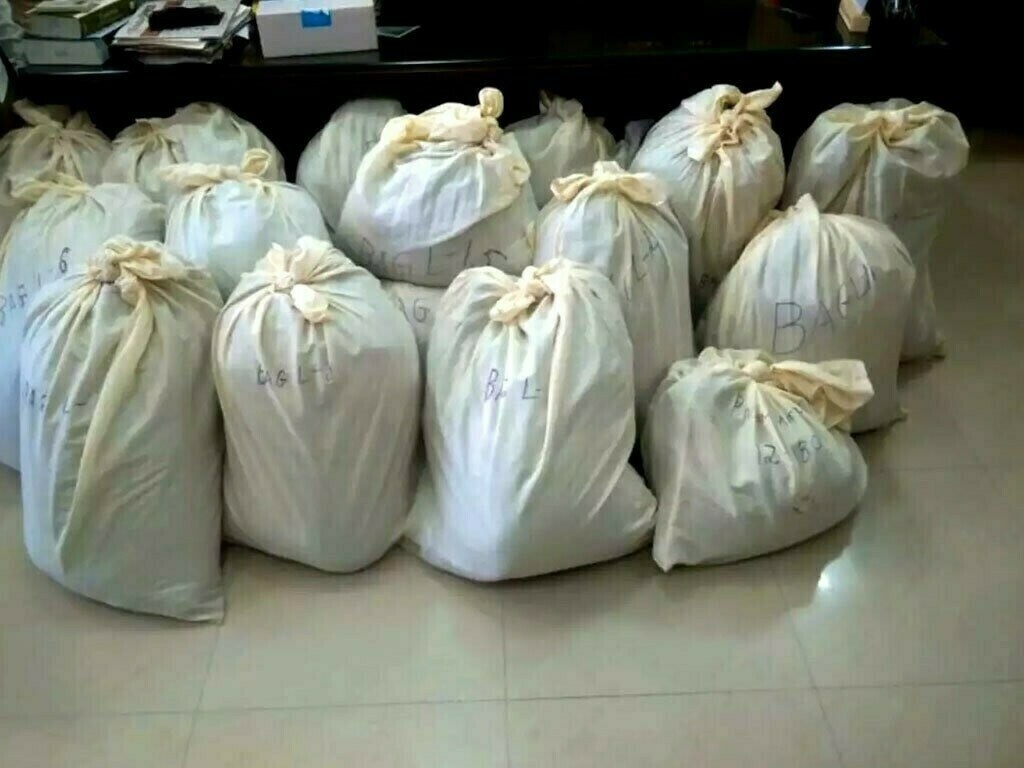

KARACHI: Local markets are flooded with smuggled Indian Gutka and illegal betel nuts, resulting in an annual revenue loss of nearly Rs100 billion, allegedly due to the complicity of customs officials, according to an extensive BR survey.
“The betel nut mafia is being supported by senior customs officials,” customs sources told on condition of anonymity, alleging that these officials are responsible for import documents manipulation and lax enforcement to allow health-hazardous smuggled betel nuts, especially in Karachi.
More than 650 containers of betel nuts are reportedly being smuggled every month, while official data shows merely 50 containers are being imported each month - a gap that has raised alarm about ‘systemic failures’ in the enforcement and possible corruption within Pakistan customs.
The last significant seizure was in July 2025, but since BR started working on the story, the Collectorate of Customs Enforcement in Karachi has made about four seizures in just a week, confiscating smuggled diesel, fabric, and betel nuts.
However, the illicit trade of smuggled betel nuts costs the cash-strapped government nearly Rs 6 billion monthly and around Rs 72 billion in revenue loss a year, when Pakistan grapples with a chronic fiscal crisis, mounting external debt, and pressure from international lenders to expand its narrow tax base.
The megacity, Karachi, hosts 14 large-scale sweet Supari factories besides approximately 200 smaller manufacturing units, supplying products throughout Sindh and beyond. Yet the survey found tax records for only one registered factory.
Despite being a household name and being sold at every shop across the city, this registered company has been filing ‘nil’ sales tax returns for several consecutive months.
The situation with unregistered manufacturers is even more troubling. All top 13 major Supari manufacturers operate without sales tax registration, despite their products being widely available across the megacity.
Collectively, these sweet Supari factories account for approximately 50 containers worth of betel nut consumption monthly, yet have no import documentation.
“These are not small street operations - these are established brands with wide distribution networks,” said tax consultants. “Yet they operate completely outside the tax system. If all these Supari brands are brought into the tax net, the FBR could easily generate nearly Rs. 20 to 30 billion annually in sales tax.”
The stark discrepancy between legal imports and actual consumption becomes more evident when examining ground realities in Karachi, Pakistan’s commercial capital and port city, where the betel nut trade flourishes.
The sprawling metropolis of nearly 40 million people has some 300,000 Paan shops and kiosks selling Paan, chewing tobaccos, cigarettes, Supari products, etc, showing the scale of an underground economy operating in plain sight.
District Central alone operates nearly 70,000 Paan shops, cabins, carts, and kiosks, while District West hosts between 75,000 and 80,000 outlets. Districts South, East, Malir, and Gadap collectively account for approximately 150,000 such outlets, the survey said.
Field surveys across all these districts revealed that each shop sells approximately three boxes of sweet Supari and three to five boxes of tobacco-based Supari daily. This consumption pattern translates into staggering volumes when multiplied across the city.
Factory workers interviewed during the survey said that an estimated 12 boxes of Supari contain one kilogram of betel nuts, meaning Karachi consumes some 200,000 kilograms of betel nuts daily just through these retail Paan outlets, which is equivalent to around seven containers of betel nuts a month or around 214 containers monthly. “Each shop is selling these products openly, yet there’s no corresponding import data to match this consumption,” the sources said.
The survey employed a more detailed betel nut consumption analysis in Paans to expose the gap between official figures and ground reality through betel leaf consumption.
The customs import data shows approximately 300,000 kilograms of betel leaf imported monthly, primarily for upcountry consumption. Additionally, domestic cultivation in Sindh province’s Thatta, Badin, and other districts produces around 100,000 kilograms of betel leaf daily for Sindh, particularly Karachi consumption, totalling approximately 3.3 million kilograms monthly.
It was revealed that approximately 1.25 kilograms of betel nuts are required per kilogram of betel leaf used in traditional Paan preparations. This ratio translates to 4.12 million kilograms of betel nuts needed monthly just for Paan consumption, which is equivalent to 147 containers of betel nuts per month.
Yet customs data shows an average of only 50 containers being imported monthly over the past two years, which is not even enough to meet Paan customers’ requirements, alone.
The consumption figures escalate dramatically when accounting for Gutka and Mawah products, which have become increasingly popular even though oral cavity cancer is now the most widespread cancer in the country.
Surveys conducted at major dental hospitals across Karachi disclosed that over 500,000 people in the nearly 40 million population of the city regularly consume gutka/ mawah, with each packet containing between 50 and 75 grams of betel nuts. “We see patients daily with oral health problems linked to gutka/ mawah consumption,” said M Rizwan, a dental surgeon at a major Karachi hospital. “The scale of consumption is enormous,” he added.
The survey disclosed the average consumption estimated at three packets per person daily, which alone accounts for 40 containers daily or 120 containers monthly, a figure that excludes casual or occasional consumers.
When the 147 containers used in Paan preparations and 214 containers consumed through sweet and tobacco Supari are added to the 120 containers for gutka products, Karachi’s monthly requirement reaches over 450 containers of betel nuts, excluding consumption in Punjab, Khyber Pakhtunkhwa, Balochistan, and other parts of Sindh.
“Pakistan’s actual monthly consumption stands at approximately over 650 containers when you factor in upcountry demand,” the survey showed, based on field research across Karachi’s six districts and interviews with factory workers, distributors, shop owners, and customs sources.
With only 50 containers being imported officially, over 450 containers are being smuggled monthly in Karachi under the very nose of the Collectorate of Customs Enforcement, say the sources.
The investigation into Karachi’s Supari manufacturing sector disclosed another layer of regulatory failure that compounds the smuggling problem. Sources within the customs department provided disturbing insights into how the smuggling network operates with such brazen efficiency.
The betel nut mafia allegedly enjoys active support within the department, facilitating the ‘systematic’ manipulation of essential import documents needed to clear goods through customs, sources said. “The minimal legitimate imports provide cover for the massive quantities of smuggled products,” they added.
“If any betel nut consignments were stopped in the past, they are now being released under auction. However, health-hazardous betel nuts cannot be auctioned but destroyed under the laws,” the sources said.
This arrangement allows smugglers to operate on an industrial scale while maintaining plausible deniability through a small stream of legal imports that create the appearance of normal trade.
Meanwhile, customs enforcement through its official statement defended the department’s performance by citing increased legal imports from 2.1 million kilograms in the 2022-23 fiscal year to 6.5 million kilograms in 2023-24, reaching 18 million kilograms in 2024-25, raising the question: how this demand was being met in the past.
Moreover, the official statement said that the department had detained 140 conveyances, including private vehicles and rickshaws. In the first quarter of FY 2025–26, 90,000 kilograms of betel nuts were seized.
However, the survey findings suggested such seizures represent only a fraction of the actual smuggling volumes, with the gap between official imports and documented consumption widening dramatically despite the claimed enforcement successes.
The official statement also quoted the Economic Census 2023, saying that: “approximately 695,000 establishments are there in the ‘wholesale and retail trade’ category. Karachi, representing around 36 percent of Sindh’s population and about 70 percent of its urban base, would thus have between 250,000 and 475,000 retail outlets of all types. Even assuming that 2–4 percent of these outlets are Paan shops, the realistic number would range between 9,000 and 19,000 — not 300,000 as claimed”.
This report didn’t mention the number of kiosks, cabins, and carts, where major sales of betel nut products are done. But if we assume they are 19000, as given by customs enforcement as exact number of Paan shops, even then the consumption of betel nuts in Karachi is around 150 containers a month against an average monthly import of 50 containers for the whole country, confirming the failure of the customs enforcement department to avert the smuggling of 2.8 million kilograms every month or 100 containers of betel nuts only into Karachi.
Apart from betel nuts and their consumption, the customs enforcement has also appeared toothless in stopping the influx of Indian smuggled chewing tobaccos into Pakistani markets, which are openly being sold across the city.
“Customs authorities collect approximately Rs. 9.1 million in duties and taxes per betel nut container under defined customs tariffs. With 650 containers being smuggled monthly, the direct revenue loss amounts to around Rs6 billion per month, accumulating this haemorrhage to Rs100 billion a year, including Rs72 billion revenue loss due to smuggling and nearly Rs30 billion when accounting for sales tax, income tax, and other levies that would be collected if the trade were legal and properly documented,” tax consultants said.
Beyond the fiscal implications, the unfettered smuggling of betel nuts poses serious public health risks in a country where betel nut products are widely consumed despite medical warnings.
Health-hazardous betel nuts cleared through document manipulations find their way to millions of consumers across Pakistan. The World Health Organization has classified betel nut as a Group 1 carcinogen, linking it to oral cancer, oesophageal cancer, and other serious health conditions.
“We’re seeing increasing cases of oral sub mucous fibrosis, precancerous lesions, and oral cancers, particularly among gutka/ mawa users,” said the Karachi dental surgeon. “The products flooding the market are not properly tested or regulated,” he added.
In Karachi, different varieties of sweet and tobacco-based Suparis are sold at virtually every street corner, from upscale neighbourhoods to working-class areas.
The addictive properties of betel nuts, especially when combined with tobacco, ensure steady demand despite health risks, making it a lucrative target for smuggling networks.
Despite having access to consumption data, manufacturing records, retail distribution networks, and trade patterns, the customs enforcement has apparently failed to connect obvious dots or take meaningful action against betel nut smuggling.
The fact that 300,000 shops openly sell products derived from smuggled betel nuts, while major manufacturers operate without registration or tax compliance, suggests either catastrophic institutional incompetence or systemic corruption.
“This isn’t about sophisticated smuggling techniques or hidden operations,” said a trade policy expert who requested anonymity. “This is about bulk smuggling happening particularly in a port city with apparent official facilitation.”
The scale of the betel nut smuggling, over 650 containers monthly, would require systematic circumvention of multiple checkpoints, raising questions about how such volumes could move without official knowledge or complicity.
Copyright Business Recorder, 2025

























Comments
Comments are closed for this article.