


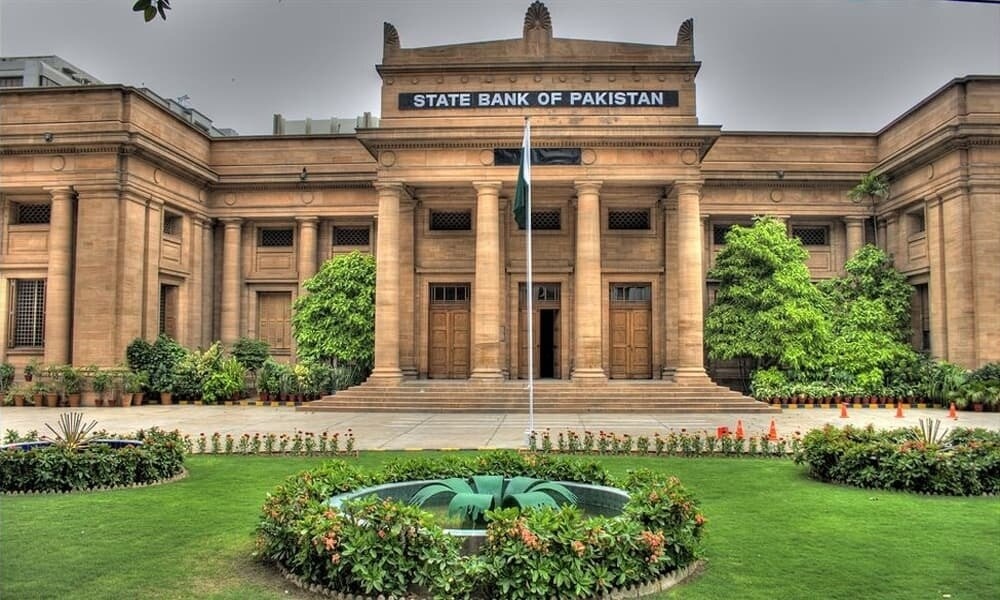

KARACHI: The State Bank of Pakistan (SBP) said on Friday that it is remains vigilant and closely monitoring emerging economic risks and incorporating them into its policy decisions to safeguard price and financial stability, which it termed vital for achieving sustainable economic growth.
According to the Governor’s Annual Report (GAR) for FY25, released by the State Bank of Pakistan (SBP), Pakistan’s macroeconomic conditions strengthened further in FY25, supported by a prudent monetary policy stance and sustained fiscal consolidation that led to a sharp drop in National CPI (NCPI) inflation. Meanwhile, the financial system remained resilient and real GDP growth edged higher.
GAR is published under Section 39 (1) of the SBP Act, 1956 (as amended up to January 2022), that mandates the Governor to submit an annual report to the Majlis-e-Shoora (Parliament) regarding the Bank’s objectives, the conduct of monetary policy, and the state of the economy and the financial system.
Pakistan’s GDP to grow 3.25-4.25% in FY26, says SBP governor
Recognising the recent reforms, such as taxation and customs tariff reforms; deregulation of agricultural commodity market; and gradual withdrawal of untargeted subsidies, the report emphasises the need for steadfast implementation of structural and governance reforms for sustaining price and financial stability.
In addition, pointing to challenges stemming from global tariff policy shifts in 2025, and the domestic 2025 floods, GAR FY25 assures that SBP remains vigilant, closely monitoring the evolving risks and factoring them into its policy decisions to safeguard price and financial stability, both of which are essential for achieving sustainable economic growth.
According to the report, the dis-inflationary trend that began in FY24 became more pronounced during FY25.
Average National CPI inflation dropped sharply to 4.5 percent from 23.4 percent in FY24 and 29.2 percent in FY23. The report notes that the decline was broad-based, with food inflation contributing the most due to improved availability of food commodities in the domestic market and lower international food prices.
Energy inflation also decreased substantially that benefited from downward adjustments in administered energy tariffs amid softer global oil prices. Core inflation nearly halved, reflecting contained domestic demand, anchored inflation expectations, and the easing of second-round effects from previous years’ shocks to food and energy prices.
The report highlights that, responding to the improved inflation outlook; the Monetary Policy Committee (MPC) reduced the policy rate by a cumulative 1,100 basis points between June 2024 and June 2025.
However, it notes that due to lingering uncertainties, including sticky core inflation during H2-FY25, evolving global trade tariffs, rising geopolitical tensions, and volatility in administered energy prices, the MPC slowed the pace of monetary easing in the second half of FY25.
This measured stance facilitated a notable expansion in private sector credit and supported a gradual recovery in economic activity, especially in the latter part of the fiscal year. With the fiscal deficit narrowing to a multi-year low of 5.4 percent of GDP, and the primary surplus more than doubling to 2.4 percent, fiscal consolidation supplemented the monetary policy stance to help bring inflation down, the report said.
The GAR FY25 also notes the significant improvement in the external sector, with the current account balance (CAB) posting a surplus for the first time in over fourteen years.
The CAB surplus, combined with increased financial inflows following the IMF’s Extended Fund Facility programme, enabled SBP to conduct significant foreign exchange purchases from the interbank market that strengthened foreign exchange reserves, and enhanced FX market stability.
Regarding the SBP’s objective of maintaining the stability of the financial system, the report highlights the resilience of Pakistan’s financial system, noting that the banking sector exhibited stability across all major indicators and saw further improvements in solvency metrics.
The adoption of IFRS-9 since January 2024 strengthened banks’ risk management frameworks and enhanced their loss-absorption capacity. Banking sector assets expanded to nearly 52.4 percent of GDP, up from 49.1 percent in FY24.
The GAR FY25 outlines several steps taken by the SBP to support the government’s economic goals, including reforms in exchange companies and measures to boost workers’ remittances through bank incentives and Diaspora outreach. It also notes initiatives to facilitate exporters, especially in the IT sector, by allowing higher retention limits to encourage reinvestment and innovation.
The report highlights major progress in digital payments, including the creation of Raast Payments Pakistan (Pvt.) Ltd., launch of the PRISM+ settlement system, introduction of a Regulatory Sandbox for payment innovation, and wider digitization of government payments and acceptance solutions nationwide.
The report also discusses the launch of the National Financial Inclusion Strategy 2024-28, which aims to further raise financial inclusion to 75 percent and reduce the gender gap to 25 percent by 2028. It notes that initiatives, such as the National Financial Education Roadmap 2025-29, continued implementation of the Banking on Equality policy, and targeted measures for Islamic banking, agriculture, and SME financing, further advanced financial inclusion in FY25.
Copyright Business Recorder, 2025


























Comments
Comments are closed for this article.