


Privatisation of PIA, airports: Saudi Finance Minister briefed
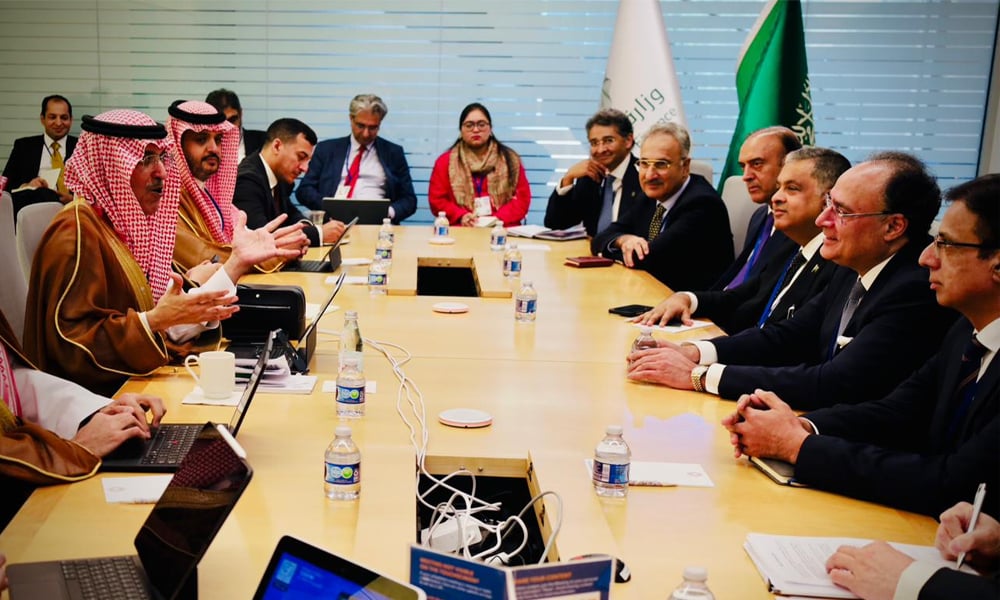

ISLAMABAD: Finance Minister Muhammad Aurangzeb has met with his Saudi counterpart Mohammed Al-Jadaan in Washington DC and briefed him on the privatization of the state-owned Pakistan International Airlines (PIA) and airports as Islamabad seeks “strategic investments,” the finance ministry said on Thursday.
The meeting between Aurangzeb and the Saudi finance minister took place on the sidelines of the World Bank and International Monetary Fund (IMF) annual meetings, where he has held a number of engagements with finance officials and business leaders from various countries and institutions.
The cash-strapped South Asian nation is looking to privatize the debt-ridden PIA to raise funds and reform loss-making, state-owned enterprises as envisaged under a $7 billion International Monetary Fund (IMF) program.
The Saudi and Pakistani finance chiefs reviewed their growing trade and investment relations, with Aurangzeb reaffirming Pakistan’s commitment to economic reforms under the IMF program to ensure long-term macroeconomic stability.
“He apprised his Saudi counterpart of the ongoing privatization process of Pakistan International Airlines (PIA) and key airports, underscoring the Government’s resolve to attract strategic investments through transparency and efficiency,” the finance ministry statement said.
“The two Ministers agreed that institutions such as the International Finance Corporation (IFC) and the Multilateral Investment Guarantee Agency (MIGA) could play a vital role in mobilizing and de-risking private sector investments in Pakistan.”
Senator Aurangzeb also sought Saudi support for infrastructure development projects, emphasizing Pakistan’s commitment to fostering a deeper economic partnership with the Kingdom, according to the statement.
Saudi Arabia has long been a pillar of Pakistan’s external financing and household income mix. The Kingdom is home to over two million Pakistani expatriates, who are the largest source of remittances to the South Asian country. In Sept, both countries signed a landmark defense pact and are now exploring new economic opportunities.
This week, Aurangzeb met the CEO of the Saudi Fund for Development (SFD) Sultan Abdulrahman Al-Marshad to reaffirm Pakistan’s strategic partnership with the Kingdom, according to the Pakistani finance ministry.
The discussions covered infrastructure priorities, notably the M-6 highway and the ML-1 railway line upgrade, as well as skills development and digital infrastructure, areas aligned with Pakistan’s broader push to improve logistics, productivity and public service delivery.
The SFD, for its part, highlighted ongoing health, hydropower and transport initiatives in Pakistan. The Fund says it has financed more than 18 development projects and programs worth about $1.2 billion, alongside over $533 million in grants since 1976.


























Comments
Comments are closed for this article.