


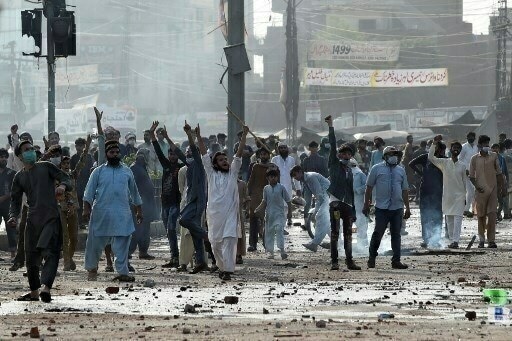
EDITORIAL: The violent confrontation in Muridke, on the outskirts of Lahore, between Tehreek-e-Labbaik Pakistan (TLP) activists and law enforcement agencies is a stark reminder of the dangers of legitimising extremist religious groups in the political mainstream.
What was presented as a march to show solidarity with Palestinians in Gaza quickly devolved into pitched battles with the Punjab police and Rangers. Main roads to Rawalpindi and Islamabad were blocked and public transport was suspended, bringing life to a standstill and causing immense hardship to citizens. Several TLP activists were reportedly killed, and many police officers were critically injured.
The TLP’s justification — solidarity with the Palestinian cause — is both ill-timed and politically motivated. A ceasefire was already in place following Israel’s brutal military campaign, and key diplomatic efforts were underway, including a summit in Egypt attended by leaders from 20 countries, including Pakistan.
Far from contributing to the Palestinian cause, the TLP’s actions seemed more geared toward regaining political relevance through confrontation and chaos. This, though, is neither new nor surprising. The TLP has a history of exploiting religious sentiment to incite violence, destabilise governments, and target minority communities.
It staged disruptive, violent, protests against two successive elected governments and has been involved in attacks on minority communities, setting fire to an entire Christian neighbourhood in Jaranwala, attacking others’ places of worship, and resorting to mob lynchings — all of which have gone largely unpunished.
Although the group was briefly banned for its violent activities, it was soon brought back into the political fold — not through reform or renunciation of extremism, but through the intervention of certain non-political forces.
The TLP was allowed to register as a “normal” political party with the Election Commission of Pakistan, and names of several of its activists were removed from the Fourth Schedule, a legal mechanism designed to monitor individuals with suspected links to terrorism. These actions effectively mainstreamed a group with a track record of violence and hate speech.
This pattern reflects a deeper problem. Time and again, extremist groups have been nurtured or appeased for short-term strategic or political gains, only to see them turn on the very forces that empowered them. The present situation is also a result of the state’s long-standing reluctance to draw a firm line between political dissent and militant extremism.
The current crackdown, however, appears more decisive than in the past, likely due to the group’s insistence on staging protest demonstration at a highly sensitive diplomatic facility in Islamabad. Yet reactive force alone is not enough. What’s needed is a fundamental shift in policy: a clear commitment to ending the use of religion as a tool for political manipulation and a refusal to appease violent actors, regardless of their ideological cover.
Copyright Business Recorder, 2025




















Comments
Comments are closed for this article.