


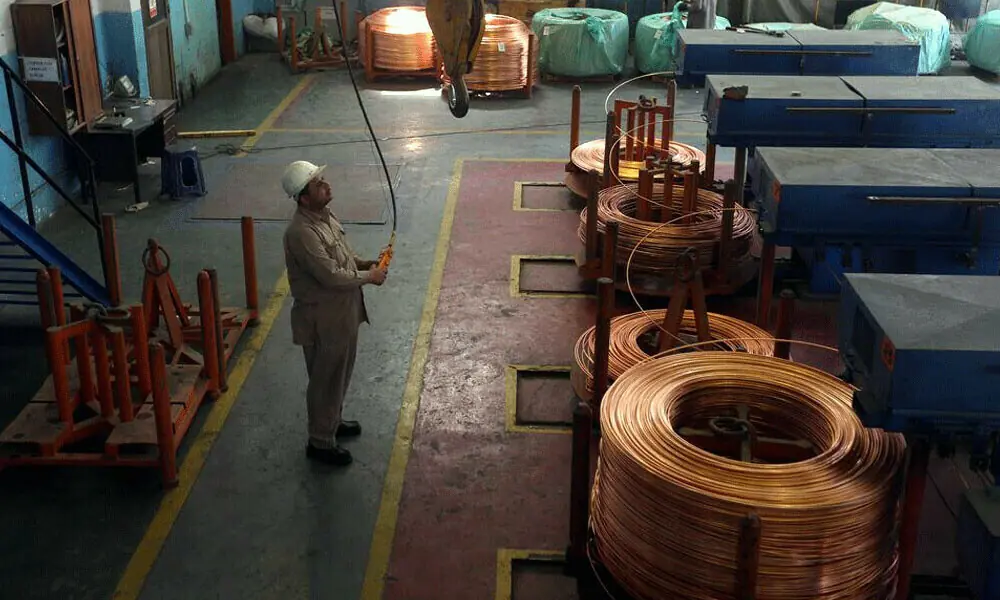

It has been reported that the mineral wealth of Pakistan is estimated at $ 7 trillion mainly because it remains untapped. When I completed my master’s programme at University of Arizona (U of A) College of Mines the copper mining industry was booming there. The metal was on top of the Five Cs of the state (Copper, Cactus, Cotton, Canyon, Climate). Gradually, the mines were depleted, and recovery of residual metals started.
Briefly for my Doctoral Research, I worked on a process called ‘Mahalla Cell’, which was developed to recover Copper from the mine waste waters through cementation. Most mines are now closed with several ‘Ghost Mining Towns’ where the miners once worked and lived.
On my return home in the year 1992, I had the chance of working as a consultant on Saindak Copper Gold project which was the first large-scale commercial mining effort started by the government of Benazir Bhutto. At Rs 16 billion it was the largest public-sector undertaking in the country. MCC (Metallurgical Corporation of China) the contractor came with an investment of $ 500 million. It was planned as a turnkey project to be completed and handed over in August 1995.
Unfortunately, the opportunity was badly squandered mainly because of mismanagement, incompetence and corruption. After completing the site visit, a de-briefing session was held at the head office of Saindak Metals Limited (SML) presided by the Managing Director (MD) in Quetta on December 30, 1992. Sensing the impending challenges that lay ahead, the following recommendations were made: 1. Immediate formation of a co-ordination group between SML & MCC for daily operations review. 2. Appointment of a Deputy Project Director (PD) at site. 3. Both monthly and quarterly progress reviews at site. 4. MCC to present basic engineering details for discussion and review. 5. Fully functional laboratories at Saindak for extensive lab scale testing. 6. Development of a transfer of technology package that includes training, hiring and consumables. 7. Formation of a task force to address water and power issues. 8. Joint efforts to improve communications 9. Seminars to introduce concepts of Project Management. 10. Financial powers to be delegated to the PD posted at site. Only two recommendations were implemented (2, 10).
Despite my efforts to save the project in best long-term national interests it was handed over to the contractor who has been mining there since then. Recently, a ten-year extension has also been granted till the entire deposit is totally depleted with tailings left behind.
Initially, the concentrate was shipped to China for finishing followed by local smelting. Leaving Copper aside at least we should be able to calculate the Gold and Silver that has been shipped out since 1998 and demand our fair share. In future, Gold and Silver should be tracked and kept in State Bank of Pakistan (SBP) vaults to be utilized for nation-building.
Value-addition is the name of the game. Producing and then shipping concentrates robs the nation of its mineral wealth. Most mining companies in the USA, South America, China have integrated units where the entire value-chain is covered from mining to refining.
In the decade of the fifties and sixties there was focus on developing the mineral sector in the country. PCSIR Lahore established a Metals & Mineral Centre, which was manned by highly qualified researchers but unfortunately as no major project was launched in the country the entire effort fizzled out.
As Chairman Pakistan Science Foundation (PSF 2002 - 2005) I launched several projects to fully exploit the mineral wealth of the country, which included Production of Iron from Kalabagh Iron Ore; Pilot Scale Studies for production of Directly Reduced Iron utilizing Chiniot, Chichali, Nokundi Iron Ores; Development of Spring Steel; Development of Special Steels in Pakistan; Use of Indigenous Iron Ores in Pakistan Steel Mills; Development of up-country Steel Mill based on Chiniot deposit; Pilot Study for production of Ferro Chrome; Development of Waziristan Copper deposits; Mining of Thar Coal; and Gold Metallurgy Lab in Chitral.
Around the year 2004, I received a request from the Prime Minister (PM) Secretariat to revisit the abandoned Kalabagh Iron deposit. In the decades of fifties and sixties Krupp Wren process was used to produce Iron from this ore. The project was later shelved. In the seventies Steel Mill was established at Port Qasim based on imported Iron Ore and Coal. PCSIR Lahore centre succeeded in producing Iron Luppens from the ore.
They were able to upgrade the Iron contents to about 80%, making it useable in Electric Arc Furnace. A pilot plant is needed to establish the process for large scale processing. While the Iron Ore in Kalabagh is easily mineable, the Chiniot deposit is under the city for which tunnel mining will be needed.
Both are ready to make Pakistan self-sufficient in meetings its need of Iron and Steel, which is currently being met through imports. While 5 to 7 MTPY (Million Ton per Year) of steel and 0.5 MTPY of Copper is being currently imported by selling the proverbial ‘family silver’ through export of unfinished concentrates.
Australia has a huge mining sector. BHP Mining has projects worldwide; they were the first to reach Reko Diq before Tethylan Copper Company came. The current stake holder Barrick Gold of Canada was a partner in this venture with Antafugusta Copper Company of Chile which pulled out. RDMC (Reko Diq Mining Company) is now jointly owned (RMDC 50%, GOP 25%, GOB 25 %).
Our share of the concentrate should be processed and finished locally. Copper refining is energy intensive which can be done with inexpensive power being generated at Thar. Gold and Silver can be separated through several available technologies. Australia has set up CFCs (Common Facilities Centres) all over the country depending on the available minerals.
Copper CFC can be established at Koh-e-Taftan where Reko Diq is located, Iron CFC at Chiniot, Gold at Chitral/Peshawar, Coal at Thar. Indeed, the mineral sector can be a game-changer for Pakistan provided it is managed well by professionals.
These are long-term high value projects which require careful planning and effective strategy for maximizing the returns for the nation; otherwise, the Islamic Republic of Pakistan and its people will languish in poverty like our brothers in suffering living in the mineral rich African continent.
Copyright Business Recorder, 2025
The writer is an ex-Chairman Pakistan Science Foundation; email: [email protected]






















Comments
Comments are closed for this article.