


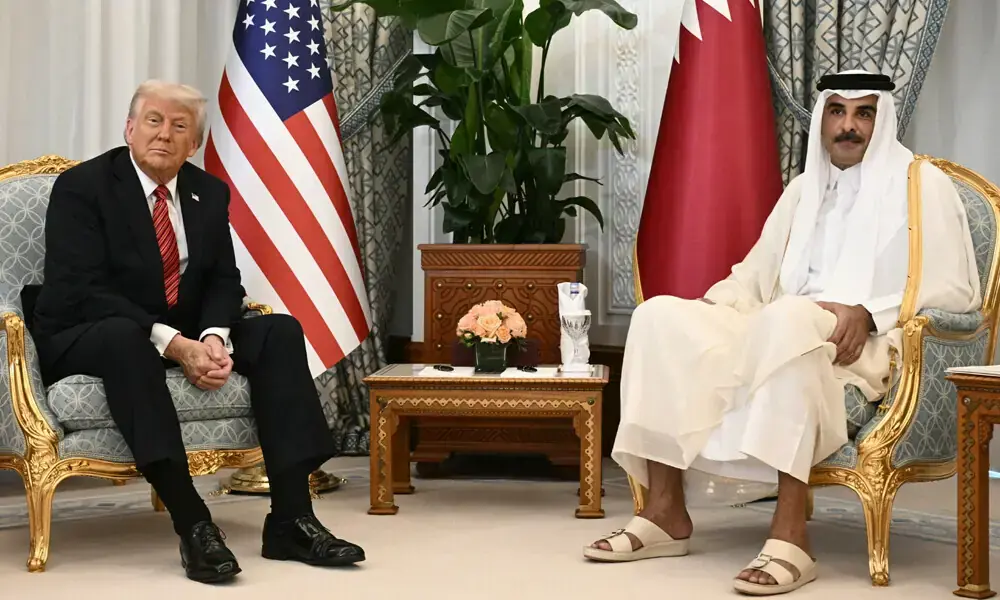

DOHA: US President Donald Trump signed an executive order this week vowing to defend Qatar against attacks, following Israeli air strikes targeting Hamas leaders in Doha.
The security assurance from Washington is unprecedented for an Arab ally and is seen as both a boon for key Gaza mediator Qatar and a rebuke to Israel.
Here we unpick what it means for Qatar, the Gulf and Israel:
The order says “the United States shall regard any armed attack on… Qatar as a threat to the peace and security of the United States”.
It says the US will take “all lawful and appropriate measures — including diplomatic, economic, and, if necessary, military — to defend the interests of the United States and of the state of Qatar” if it is attacked.
For Andreas Krieg, a senior lecturer at King’s College London, the directive “turns attacks on Doha into problems for Washington”.
“For the region, it restores a measure of deterrence but leaves the United States with ample discretion over how to act,” he added.
Elizabeth Dent, a senior fellow at the Washington Institute think-tank, noted that executive orders, unlike Senate-ratified treaties, are non-binding and can be overturned.
“While the language is much stronger than anything we’ve seen for Qatar (and frankly most countries in the Middle East)… it is largely unenforceable and likely intentionally vague,” said Dent, a former director for the Gulf and Arabian Peninsula in the Office of the US Secretary of Defense.
Qatar is a key US ally that hosts the region’s largest American military base, Al-Udeid, and its leadership is close to Trump.
It has been attacked twice recently — first in June, when Iran targeted Al-Udeid, and then last month when Israeli strikes targeting Hamas leaders killed six people including a Qatari security officer.
The latest attack triggered outrage from Qatar and its Gulf neighbours, which lean heavily on the United States to preserve their security.
Trump’s order has given Qatar “a major diplomatic and strategic win”, said Dent, adding that “it also signals the value the US places on Qatar’s role as a diplomatic negotiator”.
The same day the order was signed, Trump held a three-way call where Israeli Prime Minister Benjamin Netanyahu expressed regret to Qatari Prime Minister Sheikh Mohammed bin Abdulrahman Al Thani and promised no further strikes.
Qatar then resumed its mediation role in the Gaza war and Trump announced a new plan for the Palestinian territory, which Hamas officials are currently reviewing.
The security guarantee reinforces Qatar’s “unique position in the region”, Dent said, referring to its mediation with US foes including Hamas, Iran and the Taliban government in Afghanistan.




















Comments
Comments are closed for this article.