


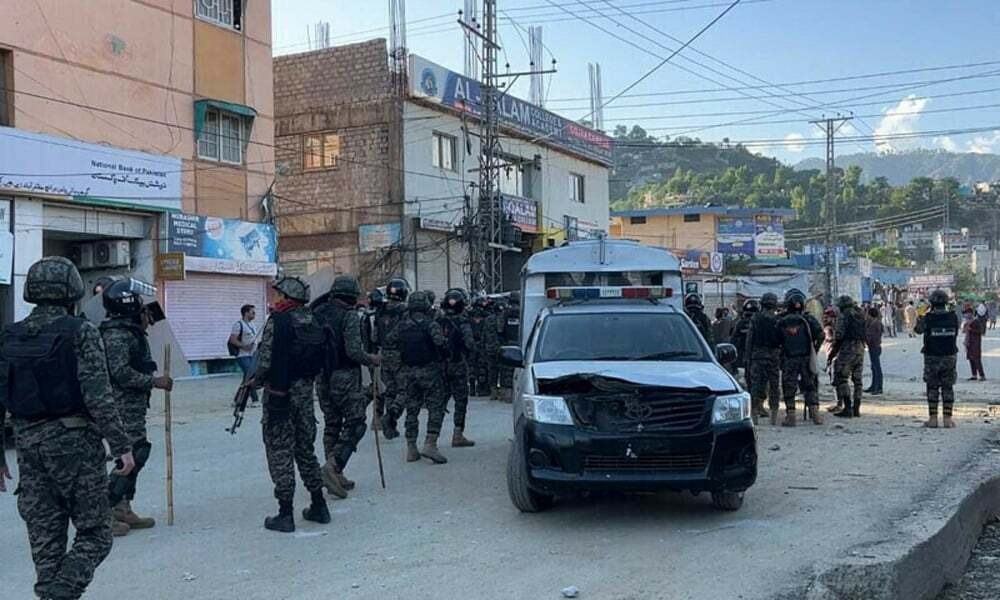
EDITORIAL: The ongoing unrest in Azad Jammu and Kashmir (AJK) has taken a tragic and deeply concerning turn, with nine people — including three policemen — killed in violent clashes between protesters and law enforcement personnel.
The protests, led by Joint Awami Action Committee (JAAC) of Azad Jammu and Kashmir, began as a largely peaceful movement, but the authorities’ use of counter-demonstrations and police force has triggered a cycle of violence and confrontation.
In response, more people have taken to the streets, burning bushes and erecting roadblocks to express their anger over the killings and the government’s failure to address their core demands.
Tensions escalated last week after negotiations between the JAAC, the AJK government, and federal representatives broke down. The JAAC has since accused the government of favouring an entrenched elite, while ordinary citizens continue to suffer under mounting economic pressures.
The JAAC’s criticism of “elite privileges” resonates widely, as many in the region view the ruling coalition as a bloated, unaccountable, and out of touch political class benefiting from state resources while the broader population struggles with rising costs, unemployment, and inadequate public services.
A major contention in the current crisis is the issue of reserved seats in the AJK Legislative Assembly for so-called ‘refugees’ from Indian-occupied Jammu and Kashmir who do not reside in AJK.
Prime Minister Chaudhry Anwarul Haq claimed in a recent press conference that 90 percent of the protesters’ demands had been accepted and that judicial reforms could also be implemented through legislation.
However, these assurances have failed to de-escalate tensions, as the most contentious issue — the refugee seats — remains unresolved.
The prime minister said there is a “deadlock” over the matter, arguing that the reserved seats “cannot be abolished in the context of the Kashmir freedom movement” — a justification that has few takers.
In contrast, the JAAC’s position is clear and based on democratic principles. While acknowledging that refugees living elsewhere in Pakistan should retain the right to vote in AJK elections, the Committee rightly argues that only those residing in AJK, whether locals or refugees settled within its territory, should be eligible to represent the region in the assembly.
Representation must be rooted in a direct connection with constituents. Allowing individuals who live outside AJK to occupy legislative seats not only undermines this principle but also reinforces the perception that the system is designed to safeguard the privileges of political elite.
The government in Muzaffarabad must listen to the voices on the streets and refrain from further use of force. The current crisis reflects a deeper disconnect between the ruling class and the people it purports to represent — a gap that cannot be bridged through coercion or token measures.
A durable solution demands honest and inclusive dialogue that addresses the socio-political roots of public discontent. Only through genuine negotiations can lasting peace and stability be restored in the region.
Copyright Business Recorder, 2025




















Comments
Comments are closed for this article.