


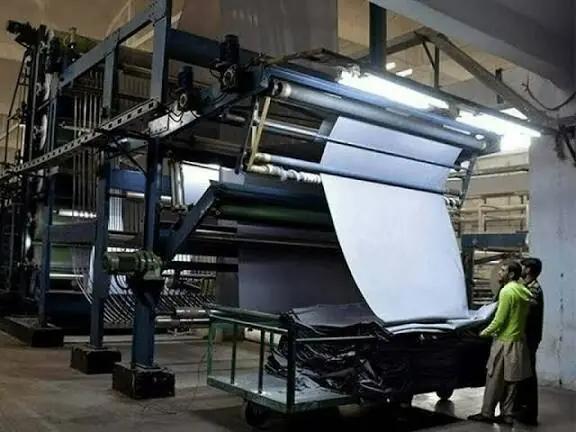

The Pakistan Textile Council (PTC) has sounded alarm over the country’s deteriorating export performance and growing industrial shutdowns, urging urgent reforms to restore competitiveness.
Pakistan’s merchandise exports fell 3.83 percent year-on-year in the first quarter of FY26, clocking in at $7.61 billion compared to $7.91bn in the same period last year, official data showed on Friday.
Exports in September dropped 11.71pc to $2.51bn — the fifth monthly contraction in the last six months, according to the Pakistan Bureau of Statistics.
Meanwhile, the trade deficit widened sharply to $9.37bn during July–September, against $7.05bn in the corresponding period last year, as imports rose 13.49pc.
Pakistani textile firm begins work on 2.57MW solar power project amid rising fuel costs
PTC said the textile sector — the country’s largest export earner — is under strain from subdued global demand as well as surging domestic costs.
Gul Ahmed Textile Mills Limited recently announced the closure of its export apparel segment, citing high input costs, shifting taxation, and rising regional competition.
The crisis extends beyond textiles, with multinationals including Procter & Gamble, Microsoft, Shell, Total Energies, Pfizer, Sanofi and Careem either exiting or scaling down operations in recent months. While some moves were part of global restructuring, industry players link the broader trend to policy unpredictability, uncompetitive energy tariffs, high taxation and regulatory hurdles.
“These developments are a wake-up call,” said PTC Chairman Fawad Anwar. “They are symptoms of deeper structural issues — Pakistan’s cost of doing business is simply becoming unbearable.”
The Council has long pushed for reforms to improve competitiveness, including:
Aligning wage and labor policies with regional peers
Ensuring predictable and regionally competitive energy pricing for export industries
Streamlining tax refunds and ensuring zero-rating of inputs
Expanding export financing facilities through EXIM Bank, EFS and LTFF
Establishing transparent policy stability with monthly KPIs
“If urgent corrective measures are not taken, Pakistan risks further closures of export-oriented units and reduced foreign investment,” Anwar warned.
He stressed that PTC’s proposals were not demands for subsidies but aimed at creating a level playing field with competitors such as Bangladesh, Vietnam and India, where lower costs and supportive policies continue to attract investment.
“The writing is on the wall. Unless the government recalibrates its approach on energy, taxation, and policy stability, Pakistan will see more closures in both textile and non-textile sectors,” Anwar added.




















Comments
Comments are closed for this article.