


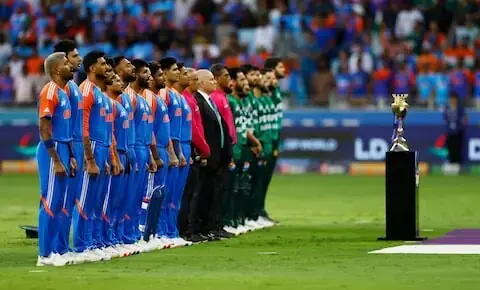
EDITORIAL: Cricket has long been celebrated as the gentleman’s game, a rare arena where the fiercest of rivals could set aside politics and compete under a code of respect. That India’s government, led from the very top, has now reduced it to another theatre for political posturing is nothing short of disgraceful.
Prime Minister Narendra Modi’s choice to cloak his team’s Asia Cup victory over Pakistan in the language of war was a deliberate diplomatic provocation, blurring the line between sport and statecraft. When a cricket win is equated with Operation Sindoor — the military confrontation of May — it ceases to be cricket and becomes an extension of conflict by other means.
That is why the episode has drawn criticism not just from Pakistan or neutral observers, but also from within India itself. Analysts and commentators have rightly pointed out the contradiction: if New Delhi truly viewed cricket as inseparable from politics, it should not have allowed its team to play at all.
To step onto the field while invoking the language of war cheapens the game and drags players into a narrative they did not sign up for. Sport is supposed to act as a release valve, a platform where rivalry can be contained within the boundary ropes. Turning it into a proxy battlefield strips away that function and leaves only bitterness behind.
The Indian team’s refusal to shake hands with Pakistani players and collect the Asia Cup trophy from Asian Cricket Council chairman Mohsin Naqvi drove the point home further.
Whatever the intention, the effect was unmistakable: the spectacle of athletes holding back from the basic courtesies of sport, thereby deepening hostility instead of softening it. Pakistan’s captain was correct when he observed that such behaviour disrespected cricket itself. To refuse handshakes, to shun the award ceremony, to snub the very institution organising the tournament — these are not the gestures of a confident side but of one shackled to political instructions.
The tragedy here is not limited to one final, or one sour presentation ceremony. Cricket has historically offered rare moments of connection across the India-Pakistan divide. From tours in the 1950s to the diplomacy of the 1980s, matches were often described as “wars without weapons” precisely because the metaphor implied substitution, not escalation.
Modi’s attempt to collapse the distinction — to say that a cricket win is the same as a battlefield success — undoes decades of effort to keep the sporting and military domains separate. It raises the stakes in future encounters and plants seeds of resentment that outlast any single tournament.
Even in the wider world of sport, there are boundaries that leaders respect. The Olympics have seen boycotts, but rarely have heads of government claimed athletic wins as continuations of live wars. To do so is to send a message to one’s own population that victory in sport validates victory in war, and that defeat in sport hints at weakness in war. It is a dangerous conflation, feeding toxic nationalism and denying both players and fans the chance to enjoy sport for what it is.
Pakistan’s gestures, by contrast, emphasised humanity rather than hostility. The cricket board’s decision to donate match fees to the civilian victims of India’s May attack was a reminder that real lives and real tragedies underpin the rhetoric. While India’s prime minister chose to score political points, Pakistan’s team chose to highlight the cost of conflict. That difference in approach should not go unnoticed.
The International Cricket Council and the Asian Cricket Council also face a test of credibility. Their silence in the face of such blatant politicisation is not neutral — it is permissive. If international cricket tolerates one government converting matches into propaganda tools, the precedent will spread and the spirit of the game will erode further. Rules against political messaging exist for a reason, and they must be enforced without fear or favour.
For now, the damage is clear. What should have been a celebration of skill and competition ended in recrimination, accusations, and a trophy left standing on a table. The responsibility for this decline rests with those who chose to inject the language of war into a sporting contest. Cricket deserves better.
The region deserves better. And India, if it values its own sporting traditions, must decide whether it wants its victories to be remembered for the runs scored on the pitch, or for the political slogans shouted off it.
Copyright Business Recorder, 2025




















Comments
Comments are closed for this article.