



In my earlier articles, I highlighted Pakistan’s power sector crisis and the urgent need for structural reforms. A central recommendation was the privatization of Distribution Companies (DISCOs). These entities, responsible for delivering electricity to end-users, remain the weakest link and consistently bleeding losses, undermining financial stability, and perpetuating circular debt. The Ministry of Energy (Power) deserves recognition for taking note of the CTBCM consultations and promptly organising a comprehensive seminar in Islamabad, with another now planned in Karachi, to engage real stakeholders and address their concerns. Yet, the same level of urgency and focus is still missing when it comes to the DISCOs themselves, the very institutions whose inefficiency continues to fuel circular debt and cripple the sector’s sustainability.
While the reduction in circular debt is welcome and the effort put into renegotiating financing is commendable, the method of achieving it through bank borrowing, or fiscal injections, even when subsidy requirements are reduced remains unsustainable and hardly a cause for celebration. The initial Rs. 801 billion injected to reduce circular debt came from fiscal space that could have been allocated to make industrial power competitive to drive the economy and further directed to education or healthcare for millions.
The subsequent debt of Rs. 1,225 billion to pay off circular debt has been financed through banks at KIBOR minus 0.9%.This will ultimately be recovered from consumers over the next six years. Such measures may provide temporary relief, but they do not qualify as structural reform — they are merely operational fixes. The burden is simply shifted into future liabilities, locking consumers into paying Rs 3.23 per unit on top of electricity rates for six more years, without addressing the underlying inefficiencies. The entire scheme is only sustainable if circular debt does not resurface — an assumption that recent history of discos performance makes difficult to believe.
According to NEPRA’s own reports, DISCOs have collectively bled Rs2,384 billion that is over 2 trillion in the last decade alone due to poor recovery, theft, inefficiency, and mismanagement. As long as DISCOs continue to operate under this model, circular debt will keep resurfacing regardless of how much is borrowed to paper over it.
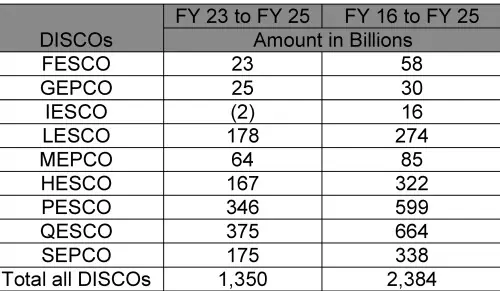
Contrary to what the Power Ministry wants us to believe, a significant chunk, 57% of these losses have been incurred during past three years. While these losses improved in FY 2025 as compared to FY 2024, FY 2025 losses are still higher then losses incurred in FY 2023. Even for first two months of Fiscal Year 2026 the DISCOs’ inefficiencies and under-recovery already cost approx. Rs 150 billion.
Table 1 - DISCOs wise Loss Inefficiency and Under Recoveries Impact
Nepra Reports and Ministry Performance Updates
Losses at DISCOs translate directly into consumer tariffs or fiscal burden without any regulatory scrutiny. Only Privatization can help shifts risk, creating strong incentives for efficiency. Private management can improve billing, metering, theft control, and customer service, reducing the billions lost every year.
Without efficient DISCOs, broader reforms like the Competitive Trading Bilateral Contract Market (CTBCM) cannot succeed. Ironically, the CTBCM itself is fifteen years too late and is being imposed in an unsustainable manner by shifting the burden of capacity payments on pool through revision in open markets regulations which previously required full recovery of stranded cost.
Hence, DISCOs are expected to bleed more in the coming years, with no one else but the taxpayer and/or consumer to bear the burden as proven recently.
The biggest challenge to privatization of DISCOs is the unviable business model offered to DISCOs along with unpredictable and unsustainable regulatory environment.
To start with, government would need to sell DISCOs’ asset at fair value, instead of historic cost, otherwise selling below market value would seem inappropriate and will raise eyebrows. Whereas Nepra allows return only on historic costs, ignoring fair value, and does not allow to retain any gain on disposal of assets. This creates stranded investment which no investor would be willing to pay as it would make no commercial sense for him.
Further, with recoveries below 75 percent for high loss DISCOs like HESCO, SEPCO and QESCO, investors would not be able to deliver 100 percent. Moreover, the tariff increases or terms of tariff would not be under control of the investors due to uniform tariff policy and high cost of centrally contracted generation, where government continues to plan to add more generation. This would make recovery improvement targets impractical to achieve as we have seen over 40% annual increase in tariffs in some years in past. Furthermore, effective legal recourse that punishes dishonest consumers and non-payers, does not exist and even after attempts at amendments in legislation, nothing concrete has come out of it. Law and order control and political interferences are effectively beyond investors’ control.
All investors would like to sell to industrial consumers at competitive market rates without any cross subsidy or drag of stranded cost. Whereas the rules and regulations require them to sell at higher rates to ensure protection of low segment consumers, while allowing bulk Industrial and Commercial consumers to move to open markets. To further, curtail any investors interest, the potential investors would have to agree to not take part in any competitive supply business across Pakistan, even for other DISCOs territories.
Unfortunately, the path towards privatization seems to exist only on paper. The glaring issues that require Power Ministry attention are being completely ignored and in fact it appears that attempts are being made to make it so unviable that it never materializes. As seen above the cost of national exchequer of over 2 trillion in last ten years, 57 percent of it from the past three years alone.
As a simple business decision, tariff setting of DISCOs need to start from actual levels and improve gradually, with private operators rewarded for efficiency gains and accountable for bad performance. Assets should be sold closer to regulatory value, or investors be allowed an opportunity to earn investment on the amounts invested and to retain earnings to the extent of market value of assets if sold later. There should be an incentive to earn profits beyond those offered in low risk segments like Generation; otherwise, who would be willing to take over entities which have lost over 2 trillion in the last decade?
For industry, the continuation of the Rs. 3.23 per unit surcharge over the next six years is particularly damaging. This surcharge, initially introduced as a temporary measure, now represents a permanent drag on industrial competitiveness. For large-scale manufacturers consuming hundreds of megawatt-hours each month, it translates into billions of rupees in additional annual cost, eroding margins and making exports unviable. Rather than sharing the burden of inefficiencies across the broader fiscal framework, the government has chosen to load it squarely onto paying consumers — effectively punishing industry for DISCOs’ theft and mismanagement. This not only discourages industrial expansion but accelerates the shift to self-generation and shutdown of industries, further weakening the grid’s financial base.
The Government needs to strengthen penal laws and ensure effective enforcement; law and order and political interference must be tackled by the state, not left to private operators.
Consumer- or taxpayer-funded borrowing to “reduce” circular debt is a short-term illusion; it does not fix the bleeding at source. These plans are only workable if the menace of Circular Debt does not come back to haunt us. Privatization must be supported by law-and-order reforms, regulatory clarity, and fair risk-sharing mechanisms. Done right, it can finally put Pakistan’s power sector on the path to sustainability. Done wrong, it risks becoming yet another costly illusion. No other reform can work till this is achieved.
Copyright Business Recorder, 2025
The writer is an avid power sector expert and a leading industrialist from Karachi. He can be reached at [email protected]

























Comments
Comments are closed for this article.