


95% Pakistan builders, developers avail amnesty scheme sans compliance
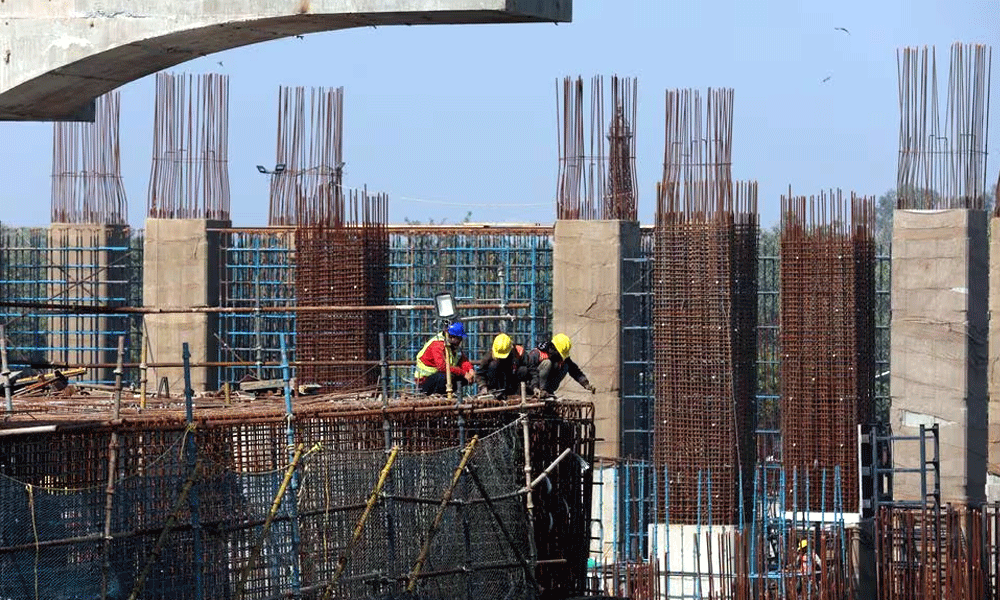

ISLAMABAD: Over 95 percent of the builders and developers, who availed the tax amnesty scheme, failed to comply with the conditionalities of the scheme.
This astonishing data has been mentioned in the “Sectoral Audit of Taxation in Real Estate Sector” conducted by the Auditor General of Pakistan (AGP).
In April 2020, the government announced a construction package to revive the construction industry and boost economic activity. The package included incentives such as tax exemptions, reduced taxes on construction materials and amnesty for the construction sector Tax amnesty schemes emerge as opportunities for the taxpayers and non taxpayers to pay a certain amount, in exchange for relief on tax liability relating to previous tax years.
Construction sector: builders, developers call for 15-year tax policy
It is one of the short-term strategies which are used mostly by the developing countries for broadening tax net and increasing revenue by encouraging people to declare their concealed incomes and assets. In this way, tax amnesties facilitate non-compliant taxpayers to pay tax without any criminal or civil prosecution.
Audit observed that despite availing incentives, taxpayers failed to comply with the conditions as contained in tax amnesty scheme which resulted in loss of revenue. The AGP has recommended FBR to strengthen and enforce laws/ regulations related to Benami (proxy) transactions to prevent individuals from concealing property ownership through nominees or proxies.
As per Federal Board of Revenue (FBR) data, 993 builders and developers got themselves registered under Section 100D of the Income Tax Ordinance, availed the tax amnesty and are being assessed by the various field formations of the FBR.
The Section 100D was inserted in Income Tax Ordinance, 2001 through Finance Act 2020, which refers to an amnesty scheme introduced for builders and developers. Section 144 mandates the documentation of immovable properties, including land, buildings, and other real estate assets. As per the legal provisions, for tax year 2020 and onwards, the tax payable by a builder or a developer, as defined in sub-Section (9), who opts to avail such scheme, shall pay fixed tax in accordance with the rules of Eleventh Schedule @ per Sq. Ft. on the basis of completion of projects.
Around 57 percent of the taxpayers (developers/ builders) assessed in Regional Tax Office Islamabad, were non-filers, which shows weak enforcement of returns and recovery of taxes by the tax authorities.
Audit also observed that all the cases of builders and developers from the provinces of Punjab and KPK were clustered into the Regional Tax Office, Islamabad as of June, 2023, clustering of the cases in RTO Islamabad was not a judicious decision which not only impaired the monitoring, assessment and recovery of taxes but also caused hardships to taxpayers. Keeping in view the hardships, the tax authorities out of total 11,243 cases re-assigned the jurisdiction of 3,702 cases to the concerned RTOs/ LTOs. The frequent transfer of jurisdiction causes delay in assessment and recovery of due taxes. Audit also pointed out that certain tax collecting and withholding agents while generating online computerised payments receipts (CPRs) did not disclose the Name, CNIC/ NTNs and address of the taxpayers which render challans as invalid but the Inland Revenue Information System (IRIS) processed such challans which results in incorrect claim of tax credits by the beneficiaries and also promotes “benami” transaction, as well.
Copyright Business Recorder, 2025




















Comments
Comments are closed for this article.