


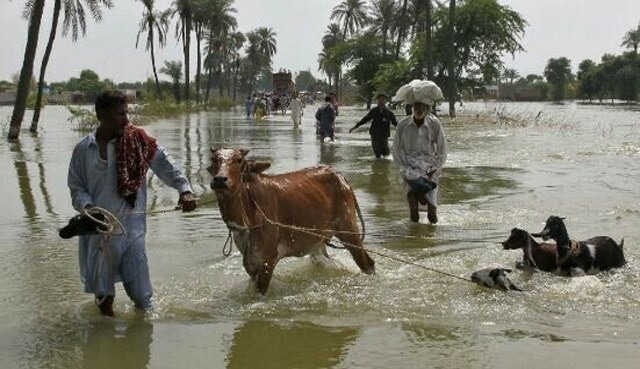

LAHORE: Agriculture Republic, a think-tank advocating rights of farmers and climate, has welcomed the prime minister’s announcement of an agriculture and climate emergency, calling it a timely recognition of the threats posed by unprecedented floods to Pakistan’s food security, exports, and rural economy.
However, the prime minister’s declaration must be followed by a multi-stakeholder resilience plan, involving banks, financial institutions, multinational corporations, input suppliers, and farmer organizations, said co-founder of the platform and a progressive farmer, Aamer Hayat Bhandara talking to the Business Recorder on Wednesday.
Bhandara said the prime minister’s decision marked “a defining moment” for the country. He noted that the devastation is not only a humanitarian disaster but a systemic risk to agriculture which remains the backbone of Pakistan’s economy.
He quoted a forum’s estimates that Punjab has suffered around 60 percent damage to rice, 35 percent to cotton, and 30 percent to sugarcane.
A capital-markets research report projects overall economic losses near USD1.4 billion, with agricultural damages exceeding Rs 300 billion. Exporters warn that disrupted shipments could cost Pakistan USD278 million in rice, USD 283 million in sugar, and USD 300 million in cotton, creating fresh pressure on the national exchequer. Meanwhile, figures from the Provincial Disaster Management Authority (PDMA) indicate that nearly 19.5 million acres of cultivable land have been affected.
Bhandara praised the efforts of provincial and district administrations, who despite limited resources and minimal training have evacuated families, provided food, and delivered livestock fodder and portable water tanks. “These frontline measures have been life-saving for rural communities,” he observed.
However, he stressed that relief alone cannot address the crisis.
He urged that the prime minister’s declaration must be followed by a multi-stakeholder resilience plan, involving banks, financial institutions, multinational corporations, input suppliers, and farmer organizations.
Such a plan, he said, should include emergency and concessional credit, index-based insurance, timely supply of quality seed and fertilizer, community-level water management, regenerative farming practices, digital advisories, and stronger extension services. He emphasized that coordination must be transparent and accountable, ensuring that smallholders “who feed the nation are not left behind.”
Bhandara further cautioned that with wide variance in early estimates, it is prudent to wait for consolidated, official figures from the Pakistan Bureau of Statistics and the Government of Punjab before finalizing relief or policy measures. “Sound policy must rest on verified data. Acting in haste without accuracy risks misallocating scarce resources,” he said.
He welcomed the prime minister’s declaration as “a timely recognition that if the farmer lives, the nation lives,” adding that unity of purpose, measurable commitments, and cross-sectoral investment are now essential to safeguard Pakistan’s agricultural backbone and ensure climate resilience for future generations.
Copyright Business Recorder, 2025




















Comments
Comments are closed for this article.