


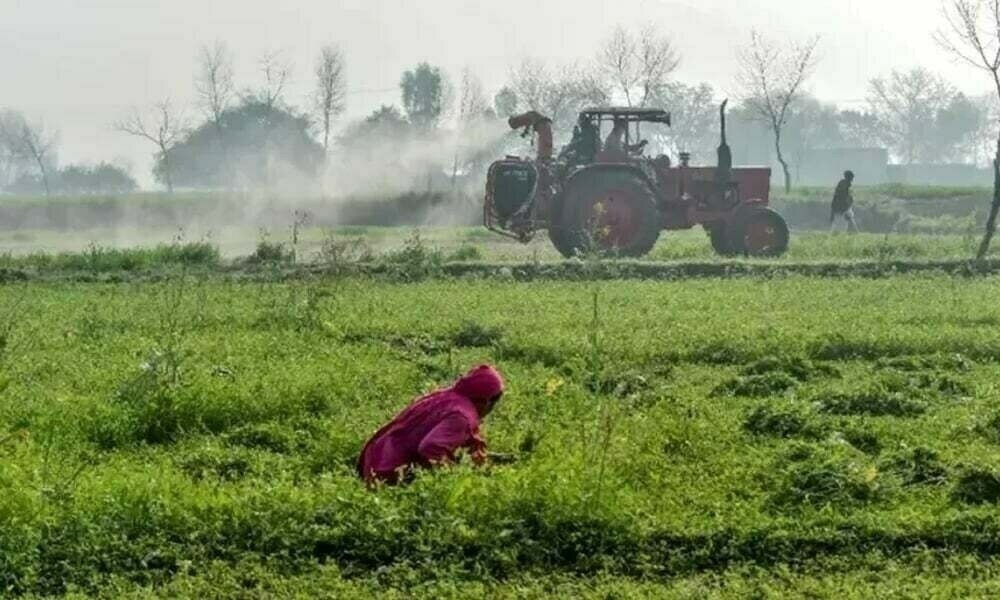
EDITORIAL: Noted economist Dr Hafeez Pasha, while speaking on Aaj television lamented the well-below potential projected revenue from the levy of agriculture income tax by all four provincial governments. Punjab government envisages 10 billion-rupee target against a potential of 450 to 500 billion rupees.
The levy was an International Monetary Fund (IMF) programme condition, which stipulated the passage of legislation by all four provinces by January 2025 on agriculture income tax with implementation to commence from July 2025.
The legislation was passed; however, the revenue potential was grossly understated by all provinces in the budgets approved by their parliaments in June 2025 due to political considerations, read the continued elite capture of the government’s source of revenue.
The October 2024 IMF documents stipulated that “the federal government and the provinces have also agreed to enter a National Fiscal Pact (end-September 2024 Structural Benchmark) that will devolve specific federal spending responsibilities to provinces, in line with the 18th constitutional amendment, and will enhance provinces own tax-collection efforts, including agricultural income tax (FY25), sales tax on services (FY26), and property tax (FY26).”
In the first review documents dated May 2025 the IMF noted that “in a landmark step toward strengthening tax equity and broadening the tax base, the four provinces have amended their Agriculture Income Tax (AIT) regimes to fully align them with the federal personal income tax regime for small farmers and the corporate income tax regime for commercial agriculture (end-October 2024 Structural Benchmark).
The new tax regimes apply on income from January 1, 2025, with the tax liability for the second half of FY25 collected in September 2025.” Additionally, the documents noted that “direct taxes and provincial non-tax and tax revenues (increasing 29 percent and 32 percent year on year, respectively), were stronger-than-expected.” However, this data applied to last fiscal year and not to the 2026 fiscal year that commenced on 1 July which is when the agriculture income tax was to become effective.
The deadline of end-September is still three weeks away though the IMF team is expected to begin the second review of the ongoing loan mid-September and it is expected that this would come under debate. It is likely that the provinces would cite the massive crop devastation caused by the ongoing floods as a reason for the very low revenue budgeted for agriculture income tax though the budgets were announced a few weeks before the onset of the floods.
The Constitution indirectly defines a tax on farm income as a provincial subject by excluding income from agriculture from the federal list that empowers the federation to legislate, thereby disallowing parliament from taking the decision to tax farm income at the same rate as that levied on the salaried class.
While previously Pakistani administrations relied on not having a two-third majority in parliament to amend the constitution yet in recent months the government has quite effortlessly passed amendments that are considered highly controversial.
One would therefore urge the government to pass an amendment to the constitution that would empower the Federal Board of Revenue (FBR) to begin collecting the agricultural income tax that could then be made part of the divisible pool.
Be that as it may, provinces must either be compelled to set a reasonable target for collections for agriculture income tax or through a constitutional amendment FBR may be tasked to collect the tax, as a component of the divisible pool for onward distribution to provinces as per the National Finance Commission Award formula or to allow FBR to collect on behalf of each province against payment of a nominal fee for collection.
Copyright Business Recorder, 2025

























Comments
Comments are closed for this article.