


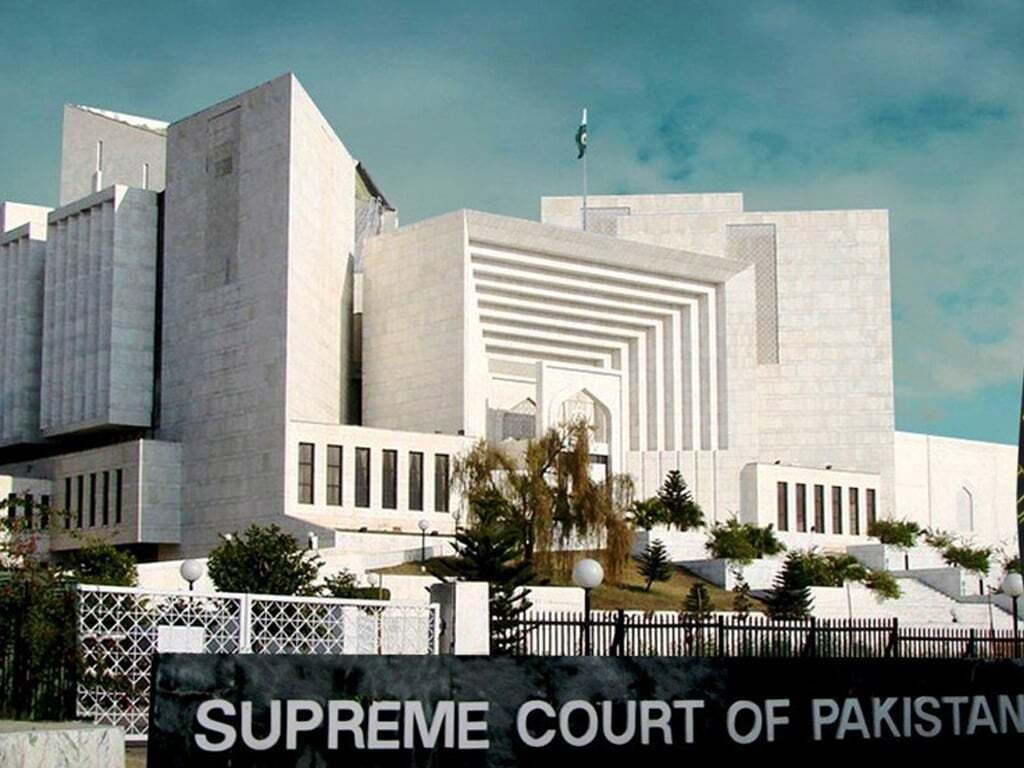

ISLAMABAD: The Supreme Court on Friday allowed the Customs authorities to retain jurisdiction to recover import-stage sales tax and advance income tax, even where short-levy is discovered after clearance of goods.
A three-judge bench, headed by Chief Justice Yahya Afridi, and comprising Justice Muhammad Shafi Siddiqui and Justice Shakeel Ahmad, on Friday announced the judgment, which it had reserved on 10th April, 2025. Justice Shafi Siddiqui wrote a dissenting note.
Through 2 to 1 majority ruling, the bench set aside the impugned judgments by the Sindh High Court. The SHC had ruled that the authority of Customs to assess and recover sales tax and advance income tax is extinguished once the imported goods have crossed the customs barrier.
Duty drawback recovery from ghee exporters: SC dismisses plea of Collector Customs
The SC judgment, authored by CJP Yahya, emphasized that customs duty, sales tax, and advance income tax at the import stage are all charged and collected as part of the same transactional event. Where, owing to a misapplied exemption or other lapse, the full liability is not realized at that stage, it is consistent with both logic and statutory design that the Customs authorities should be empowered to address and recover the deficiency.
“To hold otherwise would fracture the statutory scheme, dispersing jurisdiction between different authorities in respect of levies that are assessed and collected together at the border, thereby defeating the coherence that the Parliament sought to ensure through the scheme of cross-reference and the amendments already noted,” it added.
The judgment noted that the provisions of Section 32 of the Customs Act and Section 6(1) of the Sales Tax Act, as presently worded, contain the language inserted by the Finance Acts of 2014 and 2015. These amendments are material because they reveal the legislative intent that prompted the inclusion of the terms “taxes” in Section 32 and “including recovery” in Section 6(1).
It said: “Taken together with the subsequent omission of Section 11 of the Sales Tax Act by the Finance Act 2024, a clear trajectory emerges: Parliament has consciously moved away from a broad, catch-all recovery jurisdiction of Inland Revenue, and toward a coherent framework in which customs duty, sales tax, and advance income tax, all levied at the point of import, are administered and, where necessary, recovered through the machinery of the Customs Act.”“To disregard the significance of these insertions and omissions would be to overlook the deliberate coherence Parliament has sought to create in the scheme of import-stage taxation,” it further said.
The judgment clarified that the various Finance Act amendments made to the Customs Act and the Sales Tax Act, operate to designate Customs as the forum for recovery, and thus are purely procedural in nature. They do not create any new liability, nor do they curtail any substantive defence available to the taxpayer, but merely regulate the procedural channel through which an existing obligation is to be enforced. Since they do not affect any vested right, it is a settled principle that such provisions apply retrospectively unless expressly excluded.
The Court noted that Section 6(1) of the Sales Tax Act establishes a definitive scheme: it aligns the charge and payment of import-stage sales tax with customs duty, incorporates the collection, enforcement, and recovery machinery provided under the Customs Act, as the sole operative channel in the absence of any parallel provision in the Sales Tax Act itself.
The judgment said subsections (5) and (6) of Section 148 of the Income Tax Act,if read together, envisages and establish a scheme, whereby advance income tax at the import stage is to be assessed and collected, side by side with customs duty, through the same processes and at the same time, with the Customs Act, providing the procedural machinery for such collection.
Copyright Business Recorder, 2025


























Comments
Comments are closed for this article.