


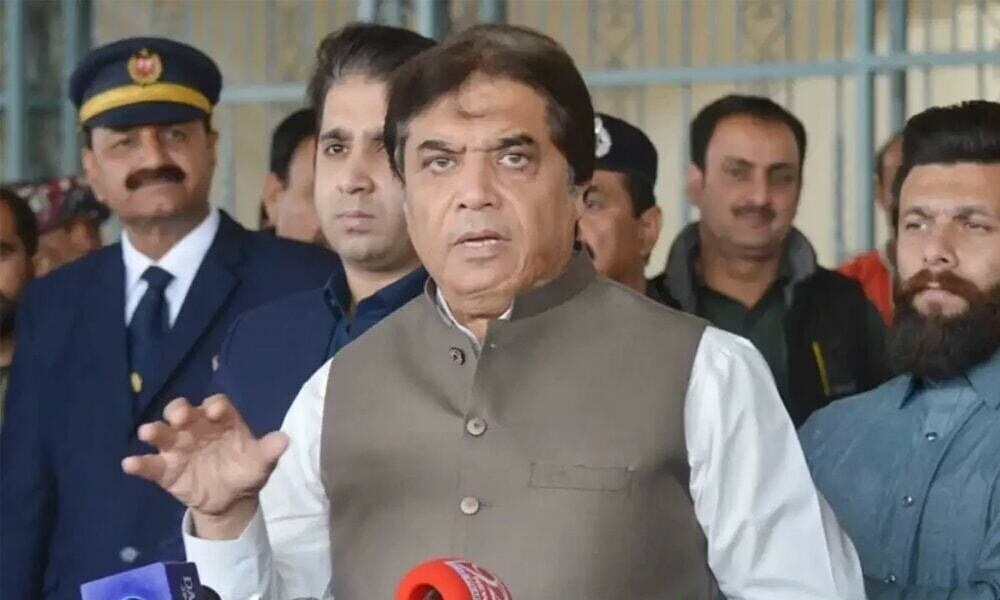

KARACHI: Federal Minister for Railways Muhammad Hanif Abbasi, during his visit to the Karachi Chamber of Commerce and Industry (KCCI) on Thursday, unveiled a comprehensive set of reforms, recovery measures, and development projects aimed at modernising Pakistan Railways and making it more efficient, transparent, and business-friendly.
The minister informed that railway lands worth Rs 15 billion have already been recovered while properties worth an additional Rs 50 billion will be retrieved during the current year.
He categorically stated that Pakistan Railways’ property is non-saleable, though partnerships on a revenue sharing basis are being pursued to ensure optimum utilisation.
Highlighting the importance of Karachi, he remarked that “without Karachi, Pakistan’s economy collapses” and “without Karachi Division, the existence of Railways ceases to exist.”
He added that the Thar coal transportation project is underway across the country, while groundbreaking of the Karachi–Rohri railway line spread on an area of 480 kilometers is expected by June 2026.
Sharing details of modernisation initiatives, the minister said that 155 railway stations, including solarisation at 27 stations in Karachi, are being shifted to solar energy, of which 60 stations have been solarised.
Wi-Fi is being installed at 40 stations, and preparations have been finalised to provide Wi-Fi and ATM facilities at all major stations. He also announced that a state-of-the-art CIP Lounge at Karachi Station, which he declared will be “better than Europe” will be inaugurated on September 22.
Furthermore, all five railway saloons have been opened to the public at affordable rates. Hanif Abbasi informed that Pakistan Railways has initiated digitisation of its operations while also addressing wastage and theft.
He revealed that Rs 4 billion have been saved through meter regularisation, whereas ticketing theft alone previously caused a loss of Rs.1 billion annually. He made it clear that ticketless travelers, as well as those facilitating them, will now face imprisonment.
“Even ministers or the chairman Railways will have to buy tickets,” he emphasised.
The minister announced that 11 passenger trains have already been outsourced, another 9 will be outsourced within 6 days, and by December a total of 38 passenger trains will be outsourced.
Freight trains are also being outsourced to meet the surging demand.
He added that two trains have already been handed over to NLC, which is now demanding 10 more, reflecting strong market confidence.
In addition, eight railway hospitals and 14 schools are also being outsourced; however, he assured that treatment for railway employees at these hospitals will remain free of cost.
The Minister admitted that trains are facing delays due to floods, while fares cannot be reduced immediately.
Commenting on the rolling stock, Hanif Abbasi revealed that bogies and engines received eight years ago were of extremely poor quality, which should have lasted 30 years but have already worn out. An inquiry has been initiated into this matter.
He said that shortage of rolling stock remains a major challenge, preventing expansion despite strong demand, particularly from NLC and the freight sector.
The Minister also disclosed that an agreement with Sindh government is being signed under which Sindh Solid Waste Management will be responsible for cleaning Karachi Station and all trains.
Measures have been taken to reduce the washing time of trains from 3 hours to just 1.5 hours, while fumigation will ensure passengers are freed from bedbugs, cockroaches, and other pests.
In response to numerous suggestions, the minister assured that all their suggestions had been noted and would be given due consideration.
He further stated that the prime minister entrusted him with the Ministry of Railways as a challenge, and within six months significant progress has been made under the Prime Minister’s vision that has resulted in ensuring a huge profitability of Rs 98 billion.
Concluding his address, the minister declared that Pakistan Railways is being transformed into a modern, transparent, and business-friendly institution.
“This Ministry is indeed a challenge, but with reforms, digitisation, recovery of properties, and public-private partnerships, Pakistan Railways will soon become a key driver of national economic growth,” he affirmed.
Chairman Businessmen Group (BMG) Zubair Motiwala, in his remarks, emphasised the need for devising effective strategies to shift Pakistan Railways’ profitability model from dependence on passenger traffic to cargo traffic, following the example of British Railways, where 80 percent of earnings come from cargo movement and only 20 percent from passenger services.
He observed that due to Pakistan Railways limited cargo operations, the bulk of upcountry cargo is being transported by road from Karachi, which further aggravates the city’s traffic situation because of the absence of a dedicated bypass connecting ports directly with highways.
The movement of heavy vehicles on city roads has led to a substantial increase in accidents in Karachi.
He stressed that establishing a bypass would potentially reduce road accidents by up to 70 percent.
Zubair Motiwala also urged the Ministry of Railways to collaborate closely with KCCI in the areas of digitalisation and artificial intelligence.
He proposed joint efforts for preparing a comprehensive policy research paper focused on digitalisation, AI, and other modern measures aimed at enhancing the quality, efficiency, and sustainability of services being rendered by Pakistan Railways, in the larger interest of the economy.
President KCCI Muhammad Jawed Bilwani, while welcoming the minister, lauded Hanif Abbasi for honoring his commitments, which have helped transform Pakistan Railways from a loss-making entity into a profitable institution.
He appreciated the minister’s effective plan of action that has drastically improved service delivery and referred to the excellent transformation of Lahore Railway Station to international standards.
He requested that similar upgrades and modern facilities be introduced at Karachi Cantt and City Stations to encourage greater public use of the railways, thereby strengthening profitability further.
He pointed out that there was a time when goods were transported to the upcountry via Pakistan Railways, but this system was systematically dismantled by vested interests, forcing all cargo traffic onto roads. This shift has not only increased the cost of doing business but also caused severe damage to infrastructure.
He stressed the urgent need to reconnect Karachi’s two ports with the railway network to reduce logistics costs, protect roads from heavy vehicle damage, and support overall economic growth, as rail transport is far more cost-effective than road transport.
He further highlighted the long-standing issue of the Karachi Circular Railway, noting that despite repeated assurances, the project has yet to materialise.
Copyright Business Recorder, 2025

























Comments
Comments are closed for this article.