


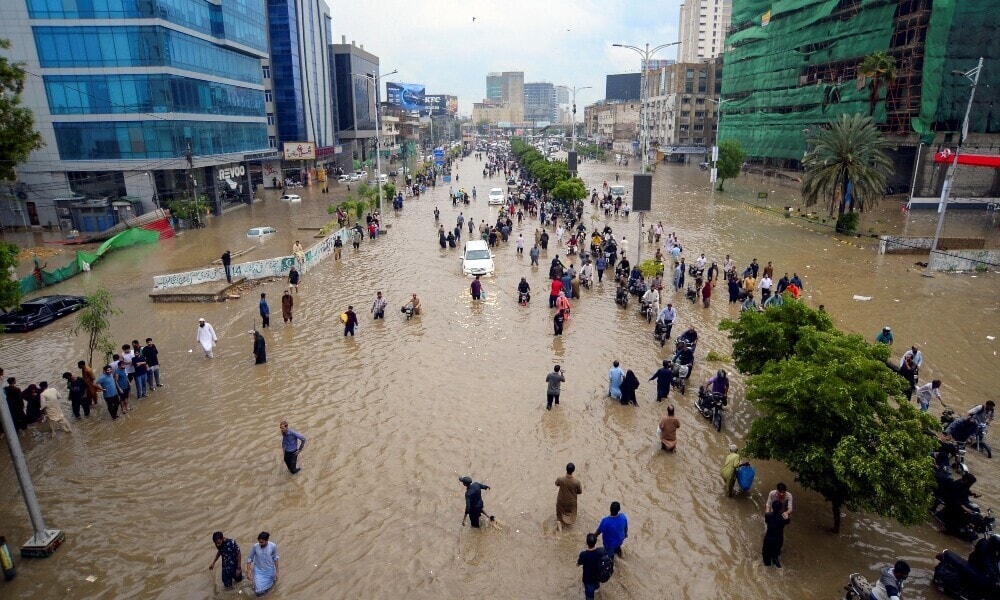
EDITORIAL: Beyond the visible devastation wrought by the recent torrential rains in Karachi that left the city’s already fragile infrastructure literally bursting at the seams, with residents forced to battle flooded streets, overflowing storm-water drains and failing sewer systems, another aspect of this havoc that is bound to be just as ruinous is the grave public health fallout of the extreme weather.
At a recent seminar organised by the Karachi Citizens’ Forum and the Pakistan Medical Association, and pointedly titled “Should Karachi Drown After Every Heavy Rainfall?”, leading medical practitioners, urban planners and activists painted a grim portrait of the metropolis, warning of a mounting health crisis triggered by urban flooding, where contaminated water, unchecked sewage and environmental neglect are fuelling outbreaks of a range of vector-borne and water-borne diseases.
From diarrhoea, typhoid, dengue, gastroenteritis and malaria to the deeper, long-term mental and physical toll on a population already struggling with multiple challenges, these consequences threaten to linger long after the floodwaters recede.
As Secretary-General of the PMA Dr Ghafoor Shoro stressed, the situation has grown so dire that people are dying of illnesses like diarrhoea that are not only preventable but, with even basic public health safeguards, entirely curable.
Added to this is the psychological toll of rain-related ordeals, such as being trapped in vehicles on submerged roads or navigating waist-deep, hazardous water for hours. This form of “rain-triggered trauma”, as Dr Shoro described it, can have lasting repercussions and may even prove fatal for long-term mental and neurological health.
It is important to point out that Karachi’s rain-induced health crisis cannot be separated from its civic and infrastructural decay. As urban planner Muhammad Tauheed noted at the seminar, poorly executed engineering projects have damaged underground water and sanitation lines, leaving neighbourhoods chronically waterlogged with sewage and rain.
Furthermore, the Lyari, Malir and Korangi rivers have been reduced to dumping grounds for solid waste, and by being officially reclassified as mere ‘nullahs’, turned into open sewers — decisions that, he warned, are poisoning the city’s environment and directly endangering public health.
In addition, large-scale encroachments have choked the city’s natural water channels and nullahs that once carried monsoon flows safely out to sea. It is no wonder then that Karachi’s municipal drainage network — limited in capacity to begin with — was utterly unequipped to cope with the scale of last week’s downpour.
So while the city authorities may shout themselves hoarse parroting the excuse that Karachi’s drains were built for just 40mm of rain, the harsher truth is that they wilfully ignored the steady destruction of its natural drainage lifelines.
The price of this neglect is now being paid in the form of a deepening public health crisis. Stagnant pools of contaminated rainwater have become breeding grounds for mosquitoes, while ruptured sewerage lines seep into drinking water supplies, spreading diarrhoeal and parasitic infections. Each spell of urban flooding thus spills over into overflowing hospital wards and lives lost to diseases that are curable and preventable.
The economic toll, though rarely calculated with precision, is equally severe — lost productivity from a sick workforce, crushing medical expenses for struggling households and unrelenting pressure on an underfunded public health system together trap Karachi in a vicious cycle of vulnerability.
What Karachi needs is not just urgent investments in public health infrastructure, but also a complete overhaul of its crumbling civic and drainage systems.
The city’s ordeal mirrors the story playing out across the country under the extreme pressures of climate change, yet the culpability of government authorities in compounding these crises cannot be ignored. Their failures have turned climate shocks into full-blown health emergencies, leaving millions exposed to disease and despair.
Copyright Business Recorder, 2025




















Comments
Comments are closed for this article.