


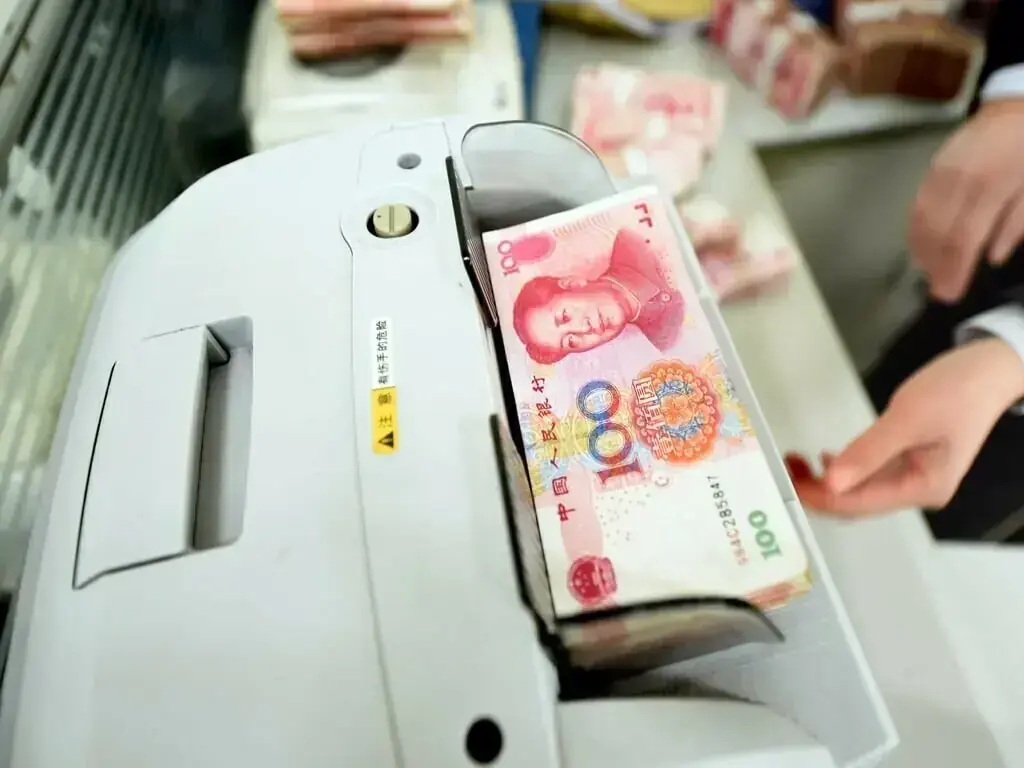

SHANGHAI: China’s yuan briefly hit its highest in nearly 10 months against the dollar on Wednesday, underpinned by the central bank’s persistently firmer guidance for the local currency and the greenback’s broader struggles.
China’s central bank has been setting a firmer-than-expected midpoint guidance rate over the past several days, taking advantage of a weaker dollar as investors weigh Federal Reserve Chair Jerome Powell’s recent dovish policy pivot and fresh attacks on the Fed by President Donald Trump.
“A strong fixing may suggest that authorities are open to some appreciation against the dollar,” said Matthew Ryan, head of market strategy at global financial services firm Ebury.
“It is, however, worth keeping in mind that the yuan has sold off in trade-weighted terms so far this year … This, in large part, reflects a more significant sell-off of the dollar against other currencies.”
Prior to the market opening, the People’s Bank of China (PBOC) set the midpoint rate at 7.1108 per dollar, its strongest since November 6, 2024 and 451 pips firmer than a Reuters’ estimate of 7.1559.
The spot yuan is allowed to trade a maximum of 2% either side of the fixed midpoint each day.
Based on Wednesday’s midpoint fixing, the yuan’s value versus its major trading partners, as measured by the CFETS yuan basket index, rose to a near four-week high of 96.57, but was still down 4.83% so far this year, according to Reuters calculations based on official data.
The yuan strengthened about 2% to the dollar during the same period.
The onshore yuan leapt to a high of 7.1447 per dollar at one point, the strongest level since November 8, 2024. It last traded at 7.1548 as of 0335 GMT.
Its offshore counterpart traded at 7.1552, down about 0.01% in Asian trade.
However, the gains were capped as some market participants remained cautious after a string of July economic data pointed to significant pockets of weakness in the world’s second largest economy, traders and analysts said.
Investors will shift their attention to manufacturing data due on Sunday for a clearer picture of the broad economy, while taking cues from the Fed’s preferred inflation gauge, the PCE deflator on Friday for more guidance on the US policy trajectory.
“We expect China’s official manufacturing PMI for August to remain subdued, coming in at 49.4 this Sunday,” said Serena Zhou, senior China economist at Mizuho Securities.
“If this trend persists, the probability of a rate cut by the PBOC in September increases, especially if the US Fed proceeds with its anticipated rate cut at the mid-September policy meeting.”





















Comments
Comments are closed for this article.