


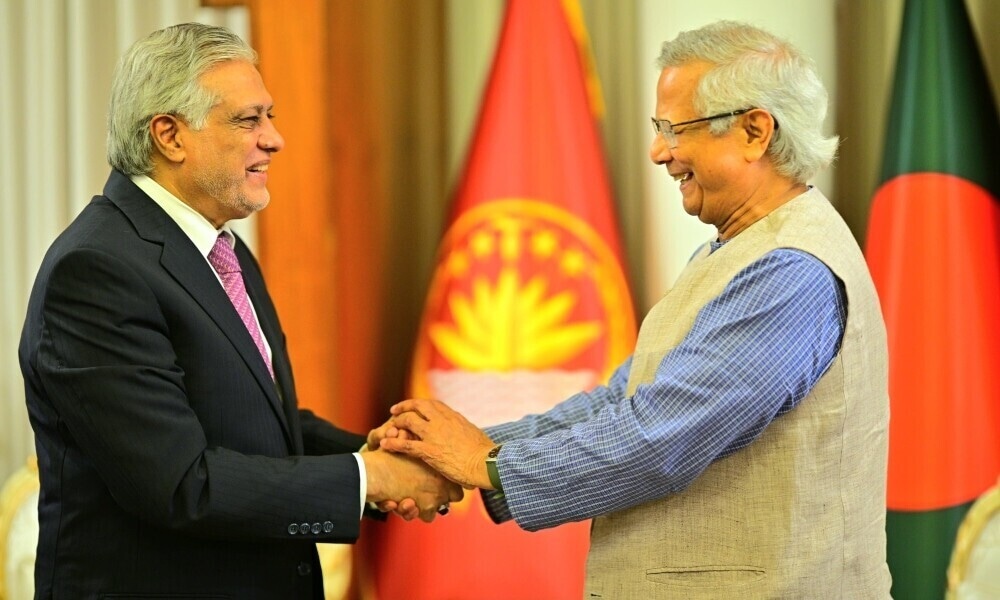
EDITORIAL: Foreign Minister Ishaq Dar’s recent visit to Bangladesh marks a potentially significant turning point in the complex relationship between the two countries. Both sides signalled a pragmatic shift in approach, showing a willingness to move beyond historical grievances in favour of practical cooperation in areas of mutual interest.
In meetings with Dhaka’s leadership, including Chief Advisor Muhammad Yunus and Foreign Advisor Md Touhid Hossain, Dar discussed a range of bilateral and regional issues. Key themes included boosting trade, enhancing youth and educational exchanges, expanding cultural ties, and — most notably — the revitalisation of regional cooperation through the South Asian Association for Regional Cooperation (SAARC).
“Our visions are aligned,” Yunus told Dar, adding that “SAARC remains a top priority for both of us.” He also noted that the two economies are complementary, with significant untapped potential for joint initiatives. These developments suggest that Dar’s visit may carry broader regional implications — most significantly, the prospect of reviving SAARC without India. India’s longstanding hostility toward Pakistan has effectively held the regional forum hostage, frustrating other member states eager to advance a collective development agenda.
Since 2016, when the SAARC summit scheduled in Islamabad was cancelled due to India’s refusal to participate following the Uri incident, the organisation has remained dormant.
Other member countries — including Nepal, Sri Lanka and Bangladesh — have attempted, so far unsuccessfully, to decouple SAARC’s functioning from Indo-Pak tensions.
Now, with China reportedly showing interest in supporting a ‘soft revival’ of SAARC, even without India, there may be momentum building for a “SAARC minus India” configuration. This version of SAARC would focus on trade, connectivity, and climate resilience—critical areas requiring regional collaboration that should not be stalled by bilateral disputes.
On the bilateral front, Dar and his Bangladeshi counterpart expressed eagerness to strengthen ties, enhance cooperation in regional and global forums, and boost economic engagement. However, key differences remain on historical issues, most notably the tragic events of 1971. Bangladesh has long demanded a formal apology and a USD 4.5 billion share of pre-1971 assets. Dar, for his part, maintained that these matters were “resolved twice” — first in 1974 and again in 2002.
Despite these differences, both sides adopted a forward-looking posture. “We agreed to forge ahead rather than looking back,” Dar said. Foreign Advisor Hossain echoed this sentiment, telling journalists, “We acknowledged that the issue of 1971 cannot be solved in a day. We have agreed to continue discussions to that end.”
These remarks reflect a cautious yet positive shift in tone — a recognition that while historical reconciliation remains important, it need not be a precondition for cooperation. If sustained, this renewed engagement with Bangladesh could pave the way for mutually beneficial partnerships. A reimagined SAARC — even in a limited, India-less form — could offer the regional reset that South Asia so badly needs.
Copyright Business Recorder, 2025




















Comments
Comments are closed for this article.