




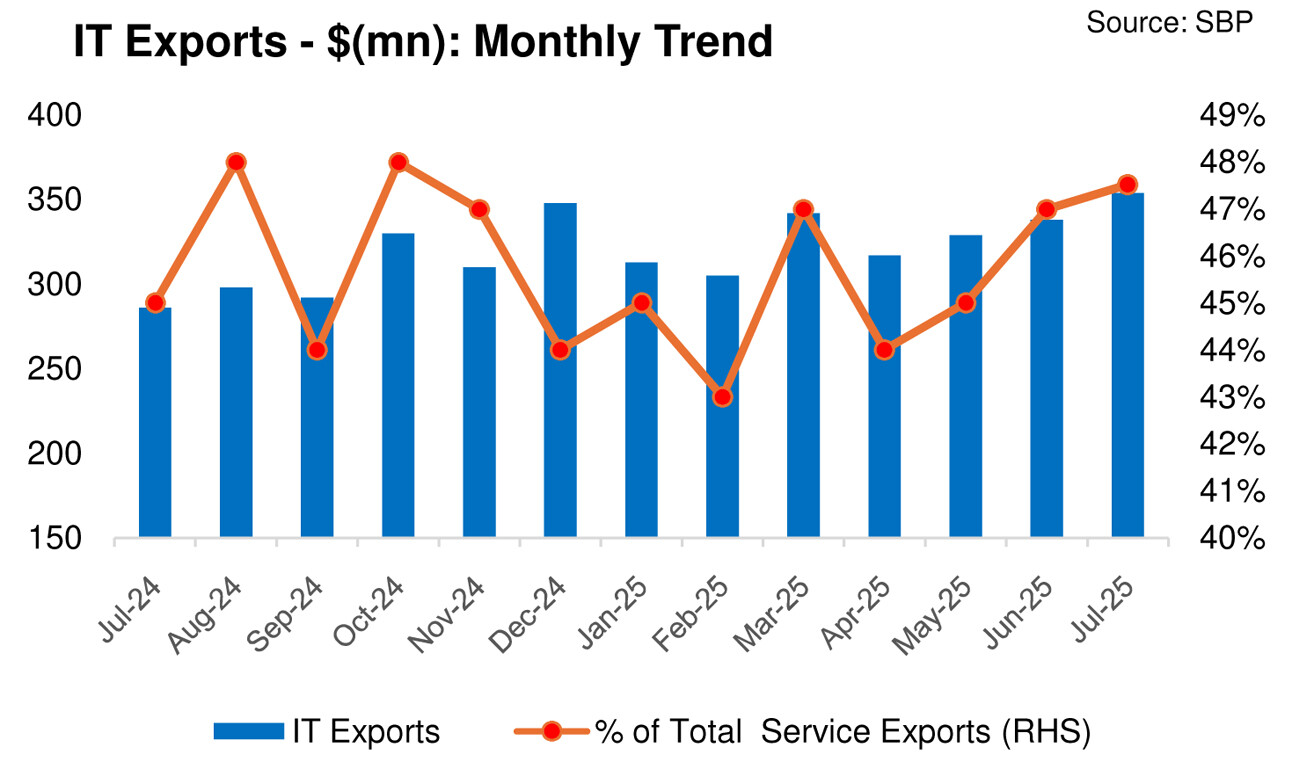
ICT exports set a new monthly record in Jul-25, clocking $354 million, up 24 percent year-on-year and 5 percent month-on-month.
Net IT exports (exports minus imports of ICT services) also improved to$317 million, rising 26 percent and year-on-year 4 percent month-on-month. Computer services led the total exports with $311 million, and within it, software consultancy accounted for $104 million, growing by 8 percent month-on-month.
Several policy and market factors have been reinforcing this uptrend. Exporters cite a healthier global client pipeline—particularly in the Gulf—alongside regulatory tweaks that have eased Pakistan’s ICT exports hit a new monthly record in July 2025, reaching US$354 million, up 24 percent year-on-year and 5 percent month-on-month.
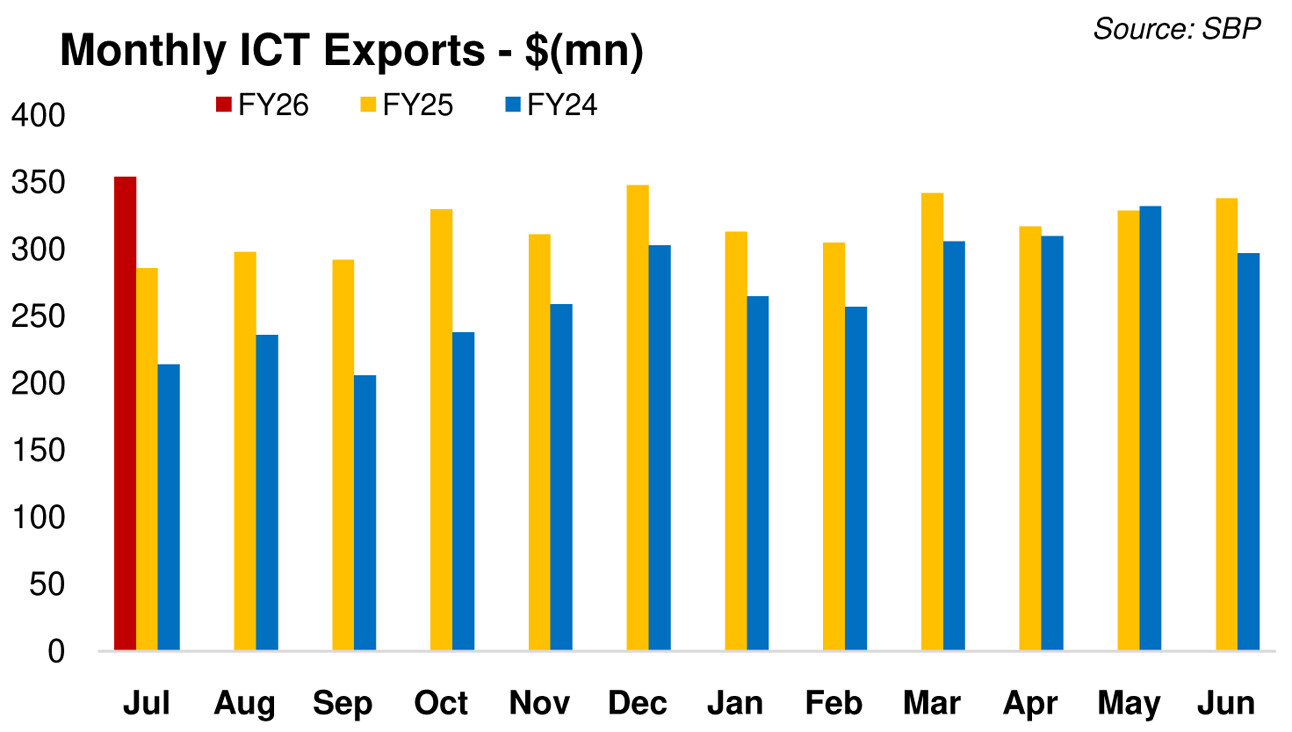
Net IT exports (exports minus imports of ICT services) also improved to US$317 million, showing a 26 percent year-on-year and 4 percent month-on-month rise. Within the breakdown, computer services led with US$311 million, where software consultancy stood out.
This momentum is being reinforced by a mix of policy support and stronger global demand. Exporters report a healthier client pipeline, particularly in the Gulf, while regulatory changes have eased cash flow and investment hurdles.
The permissible retention limit in foreign-currency accounts was raised from 35 percent to 50 percent, giving firms more flexibility, and the State Bank’s Equity Investment Abroad (EIA) framework now allows exporters to invest retained earnings in overseas entities.
A recent P@SHA survey indicates many firms are already benefiting from these accounts, and the relative stability of the rupee has encouraged higher repatriation. Together, these measures have strengthened working capital positions and improved business confidence across the sector.
The outlook for the next year looks promising. The government has set a US$5 billion export target for FY26, while analysts expect 18–20 percent growth this year from a base of around US$4 billion.
Looking further ahead, the government’s “Uraan Pakistan” plan aims for US$10 billion by FY29, which would require about 27 percent annual growth. These goals, however, will only be realistic if supportive policies work in practice—meaning consistent tax treatment (especially for freelancers and small firms), smooth dollar retention and outward payments, quicker refunds, and banking processes that do not block legitimate export transactions.
While software engineering and cloud services remain the backbone of Pakistan’s IT exports, two key areas are emerging with robust growth potential. The first is AI and data platforms, where local talent already serving global clients can move into higher-value work if better access to GPUs, clearer data governance, and compliance standards are put in place.
And the second is cybersecurity and fintech services, areas where Pakistan has built a sturdy base of expertise in security operations, payments, and core banking systems. On the market side, a “GCC-plus” strategy can further expand opportunities: treating Saudi Arabia, the UAE, Qatar, and Oman as near-shore hubs, while targeting North America and the UK as major scale buyers. This approach can diversify demand and shorten sales cycles, providing both stability and momentum for long-term growth.
However, the risks are clear. A sudden currency swing, policy rollbacks on retention or outward investment rules, patchy internet and power, or a global slowdown in tech spending could all hurt growth.
Talent is another major constraint—scaling exports by 25–30 percent each year will need thousands of experienced engineers and managers, not just fresh graduates. That means serious investment in upskilling for cloud, security, data, and product management, smoother compliance for remote work, and reliable, export-grade connectivity.
The bottomline: July’s record shows the sector’s strength and maturity. If policies stay stable, talent is developed, and firms climb up the value chain, the US$5 billion near-term target looks within reach.




















Comments
Comments are closed for this article.