


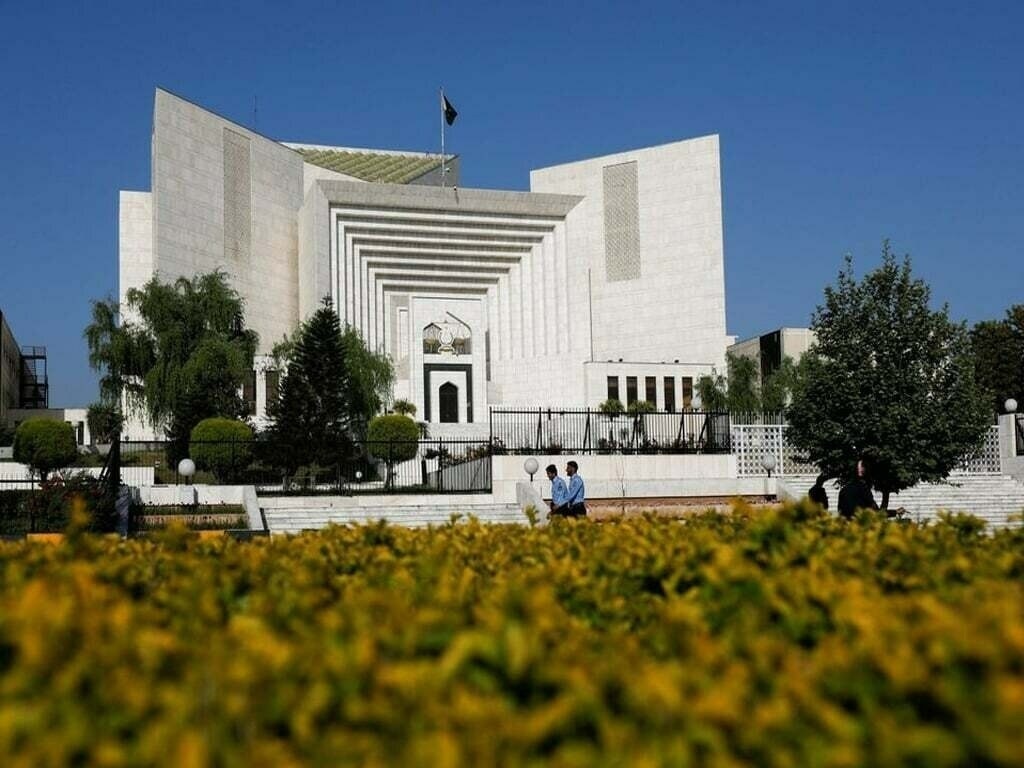

ISLAMABAD: The Supreme Court granted post-arrest bail to founder Pakistan Tehreek-e-Insaf (PTI) Imran Khan in eight cases related to 9th May mayhem.
A three-judge bench, headed by Chief Justice Yahya Afridi and comprising Justice Syed Azhar Rizvi and Justice Shafi Siddiqui, on Thursday, heard Imran Khan’s appeal against the Lahore High Court (LHC) in cases linked to May 9 incidents.
Despite the bail in 9th May case, Imran Khan will remain in Adiala Jail as he is serving sentence in the £190 million graft case. There are also multiple other cases against him.
The PTI hailed the SC ruling, using the hashtag “Victory for Imran Khan” in its post on X.
Special Prosecutor General, Punjab, Zulfiqar Naqvi contended that the petitioner hatched a conspiracy for the commission of the offences mentioned in the FIRs. He drew the attention of the Court to the ocular statements of three witnesses, as well as electronic media, and argued that these clearly implicate the petitioner and connect him with the commission of the alleged offences.
The chief justice then confronted the prosecutor with the definite findings regarding the merits of the case recorded in the LHC order refusing bail to the present petitioner.
Naqvi explained that it is by now settled that the findings so recorded in a bail granting order are tentative in nature, to be restricted only to the proceedings of bail and are not considered during the trial of an accused.
The chief justice then said this Court (SC) granted bail to Ejaz Ahmad Chaudhary, Imtiaz Mehmood, and Hafiz Farhat Abbas, who were linked to the same occurrence (9th May) and charged similarly to the present petitioner.
The prosecutor responded that the case of the present petitioner was clearly distinguishable and, therefore, the principle of consistency would not apply in the instant bail matters.
Naqvi told that in the conspiracy case, the court had granted bail to three accused, adding that in one such case, the accused were not named in the FIR. He said the apex court had laid down this criterion in 2014, earlier reaffirmed in 1996, 1998, and in the 2022 Muhammad Rafiq vs State case. “The High Court’s judgment also states that the observations are of an interim nature,” he added.
Naqvi argued that Ejaz Chaudhry’s case is different from the PTI founder’s case as “no evidence existed and the accused had not been named in the FIR. Upon that, CJP Afridi asked the prosecution to show how the instant matter is “different from earlier ones.”
Naqvi contended that three witness statements have been placed on the record, arguing the PTI founder “played a central role in all cases.”
The chief justice then stopped him from arguing on the merit of the case. He told the prosecutor that if you touch the merit of the case then Salman Safdar, lawyer Imran Khan, would present his arguments on merit, adding this would affect the trial. The CJP said; “My role was to warn you; the rest is for you to consider.”
Naqvi insisted that the law barred bail and claimed there was “solid evidence” against Imran Khan, but the CJP said, “the evidence will have to be proven before the trial court.”
Naqvi informed that out of 10 cases, the petitioner is involved in three cases. Justice Shafi Siddiqui questioned when the FIR was lodged against the petition. Naqvi replied that the FIR was filed against Imran on May 9.
He said the SC allowed the trial court to approach the court to conduct three tests of the PTI founder, adding that the police approached the magistrate for voice matching, photogram metric and polygrammatic tests. “Despite the court’s permission, these tests could not be conducted,” he added.
The chief justice remarked; “If that is the case, there will be legal consequences”. The written order of the hearing stated; “Lest this Court pass any findings on the merits of the case which may prejudice either party at trial, it is sufficient to state that the material brought on record regarding the alleged criminal conspiracy attributed to the petitioner requires scrutiny, and the same would be best adjudged after recording pro and contra evidence during the trial.”
Justice Hassan inquired; “Are such tests normally conducted in other cases as well?” Naqvi, the law prohibited bail to the suspect. “There is solid evidence against the suspect.” However, the CJP told him that the evidence will be proven in the trial court.
Salman Safdar argued that no indictment had been filed in any of the eight cases and that challans had not yet been submitted. He opposed the arguments of Naqvi and emphasised that the principle of consistency had to be applied in favour of the petitioner, as all three accused, namely, Ejaz Ahmad Chaudhary, Imtiaz Mahmood, and Hafiz Farhat Abbas, were charged with alleged criminal conspiracy, and thus the case of the petitioner would surely fall within the domain of parity, which had to be positively considered in favour of the present petitioner.
Salman explained that the cases of the present petitioner were on a better footing, in particular, than that of Ejaz Ahmad Chaudhary, who had been granted bail by this Court. He pointed out that in the case of Ejaz Ahmad Chaudhry, the investigation had been completed and the trial had commenced, whereas, in the case of the present petitioner those stages had not yet been reached, and thus, his entitlement to bail is comparatively stronger.
The order stated that the case of the petitioner has to be positively considered in view of the principle of consistency, as others similarly placed have been granted bail by this Court.
Copyright Business Recorder, 2025




















Comments
Comments are closed for this article.