


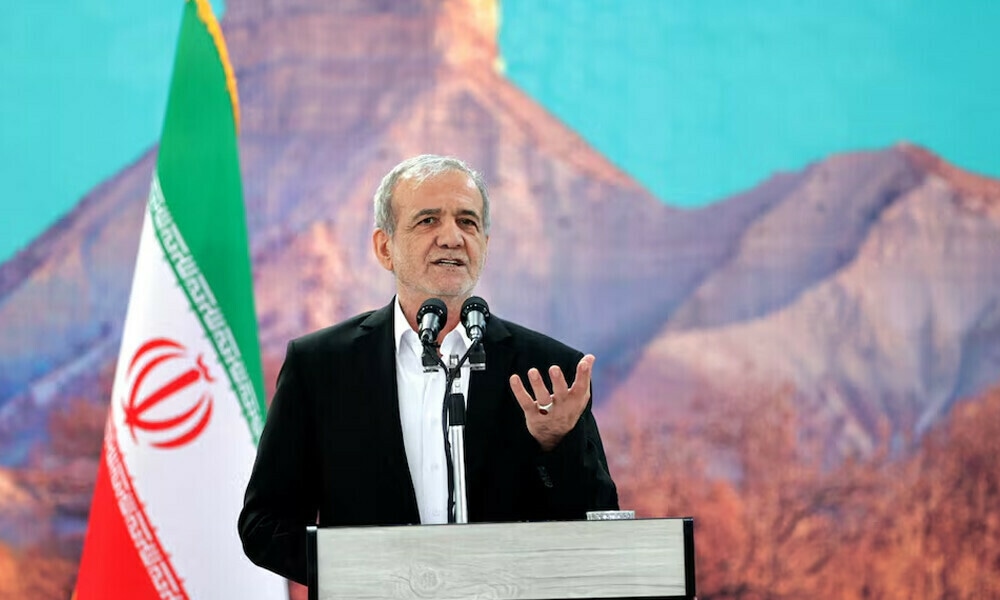

TEHRAN: Iranian President Masoud Pezeshkian warned Thursday that dams supplying the capital could run dry within months unless water consumption was curbed.
“If we in Tehran cannot manage the situation, and if people do not cooperate with us and we fail to control consumption, there will be no water left behind our dams,” Pezeshkian said during a visit to Zanjan in the northwest.
The president said reserves may be depleted by October — the first month of autumn in the Persian calendar, when schools reopen and demand typically rises before the start of the rainy season.
According to an infographic shared by state news agency IRNA, reservoirs serving Tehran are at just 20 percent capacity.
Nationally, the average reservoir level stands at just 44 percent.
According to the Tehran Provincial Water Supply Company, levels in the reservoirs supplying the city have fallen to “their lowest in a century”.
Authorities have urged residents to install water tanks and pumps to cope with disruptions to supply.
Many households have reported repeated outages in recent weeks.
Iranian media, however, have questioned the government’s focus on household use.
The reformist daily Shargh reported on Sunday that “approximately 86.5 percent of the country’s water resources are consumed by agriculture”, while “officials wrongly point the finger at household consumers... as the cause of water stress”.
While no formal water rationing has been announced, electricity is being cut for at least two hours daily in neighborhoods across the country.
Officials have acknowledged that in some areas, power has been interrupted more than once a day to ease pressure on the grid.
Last week, Mohammad Ali Moallem, director of the Karaj Dam — one of the key facilities supplying Tehran — told the Mehr News Agency that “although the hydroelectric plant is currently operational, it is likely that within the next two weeks, the water level will drop to a point where electricity generation will no longer be possible”.
The shortages come as Iran is still facing the aftermath of its 12-day war with Israel last month.




















Comments
Comments are closed for this article.