


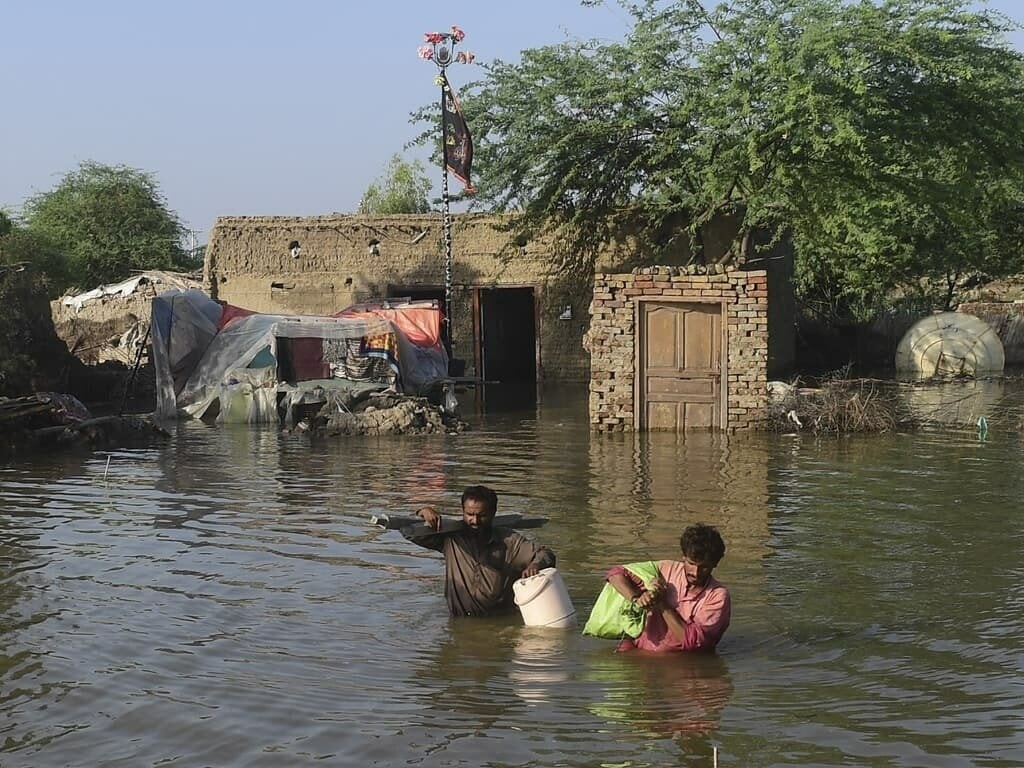

LAHORE: A South Asians for Human Rights (SAHR) fact-finding mission has revealed grave human rights violations in the aftermath of the 2022 floods that devastated large parts of Pakistan, particularly Sindh province.
The report underscores how climate change-induced disasters continue to exacerbate deep-rooted social and economic inequalities, leaving the most vulnerable communities further marginalized.
According to the findings, despite nearly three years since the catastrophic floods, significant gaps remain in the recovery and rehabilitation process, especially in districts such as Larkana, Shikarpur, and Nawabshah.
The mission found that the recovery efforts not only failed to uphold the fundamental rights of flood victims, as guaranteed by Pakistan’s Constitution and international commitments, but also reinforced existing feudal and socio-political structures.
The report was released to media on Monday by Ahmad Rafay Alam, Advocate & Environment Expert, Farooq Tariq, President Haqooq-e-Khalq Party, and Muhammad Tahseen, Executive Director, South Asia Partnership.
They said in Nawabshah district, embankments were allegedly breached to protect lands owned by influential landlords, exposing poor villages to flooding. Some distressed populations were completely erased from the official disaster response, with entire villages like Usman Brohi in UC Chanesar of the district receiving no government assessment or support, thus denying their basic right to protection and recovery.
In the Shikarpur district, the mission met a woman whose husband had two wives, both living in the same house, struggling to maintain dignity and privacy for nine people in a so-called ‘flood-resistant’ house - a mere 16×18 ft room, without a toilet or kitchen. This room-provided through the Sindh government’s housing scheme and funded predominantly by the World Bank (WB) and other financial institutions-fundamentally violated the residents’ rights to adequate housing and a living standard offering privacy and dignity.
They further added landless tenants, who make up the majority of the affected populace, found them excluded from housing assistance due to demands for the required documentation which are impossible to acquire within a system of verbal land agreements - a clear violation of the principles of non-discrimination in a humanitarian response. Many women-who are already facing obstacles in patriarchal society-described travelling long distances at considerable expense, to navigate bureaucratic processes designed with little consideration for their constraints, which undermines their right to equal access to assistance.
Sharing the recommendations of the fact-finding mission, the speakers asked the government to incorporate human rights standards into disaster management frameworks, reform land rights systems to address the vulnerability of landless populations and establish a Climate Justice Fund financed through progressive taxation, at global and local level, and re-conceptualise assistance as ‘climate reparations’ - shifting from ‘recovery financing’ to compensation, mandate appropriate housing standards with essential facilities.
It asked to ensure dignified living, implement independent oversight with community representation, revise SPHF minimum standards to include essential facilities, ensure sufficient space for average household sizes, implement participatory design processes involving respect and care for cultural diversity, eliminating discriminatory criteria that exclude self-recovering households, develop a comprehensive housing policy incorporating the principles of sustainable climate resilience, create alternative documentation systems that are made accessible for landless populations.
The Sindh government was recommended to implement land reforms addressing established feudal patterns, redesign housing programmes to ensure human dignity and cultural appropriateness, develop Sindh-specific climate adaptation strategies, establish public monitoring with direct accountability to affected communities, create district climate resilience units, integrating local knowledge, establish transparency mechanisms, making recovery information accessible, create public oversight committees with decision-making authorities, simplify administrative procedures to reduce barriers to participation, develop accessible grievance mechanisms with binding remedies.
The report also asked the international financial institutions to shift from loans to grants for climate disaster recovery, create flexible frameworks accommodating local realities, etc.
Copyright Business Recorder, 2025

























Comments
Comments are closed for this article.