


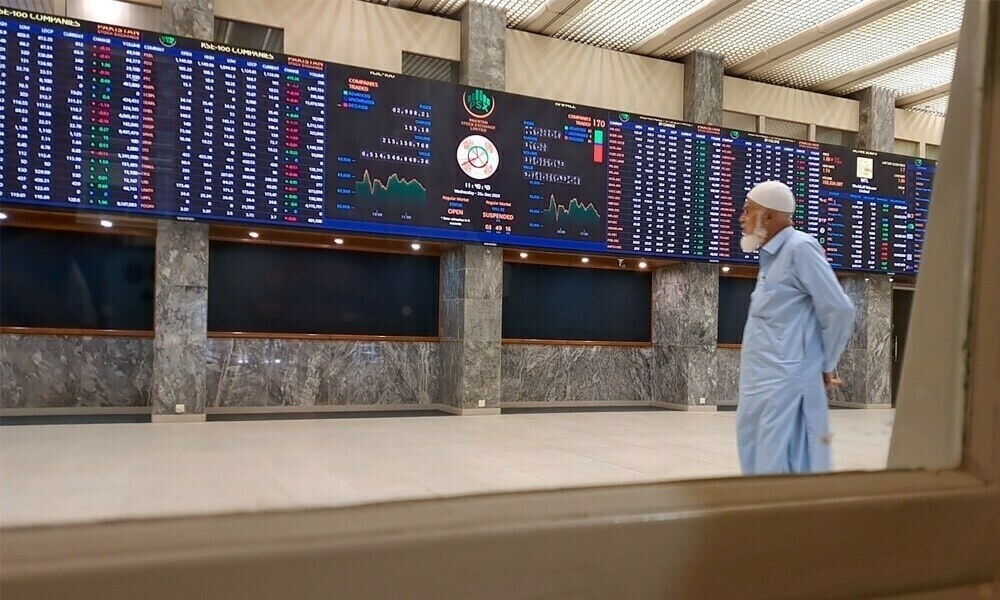

KARACHI: The Pakistan Stock Exchange (PSX) remained range-bound yet closed the week ended July 25, 2025, on a positive note, as investors weighed macroeconomic signals, anticipated monetary easing, and corporate earnings. The KSE-100 Index added 610 points, or 0.44 percent week-on-week (WoW), to settle at 139,207 points.
Despite the gain in index value, market participation was subdued. Average daily traded volume in the ready market dropped 16.7 percent to 635 million shares, while traded value in rupee terms slumped over 20 percent. Analysts attributed the dip in activity to the rollover week and a lack of strong domestic triggers.
Analysts noted that a pivotal driver of investor sentiment during the week was the long-awaited sovereign rating upgrade by S&P Global. After a hiatus of three years, Pakistan’s credit rating was lifted from CCC+ to B–, prompting a rally in long-dated Eurobonds which hit three-year highs.
The improved sovereign risk perception also helped the Pakistani rupee appreciate by 0.5 percent week-on-week to close at 283.45 against the US dollar—the strongest weekly gain in nearly two years.
Meanwhile, in the currency and debt markets, yields on treasury bills fell by 10–39 basis points, with the one-month paper declining to 10.85 percent. The SBP raised Rs 424 billion in the latest T-bill auction, more than double its target. This sharp decline in yields has fueled expectations that the central bank could cut the policy rate by 50 basis points in its upcoming Monetary Policy Committee (MPC) meeting scheduled for July 30.
According to AKD Securities, the central bank is now expected to resume monetary easing, targeting a policy rate of 10.5 percent, supported by cooling inflation. July’s Consumer Price Index (CPI) is projected to come in at 2.5 percent, down from 3.2 percent in June. Real interest rates are estimated at 8.5 percent, offering ample room for easing.
In another significant macro move, the government has formed a task force to tackle the Rs 2.8 trillion gas circular debt. JS Global reported that multiple strategies are under consideration, including commercial borrowing and the introduction of a special levy, aiming to resolve the crisis without burdening end consumers.
Other macro developments included a revised economic growth forecast from the Asian Development Bank (ADB), which pegged Pakistan’s FY25 GDP at 2.7 percent. Meanwhile, foreign direct investment showed tepid movement as repatriation of profits and dividends totalled US $2.2 billion for FY25, unchanged from the previous year. However, JS Global noted that the power sector saw the highest outflow of US $399 million, up 62 percent year-on-year.
Sector-wise, market performance was mixed. Food, auto assemblers, and Chemical outperformed with weekly gains of 6.2 percent, 4.2 percent, and 2.8 percent respectively, pharmas and power sector saw notable declines of 1.1 percent, 0.7 percent, and 0.6 percent respectively.
Among individual stocks, Unilever Pakistan Foods Limited (UPFL) led the charge with a 39.3 percent WoW gain. It was followed by Habib Growth Fund (HGFA) up 23.1 percent, First Habib Modaraba (FHAM) up 10.4 percent, and Atlas Honda (ATLH) which gained 10.2 percent. On the losing side, Pakistan Services Ltd (PSEL) fell 13.5 percent, Pakgen Power (PKGP) declined 8.8 percent, and Bannu Woollen Mills Limited (BWML) slipped 7.3 percent.
Investor flows indicated that foreign investors and other organizations remained net sellers, offloading $7.6 million and $8.5 million worth of equities, respectively. However, mutual funds and individual investors absorbed much of the selling with net purchases of $7.8 million and $5 million.
On the corporate front, earnings season has begun to reveal early trends. Honda Atlas Cars (HCAR) reported a strong annual rise in profit after tax to Rs828 million for 1QMY26, primarily driven by higher unit sales and lower input costs. However, AKD noted that gross margins were below expectations, partly due to increased marketing spend on HRV variants.
In the oil and gas sector, exploration and production companies are facing downward pressure. AKD expects sector-wide earnings to decline by 17 percent year-on-year due to lower production volumes, depressed oil and gas prices, and royalty payments. Nevertheless, improved cash collections are expected to sustain dividend distributions. The brokerage reiterated its ‘Buy’ ratings for OGDC, PPL, and POL with strong upside targets.
In the power sector, profitability is under stress as well. Earnings for key players like Hub Power and Nishat Power are projected to fall sharply, with some companies eyeing a pivot toward electric vehicles for growth. Nishat Power’s board has already approved a Rs2 billion equity investment in NexGen Auto in collaboration with China’s Chery Automobile.
The market commentators noted that market is treading cautiously upward, fueled by hopes of a monetary pivot and underpinned by improving macro indicators. With monetary policy, inflation, and earnings in focus, the coming weeks will likely determine whether the KSE-100 can break out from its current range and set sights on new highs.
Copyright Business Recorder, 2025
























Comments
Comments are closed for this article.