


Thailand, Cambodia exchange heavy artillery fire as border battle expands
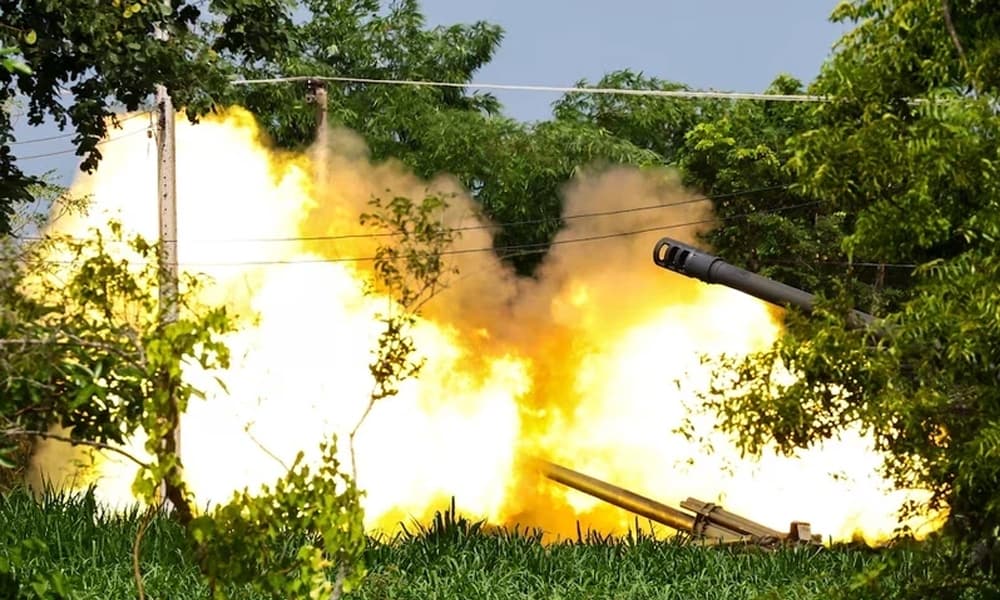

SURIN, (Thailand): Thailand and Cambodia exchanged heavy artillery fire for a second day on Friday as fighting intensified and spread, while Cambodia’s leader said Thailand had agreed to a Malaysian ceasefire proposal but then backed down.
At least 20 people have been killed and more than 130,000 people displaced in the worst fighting between the Southeast Asian neighbours in 13 years.
Both sides have blamed each other for starting the conflict and on Friday ratcheted up the rhetoric. Thailand accused Cambodia of deliberately attacking civilians and Cambodia condemned Thailand for using cluster munitions, controversial and widely condemned.
CEASEFIRE PROPOSAL
Thailand’s acting prime minister, Phumtham Wechayachai, said Cambodia had attacked on multiple fronts.
“The situation has intensified and could escalate into a state of war. At present, it’s a confrontation involving heavy weapons,” he told reporters.
Cambodian Prime Minister Hun Manet said in a social media post that he had agreed to a ceasefire proposed by his Malaysian counterpart Anwar Ibrahim, chair of the ASEAN regional bloc, who had informed him that Phumtham had also agreed.
“However, it is regrettable that just over an hour later, the Thai side informed that they had reversed their position,” Hun Manet said.
Thailand’s government did not immediately respond to a request for comment.
Anwar said both countries had agreed in principle to stop attacks, but that there were issues related to “some violations”. He made no mention of a Thai withdrawal.
Two senior Thai foreign ministry officials earlier said Bangkok had received offers of mediation from the US, Malaysia and China, but preferred to use bilateral mechanisms.
THAILAND ALLEGES ‘BARBARIC ACTS’
Fighting re-erupted before dawn on Friday, with clashes reported in 12 locations, up from six on Thursday, according to Thailand’s military. It accused Cambodia of using artillery and Russian-made BM-21 rockets to attack areas that included schools and hospitals.
“These barbaric acts have senselessly claimed lives and inflicted injuries upon numerous innocent civilians,” it said.
“The deliberate targeting of civilians is a war crime and those responsible must be brought to justice.”
It put the blame squarely on the Phnom Penh government, which it said was being steered by Hun Sen, influential former premier of nearly four decades and father of Hun Manet.
Reuters journalists in Thailand’s Surin province saw a Thai military convoy of about a dozen trucks, armoured vehicles and tanks cut across provincial roads ringed by paddy fields as it moved toward the border. Intermittent bursts of explosions could be heard.
Soldiers marshalled traffic on a rural road along which artillery guns were being loaded and fired in succession, emitting orange flashes, loud explosions and grey smoke.
The fighting started early on Thursday, quickly escalating from small arms fire to heavy shelling in multiple areas 210 km (130 miles) apart along a frontier where sovereignty has been disputed for more than a century.
Thailand on Thursday deployed an F-16 fighter jet to strike a Cambodian military target, underlining its military advantage.
Cambodia has no fighter aircraft and significantly less defence hardware and personnel. It appealed for the UN Security Council to address the issue.
PREAH VIHEAR TEMPLE REPORTEDLY DAMAGED
It said Thailand’s bombardments had caused “significant and visible damage” to the 11th-century Preah Vihear temple, a UNESCO World Heritage Site that both countries have laid claim to for decades.
Thailand’s military called the allegation “a clear distortion of facts”.
The trigger for the conflict was Thailand recalling its ambassador to Phnom Penh and expelling Cambodia’s envoy on Wednesday, in response to a second Thai soldier losing a limb to a landmine that Bangkok alleged had been laid recently by rival troops. Cambodia denied that.
Cambodia’s government on Friday expressed outrage at Thailand’s use of what it said was a large amount of cluster munitions, calling it a violation of international law.
Thailand’s military said Thailand was not a party to the Convention on Cluster Munitions but that it followed the principle of proportionality, “to enhance explosive destruction capabilities against military targets only”.
The death toll in Thailand rose to 19 on Friday, 13 of them civilians, with 62 people wounded. Cambodia’s government has not reported any casualties, but a provincial official said one person had been killed.
Thailand has prepared nearly 300 facilities for evacuees, more of which poured into shelters in Surin province after hearing shelling.
Elderly people dozed while others queued for food to be served by volunteers as children played outside. Some evacuees sifted through donated clothing, others sat talking on floor mats, recounting how they had fled the fighting.
“We heard very loud explosions, so we came here. We were so scared,” said Aung Ying Yong, 67, wiping away tears with a towel.
“So many people are in trouble because of this war ... we are very sad that we have to live like this.”






















Comments
Comments are closed for this article.