



Uniformity in gas pricing may make for clean regulation, but in Pakistan’s fragmented socioeconomic landscape, it often produces more friction than fairness. A case in point is Balochistan — where the prevailing gas tariff regime, especially the classification of almost all domestic consumers as “Non-Protected,” continues to compound marginalization and fuel systemic inefficiencies.
Under the current slab-based tariff system, “Protected” consumers — typically low-income users — receive heavily subsidized rates. But in Balochistan, where winter gas consumption is naturally high due to sub-zero temperatures and the widespread use of gas for space heating, even low-income households routinely exceed the consumption threshold and are pushed into the Non-Protected category. As a result, poorer consumers face higher gas tariffs — in some cases exceeding industrial rates, irrespective of their actual capacity to pay.
This pricing mismatch has done more than just burden household budgets. It has incentivized theft, tampering with meters, and bypassing infrastructure in areas where UFG (unaccounted for gas) already exceeds 50 percent. The socioeconomic impact has been no less severe. In a province already grappling with poverty and underdevelopment, high winter gas bills have only reinforced the perception of resource inequity and policy neglect — especially when 75 percent of domestic consumers elsewhere remain in the Protected bracket and benefit from over Rs100 billion in annual subsidies.
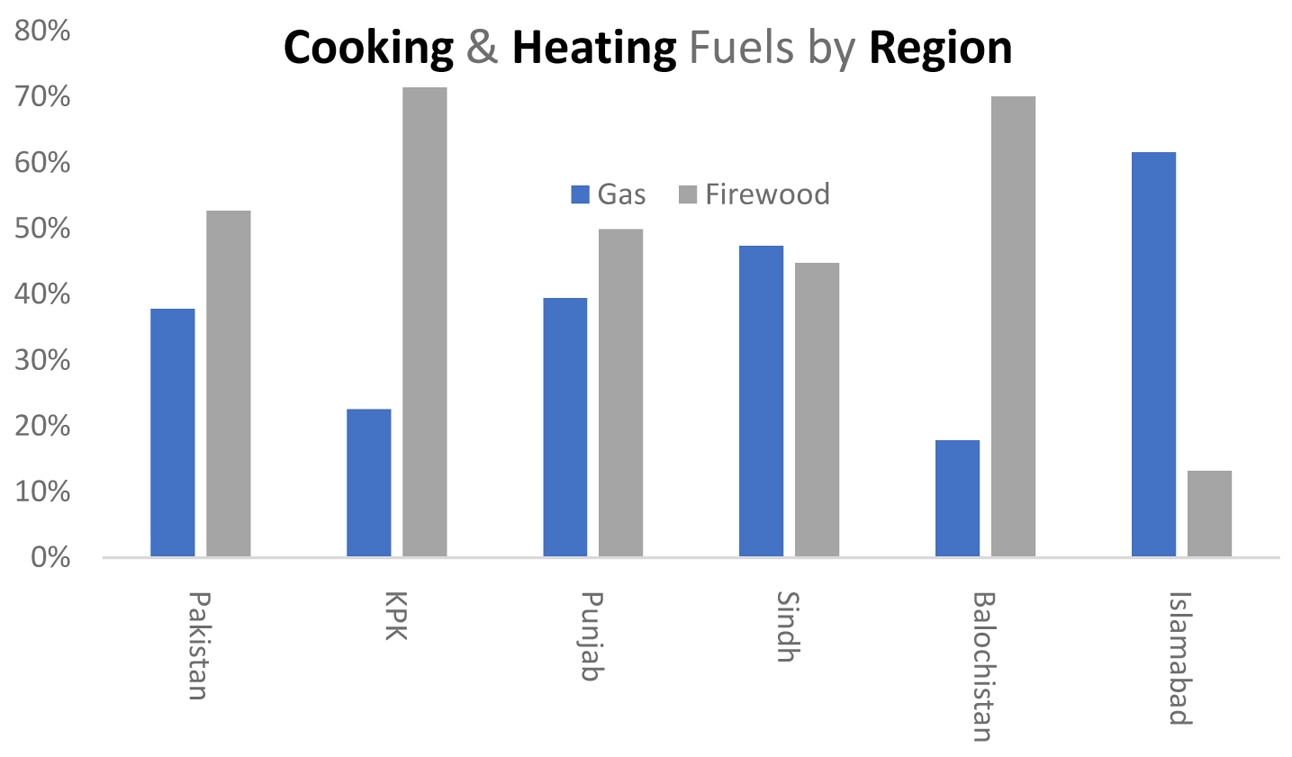
Crucially, the disparity isn’t just anecdotal — it’s visible in household energy usage patterns. As per the Population Census 2023, Balochistan has the lowest share of households using gas for cooking and heating (just 17 percent), despite being one of the coldest regions. In contrast, over 70 percent rely on firewood, exposing the population to indoor air pollution and deforestation. This underscores a troubling reality: even where gas pipelines exist, access does not always translate into affordability. The pricing structure is effectively pushing vulnerable communities toward more hazardous and less sustainable energy sources.
It’s not that Balochistan consumes more gas by choice — it does so out of necessity. Linking subsidy eligibility purely to volume — without accounting for regional weather conditions or heating needs — results in an urban policy lens being applied to a province that exists in a very different climate, both literally and figuratively.
Encouragingly, SSGC’s latest revenue petition acknowledged the challenge and recommends extending the Protected tariff slab for colder regions, adjusting eligibility to cover up to 3.6 HM³ of consumption during harsh winters. Such a recalibration would recognize temperature-driven consumption rather than penalize it — and may be a necessary first step toward a regionally nuanced subsidy framework.
The principle of uniform tariffs is commendable in theory — but unless accompanied by contextual fairness, it risks undermining its own purpose. In Balochistan, gas is not a luxury — it is survival. A slab-based pricing system that ignores that may be legal, but it is not just.




















Comments
Comments are closed for this article.