


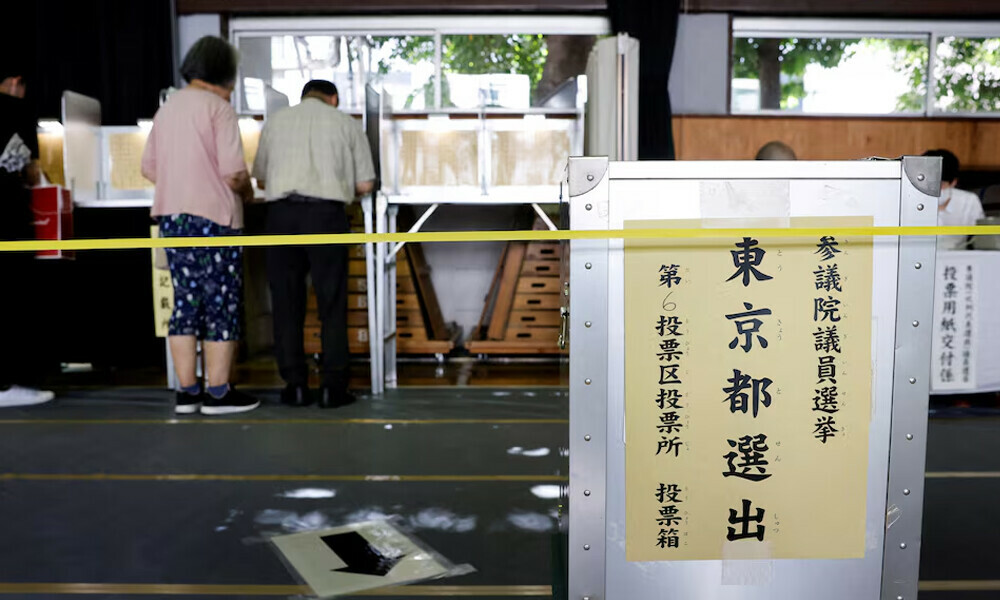

TOKYO: Japanese voters headed to the polls on Sunday in a tightly contested upper house election that could unleash political turmoil, with rising prices and immigration concerns threatening to weaken Prime Minister Shigeru Ishiba’s grip on power.
Opinion polls suggest Ishiba’s Liberal Democratic Party and coalition partner Komeito may fall short of the 50 seats needed to retain control of the 248-seat upper house of parliament in an election where half the seats are up for grabs.
The polls show that smaller opposition parties pushing for tax cuts and increased public spending are set to gain, among them the right-wing Sanseito, which vows to curb immigration, oppose foreign capital inflows and reverse gender equality moves.
“I am attending graduate school but there are no Japanese around me. All of them are foreigners,” said Yu Nagai, a 25-year-old student who said he voted for Sanseito.
“When I look at the way compensation and money are spent on foreigners, I think that Japanese people are a bit disrespected,” Nagai said.
Voting ends at 8 p.m. (1100 GMT), when media are expected to project results based on exit polls.
A poor showing by the coalition could shake investor confidence in the world’s fourth-largest economy and disrupt critical trade talks with the United States, analysts said.
Ishiba may have to choose between making way for a new LDP leader or scrambling to secure the backing of some opposition parties with policy compromises, said Rintaro Nishimura, an associate at the Asia Group in Japan.
“Each scenario requires the LDP and Komeito to make certain concessions, and will be challenging, as any potential partner has leverage in the negotiations.”
After the election, Japan faces a deadline of August 1 to strike a trade deal with the United States or face punishing tariffs in its largest export market.
Such import levies could squeeze the economy and further pressure the government to give financial relief to households already reeling from inflation, including a doubling of rice prices since last year.
Japan will continue trade talks with US for mutually beneficial deal, Ishiba says
With an eye on a jittery government bond market, the LDP has called for fiscal restraint and rejected opposition calls for major tax cuts and welfare spending to soften the blow.
Ishiba’s administration lost its majority in the more powerful lower house in October.
That was the LDP’s worst showing in 15 years, roiling financial markets and leaving the prime minister vulnerable to no-confidence motions that could topple his administration and trigger a fresh general election.
“The LDP has been running the government without resolving anything,” said Kaoru Kawai, a 59-year-old novelist who voted for the opposition Constitutional Democratic Party of Japan.
Ruled by the LDP for most of the post-war period, Japan has so far largely avoided the social division and fracturing of politics seen in other industrialised democracies.


























Comments
Comments are closed for this article.