


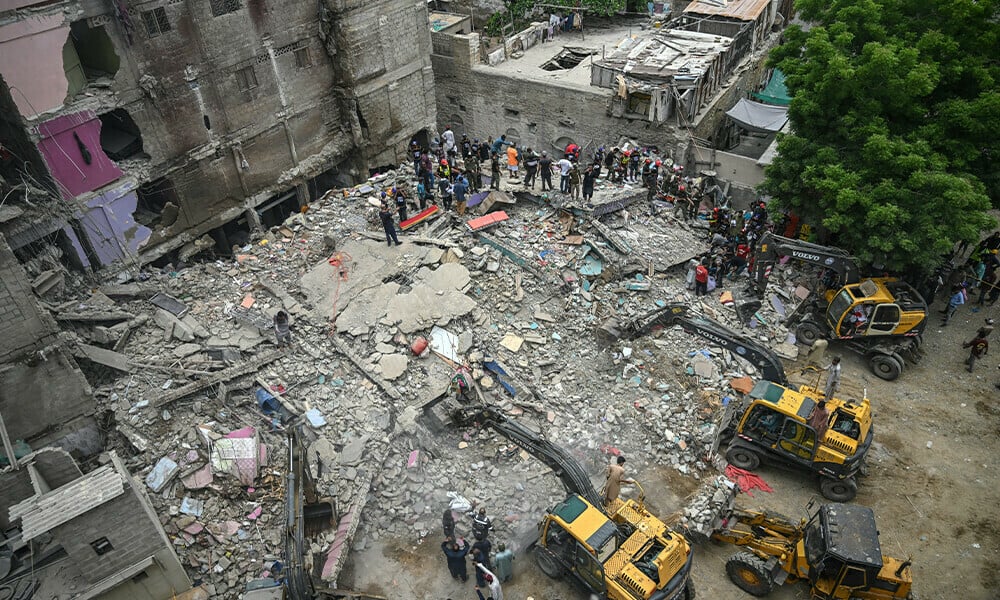
EDITORIAL: For all the death and despair it caused, the Lyari building collapse may finally have shaken the system into some action. At least nine neighbouring buildings have been marked for evacuation and demolition. A five-member committee has been formed. And for once, even the Sindh governor has publicly promised consequences and compensation. But if this tragedy is going to be a turning point, it’ll have to do much more than trigger temporary outrage and a few token demolitions.
This wasn’t just a random structural failure. It was criminal negligence, facilitated by a culture of impunity that extends from corrupt developers to complicit regulators. The Association of Builders and Developers (ABAD) has pointed to a systemic rot – unsafe, unauthorised constructions spreading across Karachi, aided by kickbacks, ignored violations, and an administration that turns a blind eye. In fact, 12 building collapses in recent years have already killed at least 150 people. How many more have to die before this is called what it is: manslaughter by design?
Even now, residents of the affected area are protesting. Not because they want to live in crumbling buildings, but because the state has given them no safe alternative. Many of them paid for these homes with everything they had – only to be told their properties were never legal, never safe, and now being bulldozed without compensation or relocation plans. It is impossible to ignore the human cost of this breakdown. And it’s even harder to ignore that it stems from a chain of greed, from the illegal floor constructed with a bribe to the planning permission granted under the table.
ABAD’s press conference didn’t pull punches. It revealed that MDA and LDA have collected more than Rs25 billion over seven years for housing schemes that were never delivered. It also accused government departments, police, and regulators of being fully aware of what’s happening – and taking their cut anyway. And in what should be an indictment of the entire system, the chairman warned that many building owners now simply wait for their structures to collapse so they can reclaim the land and start afresh.
The Sindh Building Control Authority (SBCA), of course, issued notices after the latest collapse, and has now started a safety drive. But the question must be asked: where were these notices before 27 people lost their lives? And where was the oversight when the building was being illegally modified, sold, and occupied?
Now, the state is trying to present a more humane face. Governor Kamran Tessori has promised 80-square-yard plots, six months’ rent, and ration supplies for displaced families. But even if all of that is delivered, which is a big ‘if’, it won’t fix what’s broken. Karachi’s urban landscape is collapsing not just physically, but institutionally. This city has become a maze of unregulated growth, hollowed out by political patronage, administrative decay, and private profiteering.
If there’s any silver lining to be drawn from this moment, it’s the sliver of urgency now visible across officialdom. But that will mean nothing unless it’s followed by structural reform. ABAD has offered to help rebuild the unsafe buildings in 700 days and construct 100,000 homes if the government cooperates. If the state is serious, now is the time to test that offer.
Karachi is still growing, still building – but mostly on lies, kickbacks, and unsafe foundations. Until there’s accountability from top to bottom, from the man who fakes a building plan to the officer who signs off on it, the city will keep burying its poor under the rubble of its own corruption.
Copyright Business Recorder, 2025

























Comments
Comments are closed for this article.