


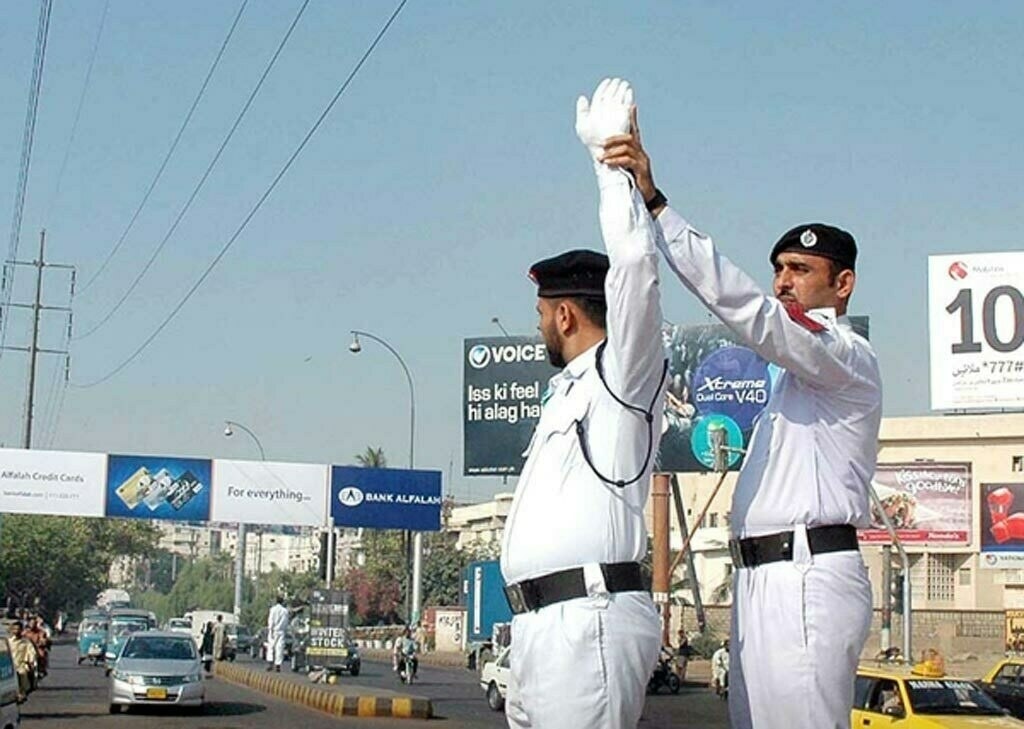

KARACHI: A high-level delegation of Jamaat-e-Islami (JI) Sindh, led by provincial chief Kashif Saeed Sheikh, has met with DIG Traffic Karachi Pir Muhammad Shah, voicing serious concerns over worsening traffic conditions.
According to the JI on Tuesday, the delegation raised important issues such as repeated accidents involving dumpers, and what they described as the “humiliation of citizens” under the pretext of enforcing new vehicle number plates.
The JI delegation, which included Karachi Chief Munem Zafar Khan, Hafiz Nasrullah Channa, General Secretary Muhammad Yousuf, Allama Hizbullah Jakhro, Muslim Pervez, and Zahid Hussain Rajpar, criticized the ongoing traffic crackdown in various parts of the city.
They highlighted how traffic police were issuing what they called “unnecessary and excessive challans,” particularly in relation to the rollout of new number plates bearing Ajrak patterns — a cultural symbol of Sindh.
“Ajrak represents Sindh’s heritage, but using it to justify economic exploitation and public humiliation is unacceptable,” said Kashif Saeed Sheikh. “The traffic police’s behaviour has crossed a line — this is no longer about traffic regulation but about infringing on people’s dignity.”
Sheikh emphasized that JI respects constitutional and civil law but asserted that the authorities’ handling of the number plate issue constituted a violation of basic human rights.
He questioned the imbalance between Karachi’s deteriorating road infrastructure — which he likened to “Mohenjo-Daro” — and the imposition of enforcement measures resembling those in Dubai or Europe. “This mismatch is an injustice and a form of oppression,” he said.
The delegation claimed that the current enforcement drive had become a new source of financial and emotional strain for Karachi’s residents, who are already reeling under inflation and rampant street crime. They alleged widespread corruption in the issuance of number plates and a lack of transparency in how fines are administered and collected.
“Changing a number plate shouldn’t require months of follow-up, police harassment, and heavy penalties,” said Munem Zafar Khan. “The real issue lies in systemic corruption and the unaccountable behaviour of the traffic police, not the number plates themselves.”
In response, DIG Traffic Pir Muhammad Shah acknowledged the grievances and assured the delegation that his department would develop a strategy to provide relief to the public. He pledged to address concerns related to traffic congestion, plate issuance delays, and public treatment — especially under the framework of the city’s broader Safe City initiative.
During the meeting, the JI delegation also offered condolences to the DIG on the recent passing of his father, praying for the departed soul’s elevation.
The JI leadership urged the provincial government to reconsider the number plate policy, end the heavy-handed fines, and prioritize reforms that bring transparency and dignity back to traffic enforcement in Karachi.
Copyright Business Recorder, 2025




















Comments
Comments are closed for this article.