


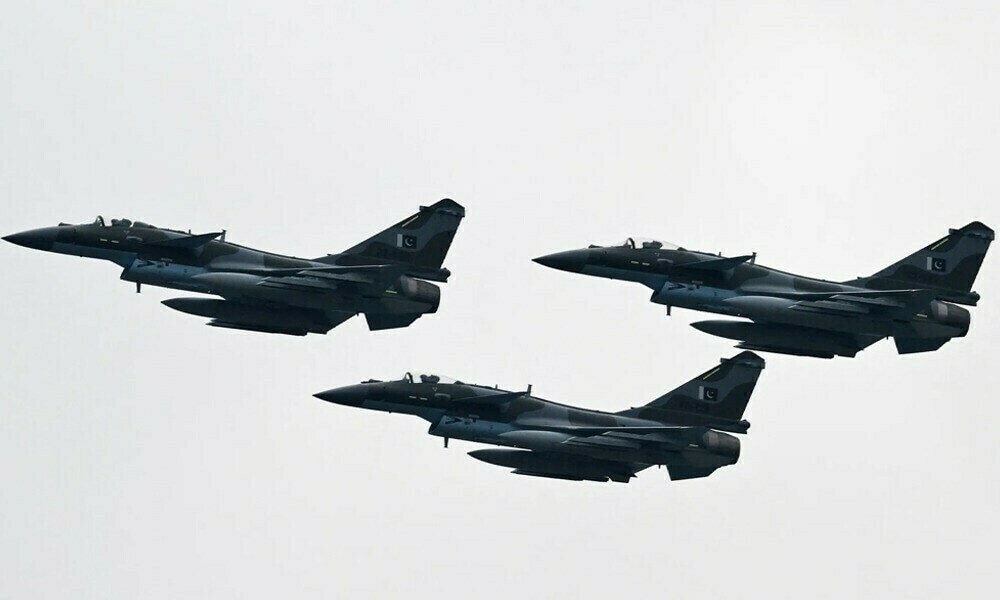
EDITORIAL: The Pakistan Air Force (PAF) has always drawn praise from everyone – not through grandstanding, but by delivering whenever it is tested.
The latest nod came from the Chief of Staff of China’s People’s Liberation Army Air Force, Lieutenant General Wang Gang, who called the PAF’s performance in the recent war with India “a textbook example of precision, discipline, and courage” in the face of unprovoked aggression. The remark came during a high-level visit to Air Headquarters in Islamabad, where General Wang also noted China’s keen interest in learning from the PAF’s battle-tested integration of Multi-Domain Operations, which says a lot.
That’s not a compliment Beijing hands out lightly – especially given its own airpower ambitions. But for those who’ve watched the PAF over the decades, this shouldn’t come as a surprise.
The Pakistan Air Force has always punched well above its weight. It captured international attention during the 1965 war, when a much smaller fleet held its own against a numerically superior Indian Air Force. Some of its wartime manoeuvres became case studies in combat aviation. The legend only grew over time – with stories of PAF pilots flying for Arab states and downing Israeli jets during the Yom Kippur War becoming part of regional military lore.
Even in peacetime, the service maintained its edge, consistently training to a standard that attracted foreign observers, joint drills, and deep bilateral engagements – not least with China, which co-developed the JF-17 Thunder with Pakistan. That same platform has since matured into a credible deterrent force, operated by highly trained PAF squadrons who’ve adapted to modern hybrid warfare challenges without bloating the budget.
What’s more, the PAF’s operational discipline and strategic clarity often stand in contrast to the disarray that marks other parts of the country’s institutional machinery. Whether it’s political paralysis, economic stasis, or diplomatic drift, Pakistan struggles to project stability in most arenas – except when its military, particularly its air wing, is in frame.
So when China singles out the PAF for praise – and explicitly expresses a desire to learn from it – the statement carries weight beyond flattery. It confirms what military analysts have long argued: that the Pakistan Air Force remains one of the region’s most competent and coherent fighting forces.
It also reinforces the reality that Pakistan’s strategic partnerships are not just alive – they’re evolving. China is not lavishing praise as a favour; it is acknowledging value. A battle-tested, professionally run air force with multi-domain integration capabilities is an asset, especially as China gears up for its own next-generation military transformation. And for Pakistan, deeper integration with China’s airpower doctrines and technologies could be the edge it needs to maintain parity with a larger neighbour constantly updating its arsenal.
Yet there’s a larger implication here, one worth noting. Pakistan’s military, and the PAF in particular, has remained committed to hard capability even as fiscal realities have shrunk civilian development space. One might argue whether this allocation of resources is sustainable – that’s a different debate – but there is little doubt that it has paid operational dividends.
For a country still fighting an internal insurgency, struggling with fiscal meltdown, and burdened by political disarray, having one institution consistently deliver competence and reliability on the global stage is more than just optics – it’s leverage.
That’s not to say the country can fly on the wings of the PAF alone. But when the civilian leadership is largely absent from diplomatic or economic strategy, and parliament rarely debates serious national security matters, such moments of international recognition carry weight far beyond military circles.
They serve as reminders of what disciplined focus can achieve, even under systemic stress.
So yes, the PAF deserves the recognition. Not just for what it did this summer, but for the decades of consistency, evolution, and excellence that led up to it. If anything still commands quiet respect for Pakistan abroad, it’s not its economy, its democracy, or its diplomacy. It’s the precision of its pilots.
And they’re still flying high.
Copyright Business Recorder, 2025

















Comments
Comments are closed for this article.