


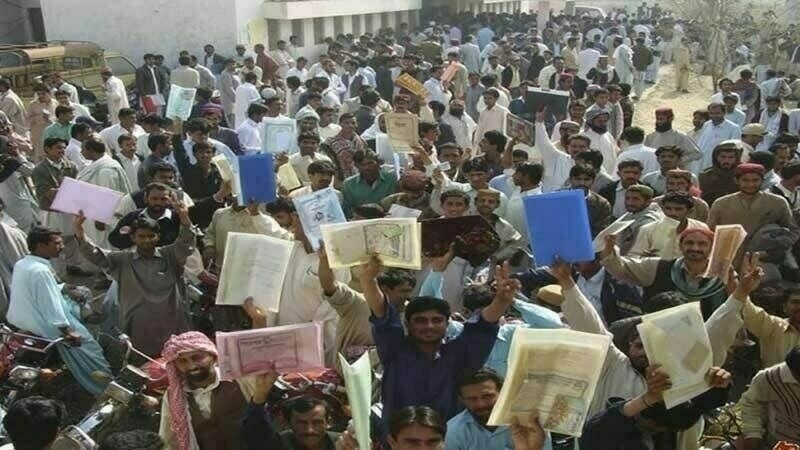
EDITORIAL: Unemployment is as high as 22 percent, according to academician Dr Hafiz A Pasha, citing the first-ever digitally-held seventh Population and Housing Census 2023 — higher for males at around 30 percent and 17 to 18 percent amongst women.
The discrepancy in the unemployment rate between males and females requires clarification as perhaps the lower unemployment rate for women is limited to those actively seeking a job, which is difficult to assess, given the fact that women’s contribution to the GDP is undervalued in most economies as their output in the home and the agriculture sector is not quantified.
Be that as it may, Dr Pasha proceeded to challenge the Labour Force Survey by stating that it consisted of a sample, which was less than one percent that led him to conclude that the higher unemployment rate reflected the increased unemployment amongst the youth — a source of concern that perhaps reflects the increase in crime rates throughout the country in recent months.
The high unemployment rate is partly on the back of a low Gross Domestic Product growth for the past three years, lower than the regional average, which is attributable to the tight monetary and fiscal policy conditions set by the International Monetary Fund and agreed by the economic team leaders.
In 2022-23, growth was negative 0.2 percent (against 6.2 percent the year before) followed by 2.5 percent in 2023-24 (on the back of a low base the year before) and 2.8 percent in 2024-25 — a growth rate that does not reflect (i) a rise in revenue collections, given the decline from 12.6 percent of GDP in 2023-24 to 11.7 percent in 2024-25 as per the recent Economic Survey or (ii) a decline in negativity in large-scale manufacturing sector, which registered negative 1.52 percent July-April 2025 against 0.26 percent in the comparable period the year before.
The unemployment statistic as well as other quality of life indices require an urgent focus by the economic team leaders who disturbingly appear to be focused entirely on incurring debt — be it from friendly countries or from multilaterals — to contain the budget deficit while raising revenue targets each year to be achieved through raising taxes mainly on existing taxpayers and bringing more items under the sales tax net (an indirect tax whose incidence on the poor is greater than on the rich).
The bravado displayed by previous finance ministers as well as chair of the Federal Board of Revenue (FBR), including the incumbents, that they would ensure enforcement of tax measures to generate higher revenue is misplaced as it belies an obvious fact: the ongoing heavy reliance on indirect taxes for revenue generation (inclusive of withholding taxes in the sales tax mode and dishonestly crediting them under direct taxes as well as the high petroleum levy payable by the common man though not collected by the FBR and placed under other taxes) is crippling the capacity of the common man to sustain his quality of life.
The current Chairman of the FBR threatened tax evaders (illegal) and avoiders (an outcome of the lacunae provided by the tax system) that he would not let anyone off the hook must be appreciated though unfortunately he then proceeded to give the example of indirect taxes payable by the sugar millers who, he claimed, were evading taxes which, one may assume, were passed onto the end consumers that no doubt account for the 40 percent increase in sugar prices since November 2024. What is urgently required is a shift away from reliance on indirect taxes and on direct taxes.
And what must be a further source of concern for the cabinet is the rise in poverty levels to a very disturbing 44.2 percent as determined by the World Bank. It is imperative for the government to look holistically at the economy rather than at the rate of inflation (which has certainly come down) and the debt-based foreign exchange reserves. At present, the latest macroeconomic data indicates a recession that the general public is too hard-pressed to withstand.
Copyright Business Recorder, 2025
























Comments
Comments are closed for this article.