


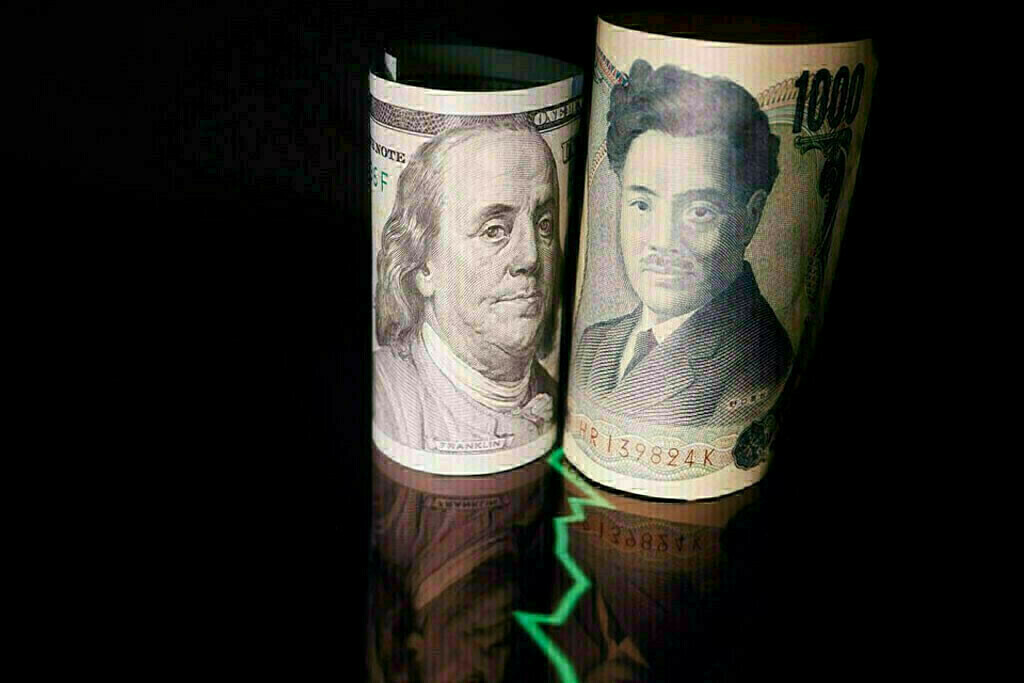

SINGAPORE: The yen fell broadly on Tuesday while the dollar held steady as U.S. President Donald Trump unveiled 25% tariffs on goods from Japan and South Korea in the latest development of his chaotic trade war.
Trump on Monday began telling trade partners – from powerhouse suppliers like Japan and South Korea to minor players – that sharply higher U.S. tariffs will start August 1.
He later said that he was open to extensions if countries made proposals.
The announcement rattled investor sentiment, sending the Japanese yen and South Korean won down roughly 1% overnight.
Both currencies remained under pressure early on Tuesday, with the yen falling to a two-week low of 146.44 per dollar.
The won rose 0.4% to 1370.20 per dollar.
US dollar flat to slightly lower
Investors entered the week with much confusion over Trump’s tariff plans ahead of an initial July 9 deadline. While the new August 1 date offers a brief reprieve, the outlook remains uncertain and global economic concerns persist.
“There is still a lot of uncertainty as to where tariff rates will eventually settle and which countries will get what rates, so uncertainty about the global economy is still high and that will keep investors on edge for the time being,” said Carol Kong, a currency strategist at Commonwealth Bank of Australia.
“This is just the start and we’ll get more headlines out for sure over the coming days.”
Japanese Prime Minister Shigeru Ishiba said on Tuesday that Japan would continue negotiations with the United States to seek a trade deal that benefits both countries.
South Korea has said it plans to intensify trade talks with the U.S. and views Trump’s plan for a 25% tariff from August 1 as effectively extending a grace period on implementing reciprocal tariffs.
Other currencies meanwhile gained some ground on Tuesday, after sliding in the prior session when the dollar rebounded.
The euro was up 0.27% to $1.1741 after having slid 0.67% on Monday, while sterling edged up 0.17% to $1.3626.
The European Union will not receive a letter from the United States setting out higher tariffs, EU sources familiar with the matter told Reuters on Monday, and is eyeing possible exemptions from the U.S. baseline levy of 10%.
Dollar holds gains
Against a basket of currencies, the dollar was little changed at 97.40, holding on to most of its gains from Monday when it rose 0.5%.
The Australian dollar last traded 0.32% higher at $0.6513, having tumbled 0.9% in the previous session as risk appetite soured.
The New Zealand dollar advanced 0.22% to $0.6015, reversing some of Monday’s 0.8% fall.
The Reserve Bank of Australia announces its rate decision later on Tuesday, where expectations are for the central bank to deliver another rate cut owing to easing inflation and a slowing economy.
“Given the ever-shifting balance of risks and the heightened uncertainty it creates for hiring and investment in the Australian economy, more RBA cuts are set to follow,” said Carl Ang, fixed income research analyst at MFS Investment Management.
“A 3.1% terminal rate by early 2026 remains the base case for this RBA cutting cycle.”




















Comments
Comments are closed for this article.