


Tax on imported solar panels: what does it mean for Pakistan’s renewable energy future?
- Govt insists tax decision balances fiscal needs while maintaining support for clean energy
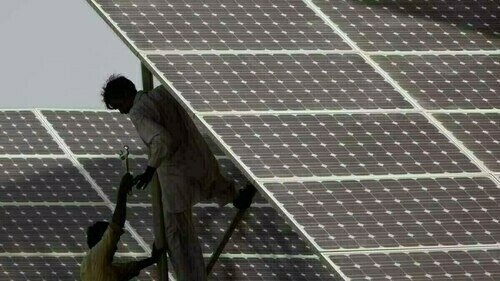
KARACHI: The recent move in the federal budget 2025-26 to impose a 10% tax on imported solar panels marks a critical turning point in the country’s renewable energy journey, while impacting consumers and dealers, according to economic nationalists and clean energy advocates.
It could also ramp up investments in local solar panel manufacturing.
After an initial proposal of an 18% tax was rolled back after the industry’s reaction-cum-pushback, the newly-approved 10% levy is due to push up panel prices by 8%–10% starting from July 1, directly impacting consumers and dealers.
The government insists this decision balances fiscal needs while maintaining support for clean energy.
However, Pakistan has witnessed a historic solar boom, while becoming the world’s largest importer of solar panels in 2024.
Ali Majid - LONGi Green Energy Technology Co Ltd General Manager Central Asia and Middle East and North Africa - said Pakistan’s solarisation momentum faces challenges with the 10% tax on imported panels.
Speaking to Business Recorder, he said he believes a long-term drive for clean energy, along with local initiatives to boost domestic solar manufacturing and optimize supply chains, can help mitigate cost impacts.
LONGi said it is committed to working with stakeholders, offering efficient, cost-competitive products and solutions, to support Pakistan in sustaining its solar growth trajectory despite these short-term hurdles.
Majid said for households and industries, the tax-driven price hike will add to energy cost burdens. But LONGi aims to ease the impact.
According to Majid, “We’ll leverage our global scale, research and development (R&D) strength, and local presence to provide high-efficiency, reliable solar products at optimized costs.”
“By promoting distributed generation and energy-saving solutions, we help reduce long-term energy expenses, supporting both sectors to navigate inflationary pressures and still embrace solar benefits.”
‘Solar continues to be the smarter long-term choice’
Meanwhile Livoltek’s Pakistan Director Sales, Max Ma, said the 10% tax will slightly scale up solar system costs, but grid electricity remains significantly more expensive and unreliable.
He told Business Recorder that while some price-sensitive customers may hesitate initially, solar continues to be the smarter long-term choice—especially with net-metering and financing options.
He said, “At Livoltek, we’re focused on easing this transition by offering high-efficiency inverters and energy storage solutions that maximize return on investment.”
“Our nationwide support network and after-sales service ensures customers feel confident in choosing solar. We believe the shift to clean energy will continue, and Livoltek remains committed to making it both accessible and sustainable for Pakistani households and businesses.”
He added that this policy could be a stepping stone toward local manufacturing—if supported by government-backed incentives, infrastructure investment, and R&D facilitation.
As a global clean energy brand with a growing footprint in Pakistan, Livoltek says it is already exploring localized assembly and partnerships to enhance supply chain resilience and cost efficiency.
Max Ma said, “We are prepared to play an active role in building a stronger local ecosystem. Encouraging domestic manufacturing can reduce import reliance, create jobs, and stabilize prices. But it requires a collaborative effort between the private sector and policymakers to turn this into a national success story.”
‘Demand for solar remains resilient’
Business Recorder also spoke to analyst Usman Suhail said the 10% levy on imported solar panels is likely to increase retail prices, creating immediate cost pressure on both residential and commercial buyers.
This price hike may temporarily slow down new solar installations, especially in the lower-income and small business segments that were driving the recent boom.
However, demand for solar remains resilient due to ongoing grid instability and rising electricity tariffs.
“Rather than a mass shift back to grid electricity, we may see a slowdown in new installations, not a reversal. On the upside, this move could incentivize serious investment in local solar panel manufacturing, which has long struggled to gain traction due to cheaper imports. But establishing competitive local supply will require policy support, quality assurance, and technology transfer,” he said.
In the short term, price sensitivity could reduce sales volume, but the long-term market fundamentals still favor solar—if supported by consistent policy and incentives for local production.

















Comments
Comments are closed for this article.