


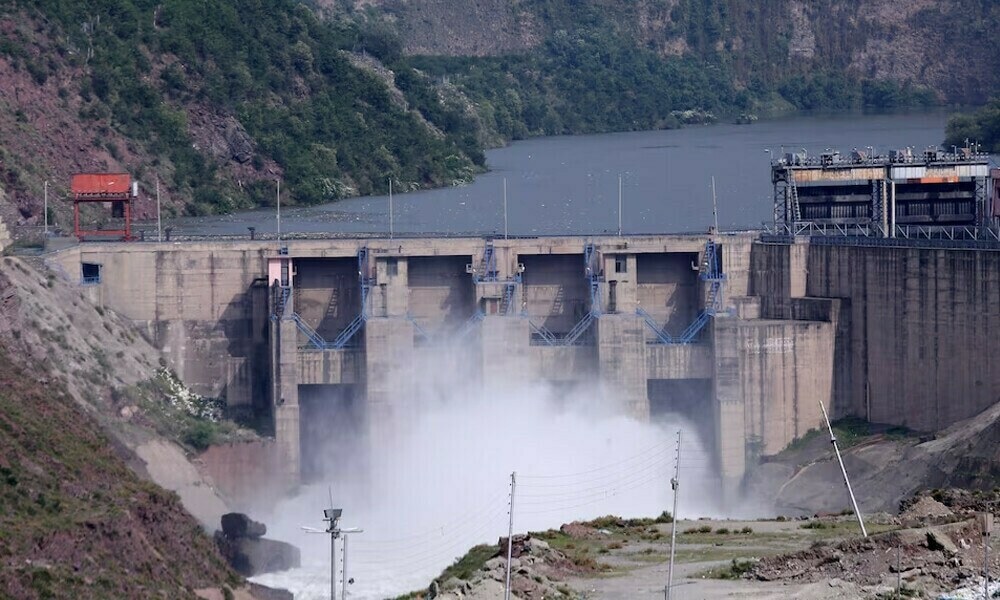
EDITORIAL: For a problem of such scale as funding mega storage dams to deal with India’s water aggression, slapping a 1 percent tax on every taxable product — except electricity and medicines — is not a solution; it’s a panic response masquerading as policy. That this is the best the federation could come up with to counter what it itself calls an act of war — India putting the Indus Waters Treaty in abeyance — only highlights how limited its strategic thinking really is.
The core issue isn’t just about funding dams. It’s about the quality of the national response to a growing existential threat. And it’s becoming painfully clear that there isn’t enough of it. Provinces won’t contribute. The federal government, despite all the alarm, has cut water sector allocations by nearly 30 percent.
The IMF, understandably, won’t sign off on another broad-based tax when existing public development allocations are already underused or mis-prioritised. So if the 1 percent tax goes through, the burden will fall — yet again — on the already taxed sectors of the formal economy. No mention is made of how to involve, let alone tax, the very large undocumented economy.
The state’s numbers don’t inspire confidence either. Diamer-Bhasha and Mohmand dams were approved in 2018. Seven years later, they still require Rs540 billion just to reach completion — and that too based on outdated cost estimates. Yet next year’s budget allocates only Rs25 billion and Rs35.7 billion to them, respectively. At this pace, even the ministry of water resources admits it could take up to 20 years to finish the job. But the public is being told, without irony, that both will be completed by 2030.
What’s worse, the logic behind this new tax crumbles on contact with reality. The IMF has already advised the government to reprioritise within the Rs1 trillion Public Sector Development Programme (PSDP) envelope instead of adding another blanket levy. But of that trillion, only Rs640 billion is actually available. The rest is tied up in road projects, provincial schemes, and politically sensitive special area allocations. Clearly, priorities are elsewhere.
There is also no discussion of accountability. The Gas Infrastructure Development Cess (GIDC) fiasco — where over Rs400 billion collected from the public still hasn’t been deposited by private companies — hangs like a cautionary tale. It’s one thing to announce a cess; it’s quite another to recover and utilise it. Even the latest attempt to enforce GIDC collections, via a committee under the finance minister, is crawling along — exactly like all its predecessors.
The method of legislation also raises eyebrows. Since the courts have ruled that cesses must be purpose-specific and passed via separate legislation, the government cannot route this through the Finance Act. Hence, the need for a new bill. But the timing is suspect — trying to quietly pass a new blanket tax amid ongoing IMF negotiations and budget debates, while bypassing real public discourse.
And where are the provinces in all this? With the exception of Khyber Pakhtunkhwa, none is willing to co-fund what are clearly national priority projects. Sindh, for instance, has gone from a reported surplus of Rs395 billion in March to suddenly projecting a Rs38.5 billion deficit — directly undermining the IMF’s target of Rs1.4 trillion in combined provincial surpluses. That makes coordination not just difficult but dysfunctional.
This is not how strategic planning works. When the threat is as serious as a hostile upstream neighbour weaponising water, the response cannot be ad hoc taxation, weak coordination, and creative accounting. It requires hard conversations, difficult decisions, and, above all, clarity of purpose — none of which is currently in evidence.
The question, then, isn’t just whether this 1 percent tax is justified. It’s whether the people being asked to pay it have any reason to believe the state knows what it’s doing.
Copyright Business Recorder, 2025




















Comments
Comments are closed for this article.