




Amid ongoing economic challenges and global uncertainties, remittances from overseas Pakistanis again emerged as a critical pillar of stability for the country’s economy in FY25 with record-breaking inflows and sustained monthly growth.
The latest figures for May 2025 and the cumulative performance over the first eleven months of the fiscal year highlight the growing importance of this financial lifeline—and the need to safeguard it against emerging risks.
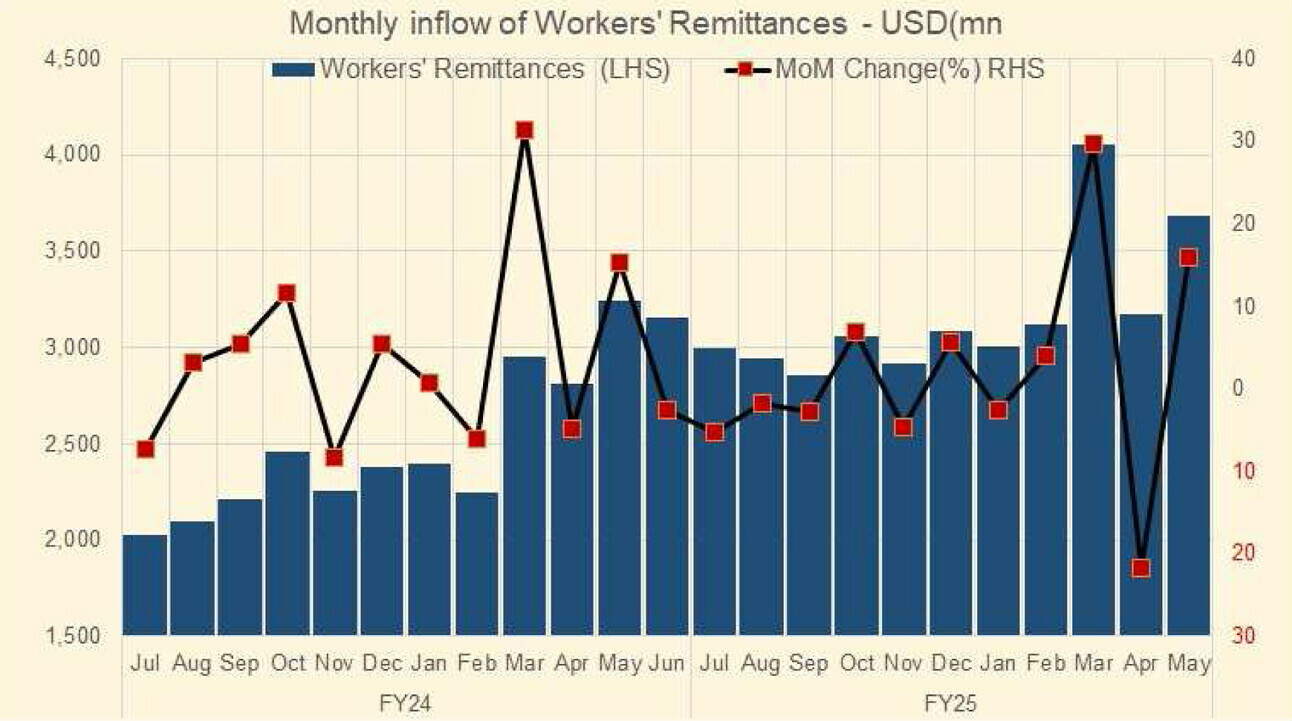
In May 2025, Pakistan received $3.7 billion in workers’ remittances, marking a 16 percent increase month-on-month, and a 14 percent rise year-on-year. This made it the second-highest monthly inflow on record, following the peak of $4.1 billion recorded in March 2025.
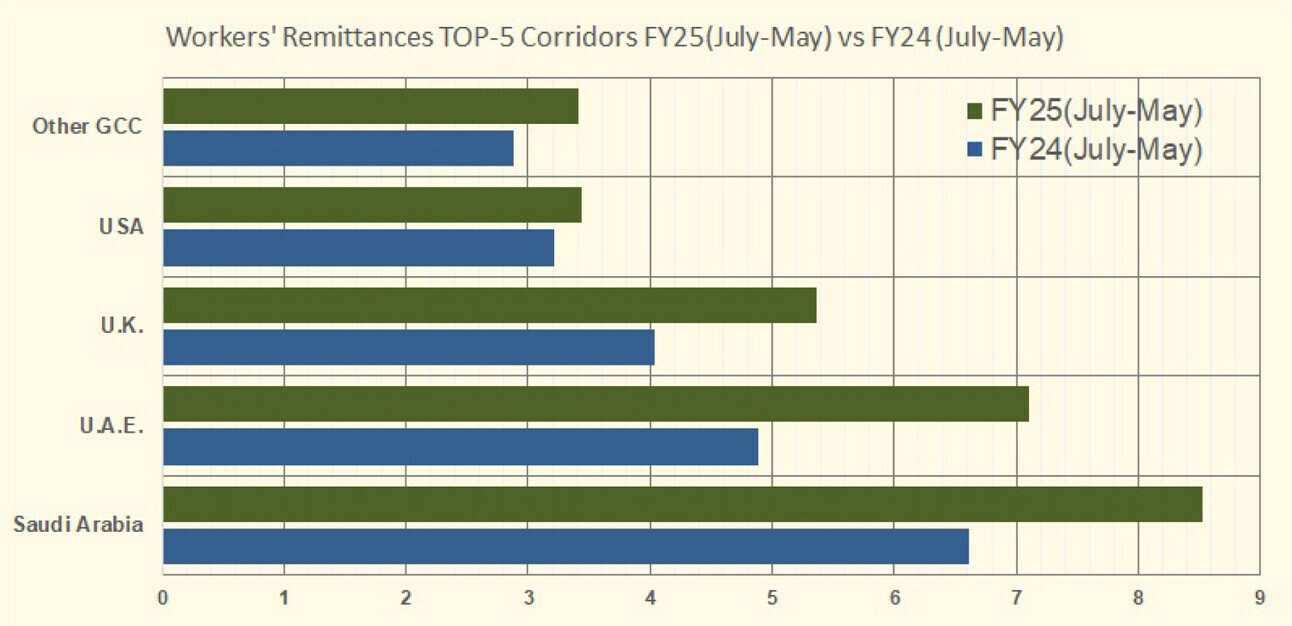
The inflows were led by Saudi Arabia, which contributed $913.9 million, followed by the UAE with $754.2 million, the UK with $588.1 million, and the US with $314.7 million.
A combination of factors contributed to this robust performance, including seasonal generosity following Ramadan and the 2 Eids, a stable exchange rate, and the government’s efforts to clamp down on informal money transfer channels. These measures helped redirect remittance flows into formal banking systems, boosting transparency and overall volume.
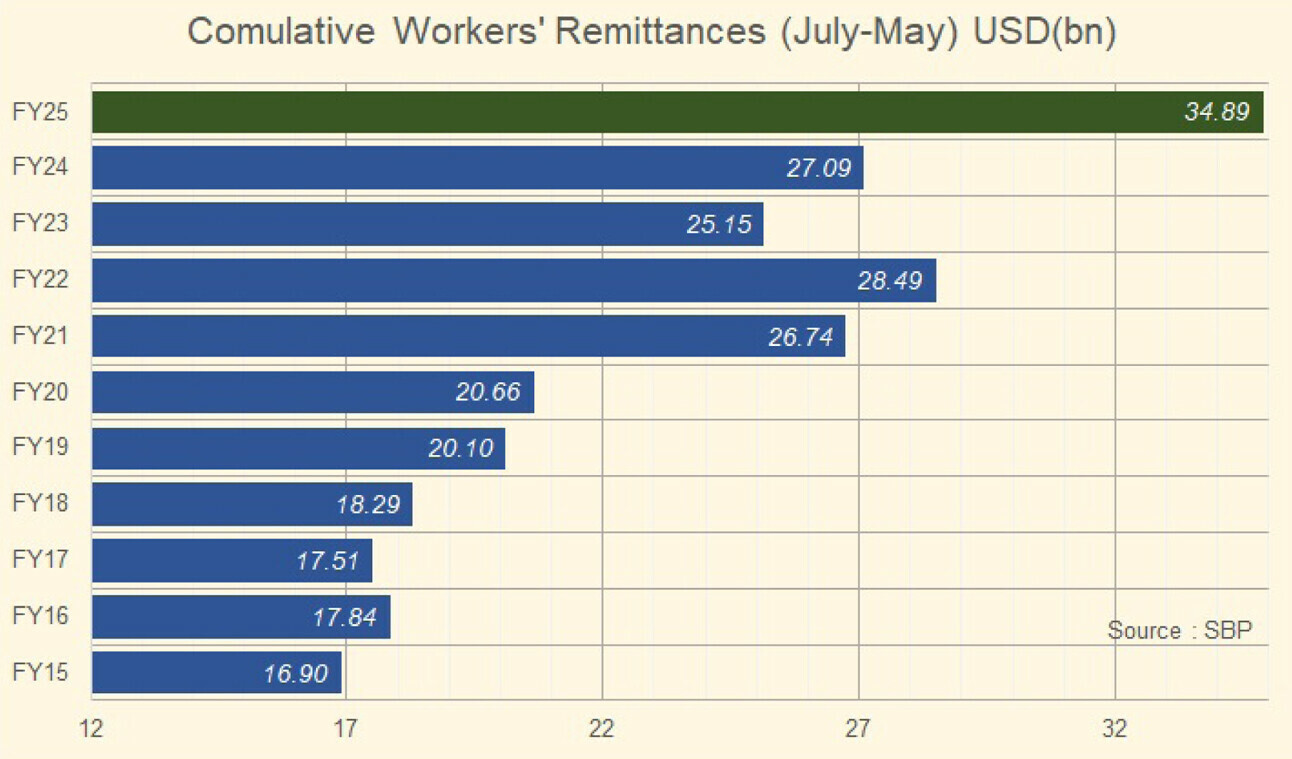
For the eleven-month period of July 2024 to May 2025 (11MFY25), cumulative remittances reached $34.9 billion, reflecting a nearly 29 percent increase from the $27.1 billion received in the same period of the previous fiscal year. Earlier data had shown remittances totalling $31.2 billion for the July–April FY25 period, marking a 30.9 percent year-on-year growth.
The increase has been broad-based, with all major corridors—particularly Saudi Arabia, the UAE, the UK, and the US—showing strong contributions. Considering this upward trend, the State Bank of Pakistan has revised its full-year remittance projection to $38 billion, up from an earlier estimate of $36 billion.
According to the Economic Survey of Pakistan 2024–25, remittances have emerged as a major stabilizing force for the economy, significantly improving the country’s external account.
During July to April FY25, Pakistan recorded a current account surplus of $1.9 billion, a sharp turnaround from a deficit of $1.3 billion in the same period the previous year. This reversal was largely driven by remittance inflows, especially from the Gulf region. These inflows also played a key role in boosting national income, with net primary income growing by 33.4 percent, and supported a rise in per capita income to $1,824. With inflation on the decline, remittances helped sustain household consumption levels, providing financial relief and maintaining economic momentum.
However, the Economic Survey also cautions about emerging risks, particularly related to stricter immigration policies in host countries and the possibility of return migration. These factors could introduce volatility in future remittance flows, underscoring the need for Pakistan to strengthen domestic labour markets.
Reducing dependence on external income sources through greater domestic employment opportunities is seen as crucial for ensuring long-term economic resilience. With consistent monthly growth and structural support, remittances in FY25 are clearly playing a pivotal role in Pakistan’s economic performance.




















Comments
Comments are closed for this article.